Friday, June 3, 2011

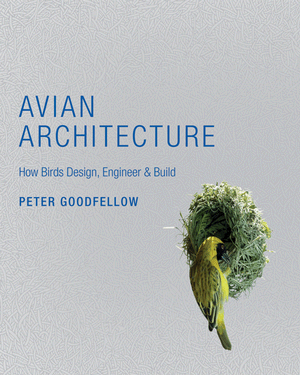
Review: Avian Architecture: How Birds Design, Engineer & Build

This has got to be one of the coolest bird books I've ever come across! Maybe its because I'm a home builder, or maybe its just because bird nests are universally appealing and awe inspiring.  Avian Architecture may unravel some of the mystery behind how birds make their nests, but Peter Goodfellow thoroughly reveals a complexity in nest building that makes birds all the more astounding!

The Bullock's Oriole hanging-sock nest has long been a feat of bird engineering that boggles my mind.  I've seen their nests come together in a matter of days, but I've yet to take the time to observe how they do it.  Well, Goodfellow has taken the time to study and watch how birds build their nests.  What's more is that he has found a creative way to share his knowledge in this fantastic compilation of blueprints, building techniques, materials used, nest design, and lots of beautiful photographs of all the varieties of nests from around the world.

Nest Types discussed in Avian Architecture:  Scrape Nests, Holes & Tunnels, Platform, Aquatic, Cup-shaped, Domed, Mud, Hanging, Woven & Stitched, Mound, Colonies & Group, Courts & Bowers, Edible nests & Food Stores. 

I'll let the pages of this must-have book speak for themselves.  Trust me, you're gonna want this!  Here are some sneak-peeks courtesy of the publisher, Princeton University Press:

Thursday, June 2, 2011

Grasshopper Sparrow

I had heard it only once before...last summer in the Boise foothills.  The habitat on Antelope Island was right for it and the sound I was hearing was distinct.  I had my son look it up on iBird and play the sound just to confirm.  I was right!  It was a Grasshopper Sparrow.  Within seconds we found it trilling from the top of a sage brush right on the edge of the road.  (Listen to the Grasshopper Sparrow)  I'm not sure why the Grasshopper Sparrow song stuck in my memory so profoundly, and I was delightfully surprised that I recognized it.

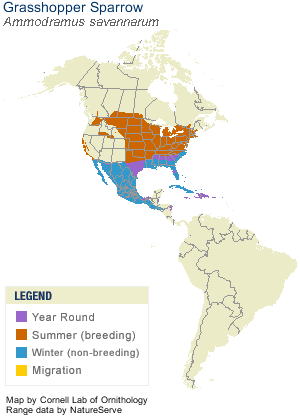
The Grasshopper Sparrow is not exceedingly common in the intermountain west, so it is a treat when you find its spring and summer haunts.  See the Cornell and eBird maps below to get an idea of its range and migration pattern.


The Grasshopper Sparrow is among the smaller of the sparrows; about the same size as a Chipping Sparrow in my experience.  In the western United States, there aren't too many similar looking sparrows, but in the east an identification might be a little more challenging. The bold white eye-ring contrasting with the orange-brown cheek makes the eye appear proportionally large.  The crown sports a white stripe down the middle with blacks stripes on either side and buff stripes outside of those. Adult Grasshopper Sparrows have unstreaked breasts and have an orange or buff appearance.  The upper parts (mantle, back, and scapulars) are a splash of black, white, and various shades of brown and rust.  In non-worn breeding plumage you'll see white edges on the coverts creating thin wing-bars.
I think their head has a very distinct shape.  The curvature of the skull continues straight into the bill without a break.  The top of the bill is also darker than the rest of the bill.  This head profile appears to be similar on most of the Ammodramus sparrows.

There are a dozen subspecies of Grasshopper Sparrow, with four subspecies breeding in North America (AllAboutBirds.org).  The most likely in the west, north of Arizona, would be the perpallidus* which, by definition of the classification name, appears "paler" than the other varieties.  That description seems to match my photos when compared other photos and illustrations.

I thought the name "Grasshopper" Sparrow referred to the sound it makes, but it turns out that it does eat grasshoppers too!

This was only my second ever sighting of a Grasshopper Sparrow and my first in the state of Utah.  Pretty cool!

*Sparrows of the United States and Canada: The Photographic Guide. Beadle & Rising

Wednesday, June 1, 2011

My 2011 Birding Goals

Just for the sake of some personal accountability, I want to give an update on my progress toward completing my 2011 birding goals.

2011 Birding Goals

1. Submit 700 checklists to eBird
2. Add 20 life birds - this will take some luck.
3. My current Utah life list is at 72 species, so I'm going to shoot for 150 which should be achievable and hopefully will not add any undue stress on my family.

Well, I not quite on track with my eBird checklist submissions.  I have only submitted 141 so far, well below my pace last year when I was hosting an eBird competition in Idaho.  Regardless of how well I perform on this goal, I at least want to meet my own challenge that I am happy to give to others of an average of at least one eBird checklist per day.

I'm excited to have added six life birds so far this year: Band-tailed Pigeon, Palm Warbler, Glossy Ibis, Northern Pygmy-Owl, Plumbeous Vireo, and Ruddy Ground-dove.  Without some luck, significant travel and/or chasing, this goal could be pretty difficult to obtain this year!

UPDATE! Today during my lunch hour, I went up to Mill Creek Canyon where I observed 4 Virginia's Warblers, so that is my 7th Life Bird this year!  Wahoo!!!

My Utah life list goal has been easily surpassed as I am currently at 171.  Perhaps this goal was to easy.  Perhaps I should bump it up to 200 birds on my Utah Life List.

Did you have any birding goals this year?  How are you doing so far?

While I was birding...
Snoozing Porcupine on Antelope Island - The Great Salt Lake


And for Mike B. of Slugyard, these photos are for you buddy...


Tuesday, May 31, 2011

Utah Birder Profile: Milt Moody

Milt Moody
Provo, Utah
How did you get into birding? Did you or do you have a birding mentor and can you tell us about that person? Did you have a “spark bird”?

While walking around the mountains looking at the trees, shrubs and wild flowers in Payson Canyon, I heard a couple of interesting bird calls. I decided, at the point, that it might be good to know a little about the birds that where around the area. A little later, I got a bird guide and headed up the Alpine Loop to see what I could see. I pulled over near the summit and immediately saw what look to be a “regular brown-looking bird” fly into a tree across the road. I put my binoculars on it and I saw a yellow, black and white bird with a red face! I couldn’t believe the colors I was seeing – I was pretty much hooked at that moment, though I don’t know if I realized that at the time. Later my sister Patricia, who was a member of the newly-formed Utah County Birders organization, hooked my up with the group and I signed up for a birding class taught by Dennis Shirley. And the rest is history.

How long have you been birding?  About 17 years

How often do you go birding? And where do you regularly go birding?

The frequency is quite variable, but in the summer I frequently bird up Provo Canyon in various places, especially near the mouth of the canyon, Vivian Park and South Fork Canyon.

Where is your favorite place to bird in Utah? In the U.S.? in the world?

My favorite place to bird in Utah might be Heber Valley.  In the USA, maybe Hawaii or the Rio Grande Valley in Texas.  And in the World, maybe Australia or Finland.

How would you describe yourself as a birder? A “watcher”, a “lister”, a “chaser”, “ticker”, “twitcher” all of the above, or something else?

I think I’m a “namer.” I’ve studied bird names in English, Finnish and Spanish as well as the scientific names including where they come from and what they mean. I do this pretty casually, so I’m a little bit nuts but maybe not completely crazy (there may be other opinions on this subject).

What kind of birding equipment do you use?

8 x 42 Bausch & Lomb binoculars, a Kowa spotting scope, a Nikon Coolpix camera with an adapter for digiscoping.

What is your favorite bird sighting and what is the story behind it?

I was visiting my brother in Haiti. In the back yard where I was staying I saw a large, long-tailed, curve-bill bird crawling up the limb of a large tree. It was a Hispaniolan Lizard-Cuckoo.

Any good backyard birding stories or amazing backyard bird sightings you can share?

A Yellow-breasted Chat surprisingly showed up one day – just passing through.

Which birding publications and websites do you read and recommend?

I go to UtahBirds.org pretty much every day.

Which is your favorite field guide and why?

Birds of Europe by Mullarney, Svensson, Zetterstrom and Grant is excellent in every way.

Are you involved with any local or national birding organizations?

I’m involved with the Utah County Birders. I’ve been the UtahBirds.org webmaster for about 12 years.

What is your nemesis bird?  Black-tailed Gnatcatcher (link to Wikipedia about Black-tailed Gnatcatcher)

Outside of birding, what are your other interests or hobbies?

I like to study foreign languages (Finnish, Spanish and Russian), I like to learn about nature (trees, shrubs, and flowers mainly). I like to play a little guitar, piano and harpsichord now and then.

Total life list?  1,249 world species

Most exotic place you’ve gone birding?  

Sacha Lodge near the Napo River in the Amazon rain forest of Ecuador


Birder Profile is a weekly blog segment at "Birding is Fun!" spotlighting a fellow birder.  If you would be interested in sharing a little about yourself and your birding experiences, please send me an email.  Is there a birder you'd like to see featured?  Please nominate that person by sending me an e-mail too.  Enthusiasm for birding is the only prerequisite!

Monday, May 30, 2011

The Chubby Chukar


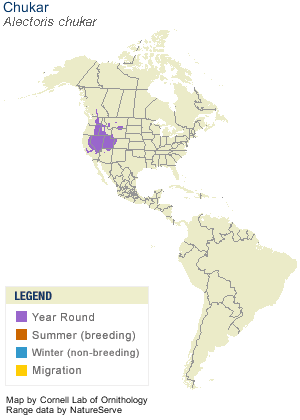
Did you know that the Chukar was brought from India/Pakistan to the western United States as a game bird?  Birds of North America Online informs me that in 1893 five pairs were released.  Between 1931 and 1970 almost a million more Chukar were released in the United States and Canada.  They seem to have survived in the arid west and have established strong self-sustaining feral populations.  Chukar are still hunted extensively by hunters who like the physical challenge of chasing them up their preferred steep, rocky, and over-grazed habitat which is very common in the intermountain west.


Chukar eat the seeds of cheatgrass.  Although romanticized by Steinbeck in East of Eden in the lush Salinas Valley of California, cheatgrass everywhere else is an invasive and noxious weed.  Dry cheatgrass is also a major concern as it is prime fuel for range fires.  I guess Chukar need to be a part of firewise planning by the BLM!


Leslie Gulch - eastern Oregon - prime Chukar country
Chukar do need water sources nearby and can often be found consistently in specific locations where they habitually come down for water in the morning and evening.  If you ever get the chance, go to Leslie Canyon in eastern Oregon and camp out so that you can awake to the Chukar chorus.  There's nothing like it!

Sunday, May 29, 2011

Bored? Do a bird word search!

Saturday, May 28, 2011

"Exotic" Parking Lot Birds

True birders are always birding; even in their office parking lots.  The office where I work has a covered area for management and executives...and several first-come-first-serve spaces for the early birds, like me.  In those short seconds from the time I park my car until I enter the building, I am birding.  Recently, I realized that all the birds I was seeing in the parking area were "exotics"; in other words, non-native species to Utah and many are introduced species to North America for that matter.  Besides the American Robin and fly-over birds, I have yet to see another native species in this particular parking lot.  Many of these non-native birds are nesting now and the level of activity and other side-effects has ramped up.

Ah, the Rock Pigeon!  I've got about a dozen of them nesting in the covered parking area of my office building.  They come in a splendid variety of plumages.  They are deeply appreciated the the company leadership as the the Pigeon's provide the luxury vehicles a nice not-so-protective coating of scat.  We also find broken eggs and even occasional dead squabs on the cold hard concrete.

Rock Pigeons likely came with the early pilgrims to the Americas and pretty much cover both North and South America except where it's too cold.  I've read that no one really knows their original range because they have been so closely tied to ancient humans through domestication.  I have seen them in more natural settings, like the rocky cliffs along the Boise and Snake Rivers.  Buildings make great make-shift cliffs, so man is providing abundant habitat and we therefore have an abundance of Rock Pigeons.
The House Sparrow was introduced into New York in the early 1850's.  (Read this interesting article debating how many Sparrows it took to start the millions we now "enjoy".)  They, like the Rock Pigeon, have spread across much of North and South America and seem to thrive in urban settings, even inside airports, home improvement and grocery stores.  I have found their nests in everything from store signage to rain gutters, from shrubbery to the roof trusses of a new home under construction.  I'm not certain, but it seems to me that they may have several broods each year.  Besides being brownish, House Sparrows are not at all closely related to the birds we know as sparrows in North America and are in a family of their own, the weaver finch.
European Starlings came to America in the 1890's by Shakespeare enthusiasts who thought they were doing the right thing by introducing North America to all the birds mentioned in Shakespeare's works. Now they are super-abundant in North America. South America at least avoided their introduction and Starlings don't appear to have made too much head-way into Central America.  Looking at eBird's global range maps, I find it interesting to see them in Australia, New Zealand, and South Africa, where I assume they were introduced by similar Shakespeare-minded folks.  These truly beautiful-in-their-own-way birds are loved-to-be-hated by birders and non-birders alike.  They nest in any cavity available, be it tree, building, or even operating machinery.

Some executives pathetic attempts at protecting their high-end automobiles from mountains of non-native bird poop.
I've seen California Quail run through the parking lot.  As far as I know, they are an introduced species to Utah too.  I found articles about them being introduced in Idaho around 1870 and I wouldn't doubt that they were introduced about that same time in the Salt Lake valley.  This is an introduced species that everybody just loves.  They are cute and have lots of cute babies and run around calling in our neighborhoods here in the western United States.

And last, but not least, this bird...

Peafowl are native to the region of India to Malaysia and have long been ornamental birds around the world.  This is the only bird discussed here today that is not officially "countable" for those of us who like to count countables.  They can and do establish feral populations, but most cannot sustain themselves without subsidies from mankind.  The bird pictured above hung out in our parking lot for a couple of days last week and really was the trigger for this post.

Native or non-native, birds are around us almost everywhere.  Why not enjoy them?!

Friday, May 27, 2011

Review: The Birds of New Jersey

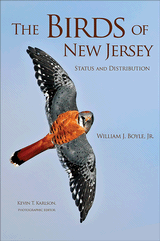
If you are thinking about compiling a "Birds of (your State here)" book, please take note:  The Birds of New Jersey by William J. Boyle Jr, and photographic editor Kevin T. Karlson sets an all new standard of excellence!

This is not a field guide for identifying birds in New Jersey.  It is a book literally about the status and distribution of each species documented in New Jersey, as indicated in the subtitle.  The text and maps describe when and where these birds have been seen in New Jersey.

Even though this isn't an i.d. guide, there are one to three birds species discussed per page along with an average of one photo per page....beautiful photos taken by popular names like Crossley, Lehman, and Karlson and several others.  I am assuming that all of the photos were taken in New Jersey, even the photos of review species birds.  While else would the Vermilion Flycatcher photo be out of focus?!

What's more, the opening pages acknowledge the importance of eBird!  I wonder how much eBird sightings maps helped contribute to the quality maps contained in The Birds of New Jersey.

The Birds of New Jersey is a very impressive book and will be a treasure to every New Jersey birder and anybody who wants to go birding in New Jersey.  I did ask myself, "What's the purpose or usefulness of a book like this?"  At first, I thought it might just be a novelty item as it is fun to look at, like a fine collection of something cool.  Thinking on it further, I have come to some better conclusions about the useful nature of a book like this.  The Birds of New Jersey is a quality reference book.  It will help those birding in New Jersey to have a better understanding of the status of each species.  Birders reporting rare species will be much better educated.  It will also increase bird awareness in New Jersey.

Now I would love to see this type of book in a companion set; cross-referenced to the birding hotspots of New Jersey.  The great birding locations are mentioned throughout the book, so can you imagine how convenient it would be to have the companion book with maps and information about those birding hotspots?!

I would also like to see books like this produced in a digital format for smartphone apps.  Bird information can become outdated within months.  The digital format would allow purchasers of this book to always have the latest and greatest information available.

Frankly, I'm jealous that none of the states in the intermountain west have a book that can even compare to this.  New Jersey, and specifically Cape May, seems to always be on the leading edge in our birding world, in culture, enthusiasm, technology, and now publications. Good on ya NJ birders!

Thursday, May 26, 2011

Black-headed Grosbeak

After a couple of years of birding and enjoying the Black-headed Grosbeak, I started to wonder about it's name.  I thought its massive bill in two shades of metallic gray was pretty cool, not gross.  Then a french-speaking friend of mine told me that gros in French means thick.  In the dictionary it defines gros as big, large, thick, and fat.  Well, that does make sense and it is an appropriate name for this awesome bird of the western United States.


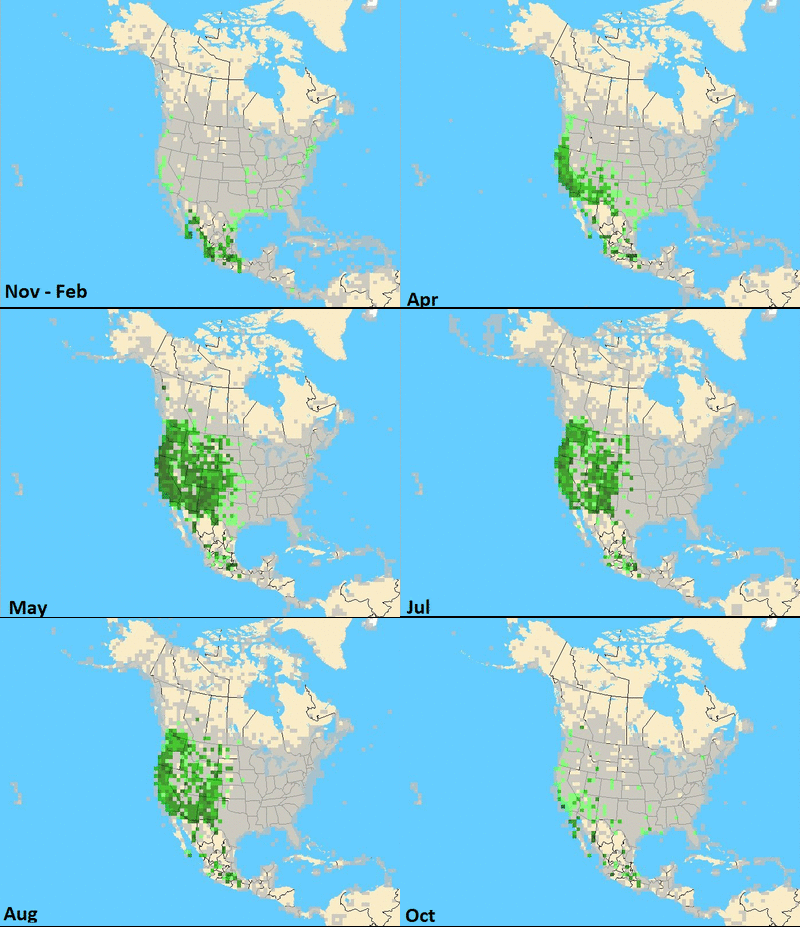
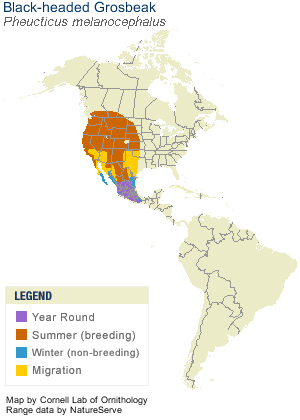
The Black-headed Grosbeak winters in Mexico.  In April it is entering the American Southwest.  By May, its distribution is widespread across the western United States.  In June and July the range is still large, but sightings appear to be more isolated and regionalized as the Grosbeaks are nesting and raising their young.  In August and September we start to see the southward push and by the end of October they have made their way back to Mexico.  For my friends in the eastern half of the United States, your best chance at seeing a mis-guided vagrant Black-headed Grosbeak in your neck of the woods will be late fall or winter.  I'll send you some Black-headed if you send me some Rose-breasted Grosbeaks!
While shooting several frames of the Black-headed Grosbeak, another beautiful birding star (Lazuli Bunting) heard the click of the shutter and couldn't stand that the Grosbeak was getting all the paparazzi attention.

Wednesday, May 25, 2011

Lunch-hour Birding at My Patch

Being the father of four, we have a busy lifestyle.  I have to sneak in my birding whenever I can.  My lunch hour has proven a very effective time to ditch the cubical farm and rejuvenate my mind with the wonderful respite nature provides.  Sometimes birding the same area day after day is...well...just ordinary; good, but ordinary.  The arrival of each new migrant species in its season is thrilling and adding new birds to your patch list is almost as exciting as seeing birds for the first time.  Today was a special lunch-hour birding session as I was able to add two birds to my patch list.  One of the birds was especially cool because I had only seen one of its species previously, and that was six years ago!

Here are some recent bird photos from my patch!

Blue Grosbeak - my 2nd time ever seeing one! and a new bird to my Utah and patch life lists!  

This photo is from a long distance for my small lens, but still diagnostic. This one surprised me and I wasn't quite sure what it was at first, but my gut told me Blue Grosbeak even though the plumage was mottled.  Once I got back to my office, I found that The Stokes Field Guide was the best resource and shows a great picture of a 1st summer male very similar to the plumage shown in my photo.

I also saw a Blue-gray Gnatcatcher, but it was too deep in the brush to get photos.  This was a first to my Utah and patch list too!

Here are some more birds I've been enjoying:

"Get off my territory! I've got ladies to breed with here buddy!" (At least that is what I think he was sayin'.)
This is the game "Where's the bully?" - male Bullock's Oriole hidin' up there somewhere.
Warbling Vireo
Cooper's Hawk - juvenile
Yellow Warbler - female - notice the plain breast rather than the red streaks on a male.
How about a little blue on blue?!  Did you know that "Lazuli" is the name of a shade of blue?
Ratty lookin' Western Scrub-jay
American Robins, no matter how common and always cool and pretty!
Western Tanager - almost Idaho's State Bird
I was decked out in my camo hat and jacket and leaning against the truck of an adjacent tree in the shade when the Tanager swooped down and then up and over me.  Awesome!

Recognizing vs. Identifying Birds

While riding the bus during the recent field trip at the Great Salt Lake Bird Festival, I overheard a very kind gentleman sitting behind me comment to his buddy, "It's just amazing how quickly Robert identifies these birds!"  Well, I appreciate the nice words, but I have to let you in on a little secret...I wasn't "identifying" most of the birds during that field trip, I was simply "recognizing" them.

Some birds are so distinctive that most birders "recognize" them without having to go through an identification process.
I am far from being an expert on bird identification...especially because of my lack of experience and the natural lack of patience that comes with my personality type.  But, because I do go birding almost everyday and have done so avidly for the last six or so years, I have gotten really good at recognizing the birds common to the places I live.  There are hundreds of birds out there that I still have to "identify" - or in other words, go through a list of steps like noting overall shape and size, behavior, habitat, color pattern, sound, etc.  This is a process that can take just a few seconds, or sometimes hours, with a lot of note-taking and pouring over reference books.

“There is no ‘wrong way’ to go birding.  Birding is something that we do for enjoyment—so, if you enjoy it, you’re a good birder. If you enjoy it a lot, you’re a great birder.”
- Kenn Kaufman
Each year, I feel my ability to "recognize" birds increases both by sight and by sound.  I spend too much a lot of time browsing birding blogs and thumbing through field guides.  That time spent looking at hundreds of bird illustrations and photos has greatly enhanced my ability to recognize rather than have to identify birds.  I think is a large part of the philosophy behind the new Crossley ID Guide.

My growing ability to "recognize" birds without having to go through the mental calisthenics of identifying them was most apparent when I was traveling the east coast last fall.  Many of the new birds I saw, I could put a name to instantly without having to consult a field guide. I felt like I had skipped the "identification" process.  I guess I had not really skipped a step; the entire identification process was just completed in a split-second.  This, I suppose, is how I define "recognizing" versus "identifying".

Do you recognize this bird? Or do you need to break out the field guide and study up on all the heron types before you figure it out.  Either way, its okay. The more you go birding, the more birds you will "recognize". 
If you feel that your enjoyment of birding will be enhanced by being better able to identify and recognize birds, I invite you to continue reading.  Fantastic tips on bird identification techniques abound in birding publications and online, so I'd like to share just three basic tips on "recognizing" birds.

1.  Go birding a lot.  Frequent outings focused on looking for birds keeps the synapses between the mind and your eyes and ears firing on all neurons.  If you are only going on one birding field trip a month, especially trips where other experts are pointing out the birds to you the entire time, you will never develop those bird recognition skills yourself.  Birding with groups is fun and rewarding, but go birding alone a lot too.

2.  Look at a lot of pictures and illustrations of birds.  Field guides are fun to flip through.  Visiting bird blogs, especially those with lots photos, helps more than you probably realize.  You get to see birds in a wide variety of poses and light conditions.  Reading birding magazines also helps expose you to lots of birds.  It is the repetition that makes all the difference.

3.  Birdwatch often.  If you are competing in a Big Day competition, you only look at or listen to a bird long enough to check off it's name on the list.  That is a lot of fun sometimes, but if you want to have the skills that those great Big Day competitors have, you need to also slow down and "birdwatch" often.  Observing bird behavior for several minutes - even if not consciously taking notes - just simple watching, will imprint that bird on your brain.  Now, you can hasten your development of bird recognition skills if you do take written notes during your birdwatching.  There really is something about the exercise of putting mental images and thoughts into words that increases the depth of learning, retention, and the speed of mental recall.

Do you recognize this flock of shorebirds at a glance?  Let me hear what you think they are in the comments.