Monday, August 15, 2011

Birder Profile: David M. Bird Ph.D.

David M. Bird Ph.D.
Baie d’Urfe (near Montreal), Canada
How did you get into birding? 

As a professor of wildlife biology at McGill University, I had tunnel vision for raptors all of my life; all other birds were merely hawk food. However, I also enjoy educating the public about birds, writing a weekly and now monthly column on birds for the Montreal Gazette for over 25 years. One day I was bird-watching with some now famous ornithologists in Tempe, Arizona during a conference and I saw a male Anna’s Hummingbird with the neon pink gorget doing a ritualized mating flight. I was so blown away that I wrote in my next column that I would no longer be a raptor bigot.

How long have you been birding? 

For about 20-25 years

How often do you go birding? And where do you regularly go birding? 

I always keep an eye on birds in my yard and I live on the water, so I see loons, terns, ducks of all kinds, etc. I am not one for going out every weekend, but I regularly take my university students out birding for Ornithology. And I have hosted/led a number of bird-interested folks to various countries, e.g. Kenya, Costa Rica, Belize, etc. I especially love leading neophyte birders into the field.

Where is your favorite place to go birding?

Ile Bizard Municipal Park with its boardwalks in a marsh has long been a favorite, but now the McGill Bird Observatory only a mile from my campus is the tops.

Where in Quebec would you say is the most under-birded place that may have great untapped potential? 

The northern part of the province, e.g. Ungava Bay

Most exotic place you've gone birding? 

Australia and Tasmania, New Zealand, Uganda, Kenya, Ellesmere Island


How would you describe yourself as a birder? A “watcher”, a “lister”, a “chaser”, “ticker”, “twitcher” all of the above, or something else? 

I can be all of these things, depending on the moment.

What kind of birding equipment do you use? 

I love my Swarovski 7X32’s and my Swarovski scope.

How do you keep track of your bird observations?

I do not have a life list per se. I usually tick off the birds I see in my field guides or on checklists which I keep. I am afraid to keep a serious list because I am fairly competitive and I cannot afford to become a chaser.

What is your favorite bird sighting and what is the story behind it? 

The spark bird above is one. Studying white Gyrfalcons (my favorite bird) on Ellesmere Island for the summer of 1973 is another. Seeing my first wild Peregrine on Cape May was very special…I recall my exact words shouted out….”I knew it was a peregrine!”

What is your favorite backyard bird?

Dark-eyed Juncos are pretty cool. Not everyone gets to see a loon in their backyard.

Which birding publications do you read and recommend? 

Obviously I am biased as a columnist for BWD, but I have to say that this magazine is pretty classy!

Which is your favorite field guide and why?

I have used them all, but I must confess that the one I always grab on the way out are the Sibley's.

Which three books from your personal birding library would you recommend to other birders? 

Again I am biased. The Bird Almanac that I wrote and compiled in 2004 is a highly useful book for birders of all kinds. Hard to choose the other two….too many good books out there.

What is your education background in birds? 

Got my PhD in 1978 from McGill University…I have been a professor in Wildlife Biology specializing in birds all of my life.

What future birding plans do you have? 

Moving to BC in a year or two….looking forward to seeing new birds. The Dipper is my favourite songbird and I see them regularly when I fly-fish in Fernie, BC visiting my son.

Are you involved with any local or national birding organizations?

I used to belong to all of the major ornithological organizations and now only the AOU, Wilson, the Raptor Research Foundation (served as president), and the Society of Canadian Ornithologists (served as President recently). Served on the board of the ABA for 9 years.

Anything about your family you’d like to share with us? 

My wife, Toni, likes to watch birds when I take her out. Same with my two grown-up kids.

Outside of birding, what are your other interests or hobbies? 

Boating and fishing of any kind, tennis, ice hockey, badminton.

Any funny birding experiences you could tell us? 

Once mistook a white shopping bag impaled on a Lundy fence as a snowy owl in front of others…..quite embarrassing.

Anything else that you would like to humbly brag about? 

I like to find humour in just about every situation and I do not mind being the center of attention at times….I find it extremely easy to talk to strangers.

Your mission in life as birder? 

To introduce neophytes to birds and birding and education the “great unwashed” to conserve wildlife.

Come meet Dave in person and listen to his presentation which will be both educational as well as entertaining at the Midwest Birding Symposium, Sept 15-18 in Lakeside, Ohio.


Birder Profile is a weekly blog segment at "Birding is Fun!" spotlighting a fellow birder.  If you would be interested in sharing a little about yourself and your birding experiences, please send me an email.  Is there a birder you'd like to see featured?  Please nominate that person by sending me an e-mail too.  Enthusiasm for birding is the only prerequisite!

Sunday, August 14, 2011

Some bird photos that could have been good

Sometimes when you're trying to photograph birds, you just don't have the tools or the skills (in my case I lack both) to get that quintessential photograph of the species before you.  I see some of these professional photographers blogs and photo galleries and I could easy cast myself into the gutter by comparing myself to them...but why do that when I'm having fun and enjoying what I have.  I'm still running on a just 150mm lens, so I'm especially grateful for those wonderful cooperative birds which pose nearby for me.  Here is a series of bird photographs of not-so-cooperative birds.  I love these birds and hope to one day get better photos for posterity's sake.  For now, these will have to do.

Blue Grosbeak - taken while looking for the Dickcissel in Farmington, Utah.  I had wonderful evening light, several regularly used perches, but not enough mm's to get close enough of that one great shot.  Steve Creek has taken my favorite Blue Grosbeak photo that I have ever come across. 
Plumbeous Vireo - Camp Maple Dell Scout Camp - Several of these birds would come through our camp each afternoon.  I did get a pretty darn good photo of this species at the Gilbert Water Ranch in Arizona, even though I didn't know what bird I was looking at at first.
Green-tailed Towhee - I used to see this at my birding patch in Arizona when I first started birding.  I saw them often enough that I thought they were everywhere for everyone.  I soon learned better.  I dipped on them in Idaho, but now I've seen and heard a few in Utah.  I think they are among the very cool looking birds.  Too bad this photo didn't do this handsome bird justice.  Oh, well.  There will be future opportunities!

Saturday, August 13, 2011

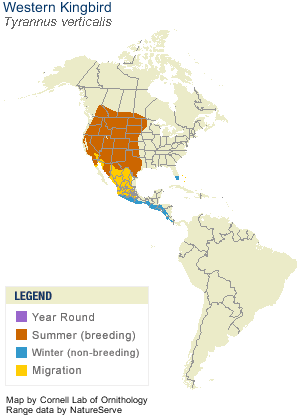
Western Kingbird


The Western Kingbird is simply a cool bird.  What is it about this flycatcher that makes me never tire of seeing it?  Is it the subtle color pattern? The sleek shape or striking pose when perched? The neat way it flies?  I can't pinpoint it.


Did you know that the Western Kingbird has a red crown?  I didn't know that either until it was recently discussed on one of the Utah birding listservs.  Here is a link to one of the best photos of that red crown on the web.  Folks tell me that in the old field guides that the red crown was often shown, but newer guides don't show it.  I figure this is because the old field guides were often made from skins in the hand, where new field guides focus on field identifiable traits.

The maps below show where Western Kingbirds can be seen.  In the eastern half of the continent you may be lucky enough to see a vagrant!

Friday, August 12, 2011

Father's Day Quail Story


Father's Day afternoon we observed a flock of quail and some brand new chicks making the dangerous trek across the neighbors backyard. Unfortunately their dog took a couple of the chicks.  Once out of the backyard, the survivors had more challenges to come; crossing the raging waters of the gutter, then crossing the street to the safety of my yard. We stood guard making sure the quail made it across the street without getting run over.


It was pouring rain and the poor chicks were soaked. The parents quickly ducked under my front shrub, but only a couple chicks were able to nestle under the adults. The other three wandered and struggled until they collapsed on my sidewalk in cold puddles of water. At that point, I decided intervene. I picked up the cold and exhausted chicks and placed them under the shrub with the adults.

A couple hours later I checked on them. The adults were gone and sadly the three little chicks lay there and appeared to be dead. I gently scooped them up in my hand and found there to be some life in them. I picked off a couple opportunistic ants and then placed the quail chicks in a cardboard box. Then I put them on the kitchen stove which had just been used to cook Father's Day dinner. The oven was off, but was still nice and warm. After about a half hour on top of the warm stove they were up and running around in the box, chirping away. It seemed a miracle!

I noticed that one of the chicks still had a bit of the nail on the top of the beak, used to break open the egg, so these must have been very recent hatchlings. They were so cute.


Now that the chicks had revived, I went looking for the parents. I found some adult quail roosting in the neighbors hedge. The gentleman neighbor saw me with the box of baby quail and upon learning what I was doing he kindly locked up his cat. I placed the chicks inside the base of the hedge and backed away. Within seconds an adult male Quail dropped down and nestled the three little chicks underneath of him. It was the most beautiful and touching thing to witness on a Father's Day!!!


Here we are a couple month's later and we have at least two families of California Quail visiting our backyard feeding area.  There are at least four juvenile quail...I hope a couple of them are those that we rescued.

Side Note:  We have a female California Quail that has become a neighborhood celebrity, known as "The Blonde Quail."  She lacks normal pigmentation and is a gorgeous caramel color all over.

Thursday, August 11, 2011

Dickcissel in Utah


I was fortunate to hear and photograph this vagrant Dickcissel, first reported by Tony Jones in Farmington, Utah, in late June.  It really was a pretty special bird sighting for Utah.  Looking through the Utah Bird Records Committee information, Dickcissels have been reported 10 times, but only three records have been approved by the committee.  This should easily be the fourth approved sighting as so many Utah birders got to see and photograph it.

What a beautiful bird!  The strange name is onomatopoeia; the name describes the sound it makes.


Here is the normal range for a Dickcissel and eBird sightings map:

Wednesday, August 10, 2011

Mourning Dove Momma

I just love this photo and have been using it as my desktop wallpaper for sometime now.  Momma Mourning Dove remained stalwart at her post protectively hunching over her young.  The nest was heavily shaded so I used the camera flash which gave the eyes a nice glint which always gives more life to birds when shown in photographs. How many dove chicks do you see in the photo above? 
My birding patch along the Jordan River has been mostly flooded all summer.  This forced me to focus on the areas I could watch birds and I discovered all kinds of cool things and learned to appreciate a smaller study site.  I found several nests for a variety of species.  The Mourning Dove nest shown in this post was just below eye level in a tree as seen from a foot bridge.  It has been fun checking in on it regularly and watching the chicks grow.

A week after the above photo, this is all that was left in the nest...a solitary egg...a dud.  The fly was already taking advantage.  I'm actually surprised the egg stayed in the nest unbroken while the other chicks hatched, grew, and fledged.

Tuesday, August 9, 2011

While I was birding...

Blue-eyed Darner - Camp Maple Dell - Payson Canyon, UT
Alkali Blue Damselfly - Camp Maple Dell, Payson Canyon, UT
Eight-spotted Skimmer - Camp Maple Dell, Payson Canyon, UT
Pondhawk (male) - Camp Maple Dell, Payson Canyon, UT
Pondhawk (?) worn - Camp Maple Dell, Payson Canyon, UT
Brown Garden Snail (?) - General Holm Park, Jordan River Parkway Trail, SLC, UT (My lunch-hour patch)
Plume Thistle with some kind of bee (?)
Penstemon (which kind?)
Salt Brush

Anything I attempted to identify, I did so using the web and I am very interested in being corrected if need be.

Monday, August 8, 2011

Anticipation Building for Midwest Birding Symposium

A couple dozen fantastic reasons to attend the Midwest Birding Symposium at Lakeside, Ohio on September 15-18th!

Al Batt
David M. Bird
Kevin J. Cook
Pete Dunne
Jeff Gordon
Mark Garland
Keith Hansen
Alvaro Jaramillo
Kenn and Kimberly Kaufman
Ben Lizdas
Jim McCormac
Greg Miller
Michael O'Brien
Nicole Perretta
Diane Porter
John Robinson
Marie Read
Bridget Stutchbury
Connie Toops
Bill Thompson, III
Louise Zemaitis
Julie Zickefoos
Ohio Young Birders Club
Sponsors


Just looking at the list has me as anxious and excited as a tween Justin Bieber fan.  I know most of these names from all the birding books, magazines and blogs I read so regularly.  Visit the official Midwest Birding Symposium website to read more about the speakers and their topics and to register to attend!

They have scheduled birding time in the morning, so I am very excited about that.  I hope I can go birding with a few of the people listed above!  Looking at eBird sightings reported for mid-September in Lakeside and the surrounding area, I should be able to add 20 life birds fairly easily.  What makes that extra exciting is that I will mostly likely add my 400th life bird on this trip!  Brace yourselves for my rendition of the life bird dance.

Sunday, August 7, 2011

Purple Martins in Utah


On the 4th of July, my son Kyle and I got up extra early and made the chase for a life bird into the mountains between Huntsville and Woodruff, Utah off of highway 39 near the Monte Cristo campground.  Purple Martins had been reported nesting there...yes, my friends from the eastern half of the continent...they were actually nesting in those tall leafy things called trees!  (In eastern North America for the last century, Purple Martins have been nesting almost exclusively in man-made nest boxes.)

As soon as we pulled onto the still snow-covered dirt road as instructed, I immediately saw and heard the Purple Martins, and there were quite a few of them.  I quickly located the nesting trees.  Amazing!  

Well, my skills as a photographer in overcast and low light conditions were worthless the natural light on the day I visited was so terrible that my photos were worthless.  So, I asked one of Utah's finest and most prolific bird photographers Paul Higgins if I could share his photos.  Paul had taken all of the photos displayed in today's post from the exact same location which I visited.


To check out more amazing bird photography from Utah's Paul Higgins, please visit his online gallery.

While very common in the east, Purple Martins are fairly uncommon in the intermountain west.
This trip also netted me another life bird, several sightings of the Williamson's Sapsucker!  Wahoo!!!  I also observed a Lewis's Woodpecker and a Western Bluebird, which are both uncommon in Cache County.

Saturday, August 6, 2011

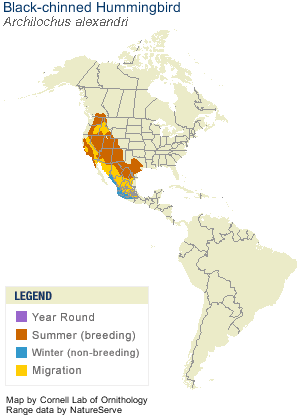
Black-chinned Hummingbird


Friday, August 5, 2011

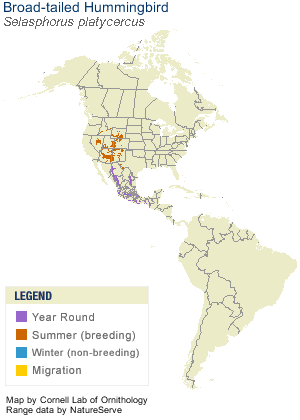
Broad-tailed Hummingbird

Gorgeous gorget!
Broad-tailed Hummer performing the gymnast's iron cross.
Flecks of Emerald
Don't ya just love that magenta throat?
An emerald cap that'd make the munchkins rejoice
You can find Broad-tailed Hummers mostly in the intermountain
west as shown in this eBird sightings map.