Sunday, August 3, 2014

Hubbard Glacier birds

The final (seventh) day of our Alaska Cruise started with a visit to Hubbard Glacier. We witnessed calving of chunks of ice as high as 20 story buildings. Favorable winds had cleared the icebergs from the area in front of the glacier, so our ship was able to maneuver quite closely. To view other posts describing our Alaska trip, click here.

Hubbard Glacier begins 76 miles away in Canada's Yukon and meets the sea in Disenchantment Bay (also known as Yakutat Bay). It is North America's largest tidewater glacier. As it breaks off into the sea it towers 60 feet tall and is 7 miles wide.

Hubard Glacier face with Batman 20140619

Far to the right, barely visible along the face of the glacier in the above photo, is an ice formation that looks like an animal's head with two protruding ears. We called it the "Batman" formation and it looked unstable.

Hubbard Glacier Batman formation2 20140619

The large deep blue tower just this side of Batman's "ear" suddenly came crashing down with a thunderous roar.

Hubbard tower crashing 20140619

Luckily, I had captured a burst of about 12 frames as the tower fell. If you do not see the animation, click on the image to view the series as an animated GIF, or visit this link.


I did not expect to see many birds from our vantage point, but a mixed flock of Surf Scoters and Long-tailed Ducks appeared in front of the ship.

Surf Scoters and Long-tailed Ducks 20140619

They burst into flight. This was the first time I had ever photographed Long-tailed Ducks. They are distinguished from the scoters by the white they show on their outer tail feathers.
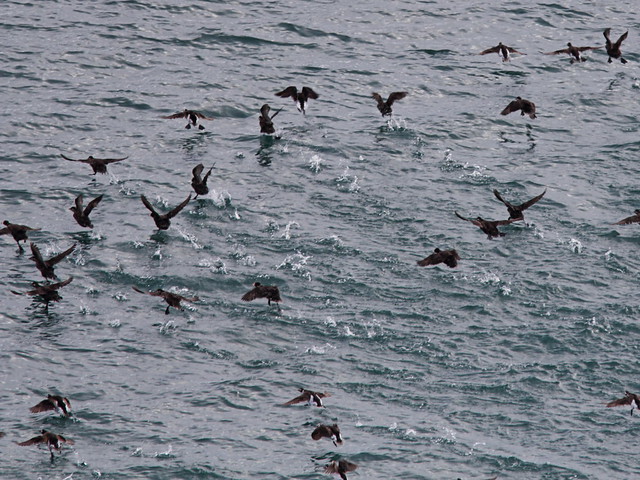
Surf Scoters and Long-tailed Ducks 2-20140619

This chunk of ice shows how the glacier's deepest layers are blue, indicating that the weight of snow that accumulated over more than a hundred years have squeezed out all the air.
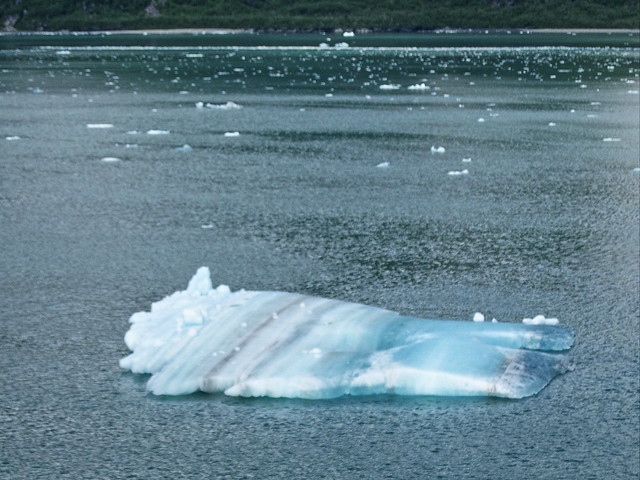
Calved Iceberg 20140619

Members of the ship's crew collected chunks of blue ice to be used in carvings (...and maybe cocktails.* Glacier "worms" crawl out when they are irritated by the alcohol-- see note at end of this post).*

Crew collecting ice 20140619

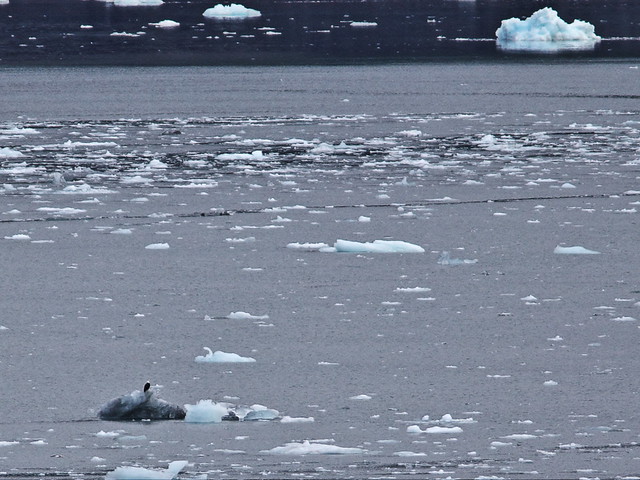
In the foreground, a Bald Eagle was roosting on an iceberg.
Eagle on iceberg 20140619

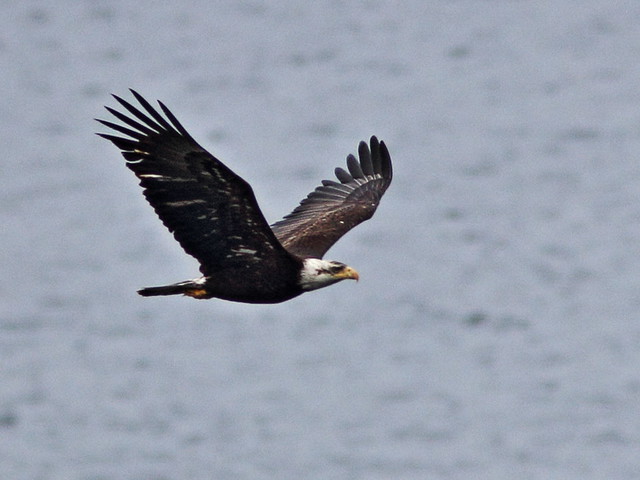
The eagle flew up. It was in sub-adult plumage, probably in its fourth year.
Bald Eagle sub-adult 20140619

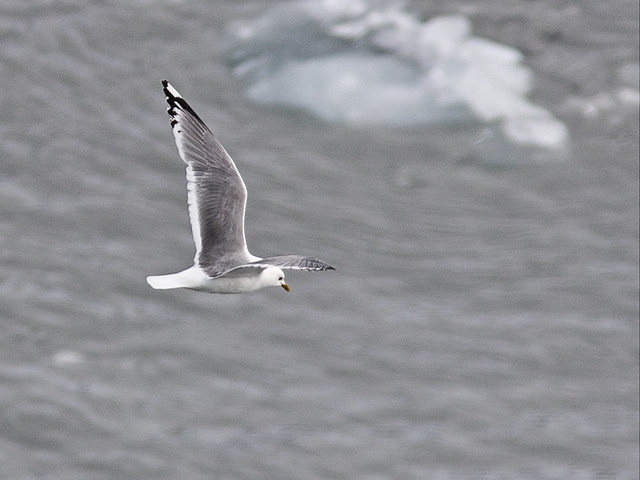
Black-legged Kittiwakes flew around the ship.
Black-legged Kittiwake 20140619

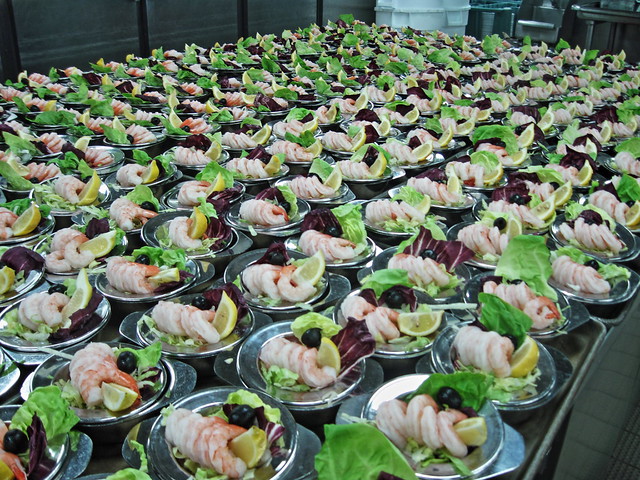
We were offered a private tour of the ship's galley.

Galley tour - bread 20140619

Galley tour - salad 20140619

The next morning, we docked in Seward. Our ship, The Radiance of the Seas, is in the background.


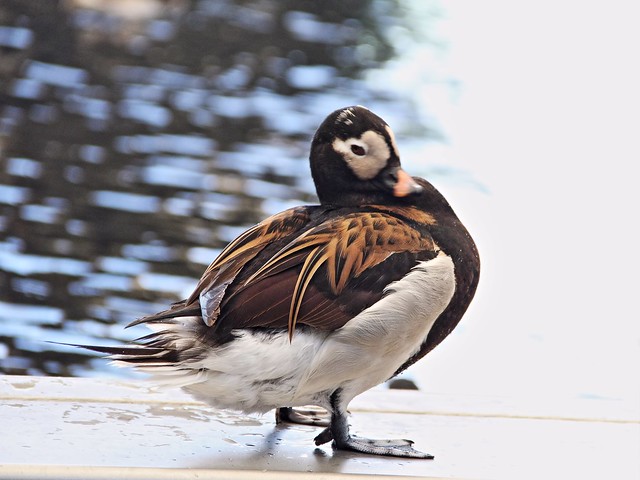
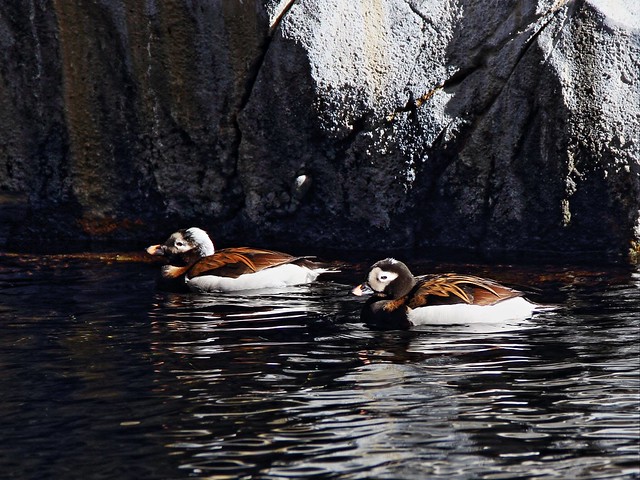
Our families visited the Alaska SeaLife Center. The open aviary provided photo opportunities. Here are better views of Long-tailed Ducks:
Long-tailed Ducks Sealife Ctr 2-20140620

Long-tailed Duck Sealife Ctr 20140620

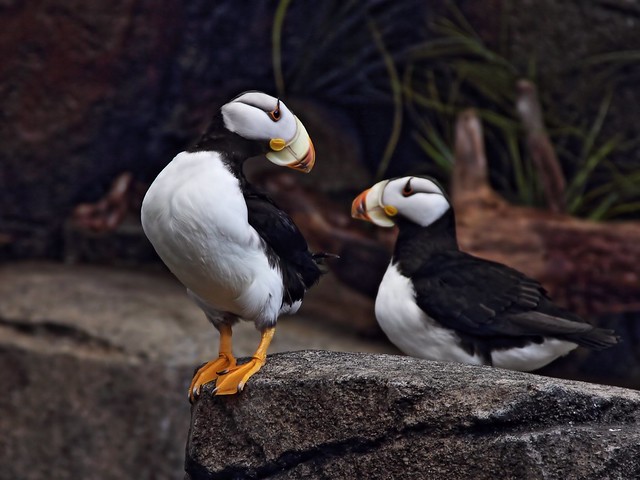
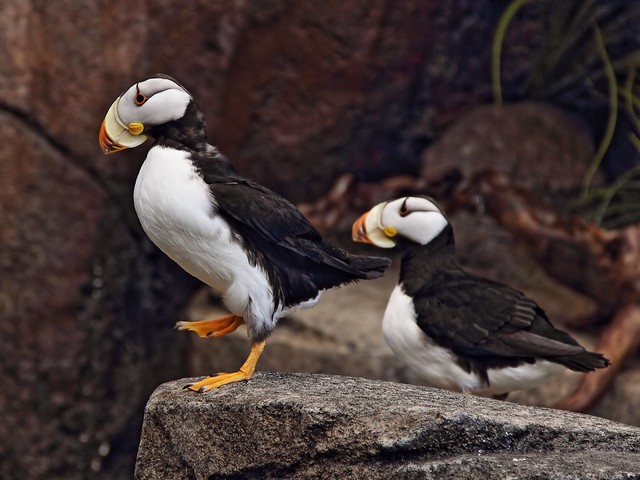
Horned Puffins:

Horned Puffins Sealife Ctr 2-20140620

Horned Puffins Sealife Ctr 20140620

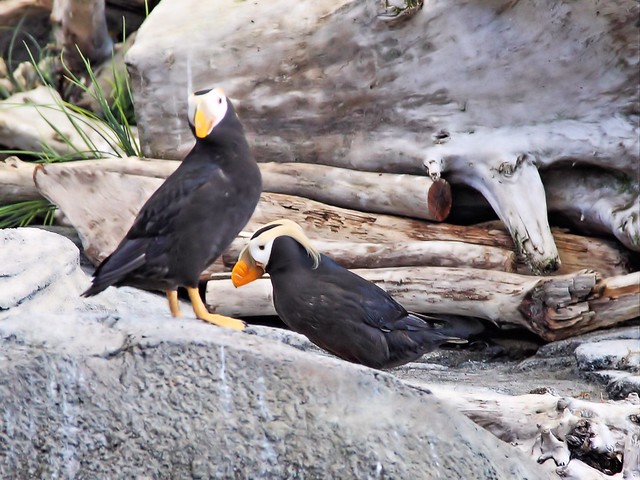
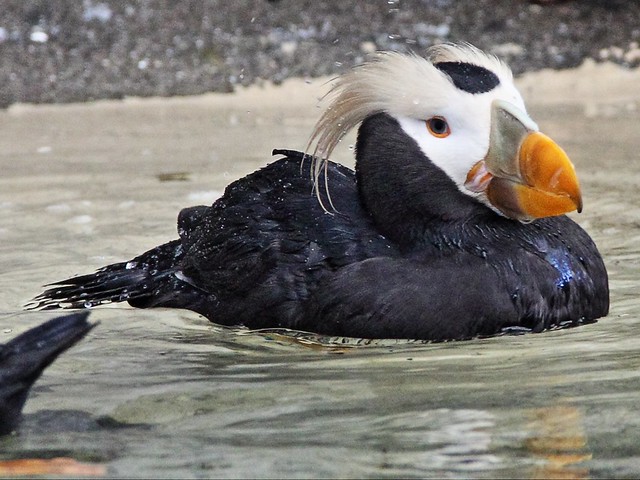
Tufted Puffins:

Tufted Puffins Sealife Ctr 20140620

Tufted Puffin Sealife Ctr 2-20140620

Common Murres:


A Common Murre with a pair of King Eiders:
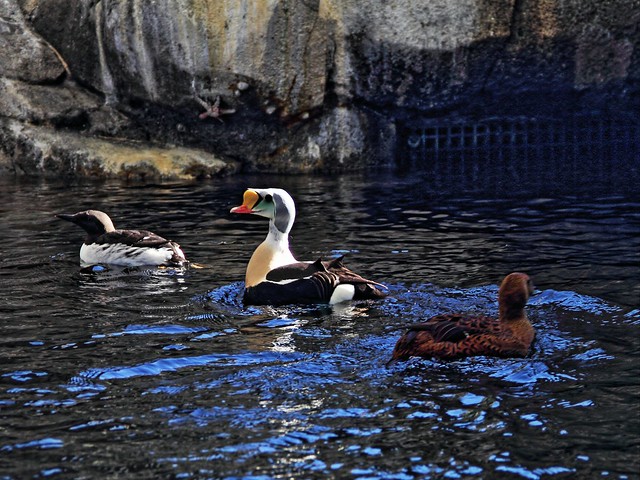
Common Murre with King Eiders Sealife Ctr 20140620

Close-up of the male eider:


Red-legged Kittiwake:


Black Oystercatcher


We proceeded up to Denali National Park on the land portion of our tour. To view other posts describing our Alaska cruise and land tour, click here.

*More about ice worms at this link

The Ballad of the Ice Worm Cocktail
--Robert Service, 1940

(final stanzas as Major Brown finally drinks it down
to earn the right to be called a "sourdough.")

...The Major took another look, then quickly closed his eyes, 
For even as he raised his glass he felt his gorge arise. 

Aye, even though his sight was sealed, in fancy he could see 
That grey and greasy thing that reared and sneered in mockery. 

Yet round him ringed the callous crowd - and how they seemed to gloat! 
It must be done . . . He swallowed hard . . . The brute was at his throat. 

He choked. . . he gulped . . . Thank God! at last he'd got the horror down. 
Then from the crowd went up a roar: "Hooray for Sourdough Brown!" 

With shouts they raised him shoulder high, and gave a rousing cheer, 
But though they praised him to the sky the Major did not hear. 

Amid their demonstrative glee delight he seemed to lack; 
Indeed it almost seemed that he - was "keeping something back." 

A clammy sweat was on his brow, and pallid as a sheet: 
"I feel I must be going now," he'd plaintively repeat. 

Aye, though with drinks and smokes galore, they tempted him to stay, 
With sudden bolt he gained the door, and made his get-away.

And ere next night his story was the talk of Dawson Town, 
But gone and reft of glory was the wrathful Major Brown; 

For that ice-worm (so they told him) of such formidable size 
Was - a stick of stained spaghetti with two red ink spots for eyes.

Monday, July 28, 2014

Eastern Kingbirds with Fledglings

Merritt Island NWR
Eastern Kingbird
Earlier this month I visited Merritt Island National Wildlife Refuge (near Titusville, FL), and I happened across a family of Eastern Kingbirds. Several of them breed on the island, and there's one particular location where I often see them during the summer months.  In fact, I believe I've seen them here every year since I moved to Florida in 2010. This year was the first year I've seen actual fledglings here. Two fledglings were perched on the same branch, anxiously awaiting being fed by their parents. We watched this family from a safe distance for several minutes; I'm always touched by the tenderness that the parents exhibit toward their young--at least that's the way their behavior appears to me as a human.

Merritt Island NWR
Eastern Kingbird with Food
Merritt Island NWR
Eastern Kingbirds
 I saw the kingbirds come to the fledglings twice with food and feed each of the two fledglings. The young ones were all too eager to receive their meals!

Merritt Island NWR
Eastern Kingbird Fledglings
Merritt Island NWR
Eastern Kingbird Fledglings
As you can see, the fledglings look a bit different from their parents. They are a little grayer with a darker mask around the eye, and the white-terminal band at the end of the tail has not yet fully formed. This can cause some confusion for people visiting the coastal areas of Central Florida in search of Gray Kingbirds, since they are superficially similar. But Gray Kingbirds are a bit lighter-colored, lack a white-terminal band, and their dark eye-mask has a different shape than juvenile Eastern Kingbirds, so they aren't too hard to tell apart for observant birders.

Photo & Video Sharing by SmugMug
Gray Kingbird
Eastern kingbirds may lack color--a study in black and white--but I find them strikingly beautiful birds. And I marvel at their abilities--it really is amazing how flycatchers are able to capture fast-flying insects like dragonflies in flight.  And I especially enjoy the aggressive way they defend their nests and young.  They will harass birds many times their size in defense of their territory. After all, they aren't called "tyrant" flycatchers for nothing.  And if you're lucky, you may be able to see the color they do have--the "crowns" that earn them the name "kingbird."

Photo & Video Sharing by SmugMug
Eastern Kingbird

Tuesday, July 22, 2014

The Thrill of Adventure

A slippery climb to view a Swallow-tailed Kite and the epic beauty of Semuc Champey

I love birding.  Period. But I love birding Central and South America a little bit more. My first great passion was Spanish.  It brought me to this chapter in my life.  Once upon a time, a small town boy from Wisconsin dreamed of exploring the rain forests and ancient civilizations of Central and South America. He had read about them in his National Geographic magazines.

Clay-colored Thrush enjoys an avocado
 Today that dream has turned into reality. Back in 2006, I went to Guatemala for the first time but I wasn't a birder.  So I returned last year with my new eyes and camera ready for the journey.  Birding in an exotic locale is an adventure.  There aren't reliable ebird reports in many places.  Many times I had to speak with people about a particular bird.  They didn't always know what the names of the birds were but if I had a pic on my cell phone, they'd generally recognize them right away. At that point, they'd give me directions to the various spots and also the time frame in which the birds usually showed up. I found that I was the first person reporting in many of these incredible places. And it was a very rewarding experience. 


This is where my heart belongs and perhaps one day I will return here for a longer stretch, but there is a great big world waiting to be explored.  I chose Guatemala over Costa Rica or Panama this time because it was underbirded. Plus, if you forced me to choose, I'd pick Guatemala because it is such a colorful country. The Mayan culture is still rich and alive.  However, it wasn't always the easiest place to travel and the birds could be a challenge.  

Watching a volcano erupt in the distance
 But at the end of the day after lots of research and exploration, we had the most incredible views from our lodges. 

Slaty-tailed Trogon
 There are no safety rails in Guatemala like one might find in Costa Rica or in parts of Panama.  People would ask me the purpose of my trip and I'd tell them that I was birding.  They wrinkled their noses.....meaning they didn't understand.  So I began to tell them that I was a photographer filming the amazing Guatemalan wildlife.  And then they understood. Birding is still an unknown for many around the world. We are the ambassadors for our feathered friends in this crazy human world. If people understand that there are those who would pay money to get a glimpse of their birds, they then might consider protecting areas for people to come visit. The idea is slowly catching on. 


And the animals were incredible.  With birder eyes, nothing goes unnoticed.  Plus I had a friend with me who also helped in the searches and she was amazing.  Together we laughed at the most uncomfortable situations.  I think by the end of the month, she understood my addiction towards birds better. 


Orange-billed Nightingale-Thrush(that's a mouthful)
 And while on the trails in Guatemala, I noticed during my research of strange birds that there were two birders who also reported on Ebird.  In fact, they were some of the only ones who reported often.   Both had male names and I assumed that they were older until one contacted me via Facebook.  Turns out, the top ebirders for Guatemala were two high school students.  I loved that my stereotype was shattered.  As a teacher, it is my hope that we get more young people to bird.  And I have seen an increase in their numbers!  In fact just the other day, I met a high school student with a group of birders in the Arizona area.  I had assumed the older gentleman was his grandfather.  Turns out he was a birder! Isn't our lot a strange one?  Where else can generations join together for one common goal and discover birds? Each offering the other knowledge, experience and quick spotting by sight or sound.  I think it's pretty amazing.  

Gray Silky-flycatcher
 Now birding still isn't "cool" by the regular gang, but it's catching on.  Why?  Epic locales like the ones we visit entice the young at heart to explore places that they've never heard about before.  And when I asked these young people why they've chosen birding as their hobby, they've explained to me that not only are birds amazing but that it takes them to strange and exciting places. When I heard "strange", I immediately thought about the smelly sewage plants and dumps:) Then there are the epic National Parks. We can camp, hike, canoe, etc.  Birding is also a personal challenge and for some, a competition. How many trips around the world did it take me before I put 2 and 2 together? I'd prefer not to think about it:) I'm here now and that's all that matters. 


My next series for Birding is Fun will focus on several Guatemalan places that I thought were great for birding.  I'll share some secrets with you as well plus give you some info for your non-birder crew who might want to follow. We'll explore Antigua, Tikal, Semuc Champey, Lake Atitlan, and other locales.  Each place offers birders great spaces to explore while having other things of interest for the non-birder crowd.  It's like a two-for-one:) While on this trip, I snapped this picture(below) of an artist painting her mural near Antigua.  It inspired me as I sat and watched her work.  It got me thinking about my own photography and life list. This became the header for a personal blog to help organize the sightings of new and old birds alike. 


 Each year I learn more and more about birds and it's thrilling. That's why Birding is Fun!


Where will this trail lead me?  What will I discover?

Wednesday, July 16, 2014

A Bounty of Beautiful Birds


My Birding Is Fun! June post, Magnificent Warblers!, featured many of the gorgeous, colorful warblers seen throughout the bird migration season here in the Midwest. This post will highlight several other species spotted during this time period. All these stunning birds were photographed either in the city of Chicago, on our La Porte, Indiana property, or in Berrien County, Michigan.


Always a welcome sight on our property in La Porte ~  Baltimore Oriole


A lively Blue-gray Gnatcatcher seeks insects in the brush


A Curve-billed Thrasher ruffles its feathers after a torrential downpour


So far, this is my best rare bird sighting of 2014. Curve-billed Thrashers are most often seen in the southwestern United States and in a large portion of Mexico. This golden-eyed visitor was observed over two weeks in June at Montrose Point Bird Sanctuary in Chicago.


A radiant beauty! ~ Scarlet Tanager


A tail-bobbing Solitary Sandpiper seeks nutrition


A striking Horned Grebe in full breeding plumage finery


A handsome Pileated Woodpecker searches for insects amid fallen tree debris


Posing pretty surrounded by pink blossoms ~ Cedar Waxwing


A Brown Thrasher forages near the woods edge


A lovely Veery searches for insects in the forest underbrush


A brilliant Indigo Bunting visits our koi pond in Chicago


Foraging for insects ~ Rose-breasted Grosbeak


A curious look ~ Golden-crowned Kinglet


Posted by Julie Gidwitz ~ Nature's Splendor - http://naturessplendor-julie.blogspot.com/