Thursday, September 6, 2012

Common Nighthawk Migration

For the past couple of weeks I have given supper short shrift  -  quick meals out of the freezer or whatever leftovers I could put together -  because during the second half of August supper time is when the Common Nighthawks pass through on their fall migration. Every evening for the past several years Vermont birder Don Clark of Grafton has has been observing the migration at Westminster Station near the Connecticut River, a perfect wide open location with good views in all directions.

Other birders, both local and from across the state, have been joining him in spotting and counting the passing migrants for the annual record. They fly in small flocks, starting as barely visible dots on the distant sky, then turning into tiny ciphers fading in and out of view, and then suddenly they are right overhead, flashing their white wing patches, with little time for the lens to lock onto the target. When actively feeding their flight is erratic, banking and curving, suddenly veering off into a different direction. And before you know it  the opportunity to catch a good shot has passed. I found it helps to set my camera on continuous autofocus, have a fast memory card and then fire away until the buffer is full at about 100 shots, if set on JPEG Fine, or 19 when shooting RAW.

Male Nighthawks are distinguished by a white sub-terminal tail band which is absent in females and juveniles. 
I am including these two shots, the one above and one below, because the legs are extended. They weren't coming down to land, but maybe they did so for some other maneuver that escaped me.
The birds are often flying with their huge mouth agape when hawking flying insects, but  I only caught two of them doing so.
I apologize for these blurry shots, just using them to illustrate this behavior.
Common Nighthawks are long distance migrants from continental North America, usually along river valleys and lake shores, to their wintering quarters in South America. They have been listed as critically imperiled in the New England states. In the past, migratory flocks often numbered in the 1000's. According to Don Clark the highest number this year at Westminster Station was 641 on 8/22, but on most evenings the counts were much lower, often in the 100's or low 200's.
Here's a link to a video featuring recordings - the peenting nasal call and the boom made by the wings when the bird is diving - narrated by Macaulay Library curator Greg Budney. Great photos too, much better than mine.

Finally on the last day, just when the numbers of passing Nighthawks had tapered to almost nothing, we were treated to two Bald Eagles circling above.
Happy Fall Birding!

Wednesday, September 5, 2012

Hummingbirds and Fall Migration Madness plus!

If you're a birder and you're not salivating right now at the prospect of fall migration, WELL YOU SHOULD BE. Look what's going on and what's to come.
1. Hummingbirds are still migrating big time. Ruby-throated Hummingbirds and other hummingbirds are making their way down the sugar-water and flower nectar filled flyways to their destiny with warmer climes. Here's a map where teachers have reported their sightings of fall migrating hummingbirds. Help the hummingbirds on their journey by maintaining clean nectar feeders and planting lots of red, tubular flowers. The young Ruby-throated Hummingbird above likes the Lady in Red Salvia we planted for it in our yard.
In the East, you may even see a rare hummingbird, such as this Rufous Hummingbird, a western species whose breeding range extends into Alaska, but who increasingly is showing up in fall in the eastern half of the country. I photographed this one at a feeder in NH in October 2009 where it was banded. This young bird has rufous on the sides and the arrow points to the rufous on the tail feathers. If you find a rare hummingbird report it to your local biding organization as soon as you see it.

You can even follow the hummingbirds and go to the 24th Annual HummerBird Celebration birding festival in Rockport-Fulton TX, Sept. 13-16, 2012. Take one of their birding tours to hummer homes, where sugar water feeders provide for hundreds of hummingbirds who stock up before they make their way across the Gulf Of Mexico. They also have hummingbird banding demonstrations and much more.
2. Common Nighthawks are migrating. We just saw a record number, for us, of 1,026 last night flying by us in southwest NH as we viewed them from out deck from 5-7:30 pm! Be on the lookout for nighthawks.
Broad-winged Hawk

4. Oh and the hawk-watching season is just beginning!!! Raptors, raptors and more raptors will be on the move. Peak migration time for Broad-winged Hawks, who get the heck out of the U.S. while the weather is still warm, is mid-to late Sept., when they have a mass exodus out of New England and other areas and travel south, to their wintering areas in Central and South America.
Broad-winged Hawks in a "kettle"

Broad-winged Hawks migrate in large groups (a "kettle") by soaring up in thermals of rising hot air. We have been hawk watching each fall for over 30 years. The place we go to help count migrating raptors is Pack Monadnock Raptor Migration Observatory in southern NH. Last year was phenomenal and we saw 5,290 raptors in one day on 9/18/11.
At hawk watch sites, Ospreys fly right over you.

There are many excellent hawk watching sites you can go to, (many with official counters), especially in the East. Hawk Mountain Sanctuary in Kempton, PA, Cape May Bird Observatory, Cape May, NJ are legendary places to go hawk watching. Down at Corpus Christi Raptor Migration Project in Corpus Christi, TX, they have had season counts of over a million raptors passing by. To find a hawk watch site near you, go to the Hawk Migration Association of North America website. Here you will also find the official count numbers from each hawk watch site for each season.

You can also just watch in your own yard or any nearby place that gives you a clear view of the sky to the north or northeast. Hawks prefer to migrate on a high pressure front with mild north, northwest, or northeast winds.
Yellow-rumped Warbler. Learn this bird well, it is often the most abundant and conspicuous warbler you will see in fall.

Yellow-rumped Warbler, 1st winter f.

Prairie Warbler, 1st winter f.

5. Warblers! Those charismatic gems! Warblers are migrating big time now. Go out with your binoculars and look in your favorite birding spot, or you can even see many even in your own yard. We just had 10 species of warbler in our yard two days ago, including Yellow-rumped, Tennessee, Black-throated Green, Chestnut-sided, Pine, Magnolia, Common Yellowthroat, Nashville, American Redstart, and Northern Parula. Don't get crazy and hyperventilate, thinking all warblers are "confusing fall warblers." Most are not confusing. Quoting from our Stokes Field Guide to Warblers, "You may have heard some birders talk about how confusing it is to identify "fall warblers". What is challenging about fall is that you have both adults and their young of that year (the immatures) migrating through. Immature male warblers most often look a lot like adult females, but immature females are usually quite a bit paler than immature males, sometimes with just a suggestion of the colors and patterns of the adults. The challenges in identification arise with a few immature females that look both very dull and quite similar. Only a handful of these are the most problematic...Yellow-rumped, Palm, Pine, Bay-breasted, Blackpoll, Cape May, Common Yellowthroat and Black-throated Blue. By far the most common dull species will be the immature Yellow-rumped Warbler."

Many other bird species migrate in fall also. Fall is an awesome birding time, get out and have some birding fun!

Tuesday, September 4, 2012

It's Sweltering! It's Stinky! Time To Get Your Salt On!

Located in Imperial County, CA, the Salton Sea is one of the more surreal sites in the American southwest. To access the Sea from Arizona, one must first drive hundreds of miles down the most desolate stretches of the I-10, and then progress through the denuded Imperial Valley sand dunes, which served as Luke Skywalker's home planet in the Star Wars movies.


 As one gets closer to the Sea, it does indeed feel like one is on another, post-apocalyptic planet. The dirt roads of the eastern shore take the adventurer into salt marshes and fetid bays, along strips of crunchy beach adorned with rotting fish and accumulated bones. Decaying algae, selenium run-off, and other heinous odors drift ever-gently in and out of the explorer's consciousness. At certain points, one might come under indirect fire from roving bands of Dove hunters, straight out of a Cormac McCarthy novel. The Salton Sea is a scary place, one that shakes outdoorsmen and naturalists to their core, and makes one question whether the universe has any orientation towards the Good. So why come at all? What is the Sea's appeal and where can the explorer find salvation? The Birds. Oh, the birds...


With Pelicans by the thousand, Terns, Gulls, Herons, Shorebirds, pelagic birds and a huge potential to catch vagrants, the Salton Sea is one of the premier birding hotspots in the continental U.S. Although the water of the Salton Sea is enclosed and stagnant, coastal and inland birds move through in large numbers and with great regularity.

The Wister Waterfowl Management Area now plays hosts to several hundred roosting Black Skimmers and Gull-billed Terns. I missed the Terns by about a week, but many of the Skimmers were still around--a fittingly preposterous and awesome-looking bird for a preposterous and awesome place.


While keeping one's head low to avoid the errant shots of Dove hunters, one can watch the Skimmers display their aerial prowess while the ever-calm and collected Western Grebes cruise below.


Sometimes the Skimmers come down to the Grebe's level too, and put those big mandibles to good use.


Farther south from the Wister Waterfowl area, which is essentially flooded acres of former slat cedar groves, one gets to the Salton Sea proper. The mud gets thicker, stickier, and stinkier, and the concentration of shorebirds really starts to increase.

There are various points of access for the Salton shore, many of which offer different expected species and rare sightings. Almost all of the turn-offs are guarded by Burrowing Owls who chide the obsessed birder for entering such a hellish place.


The Owls are prescient, as Owls are often said to be. While exploring the Schrimpf and McDonald Road sites it is very easy to get one's vehicle ensnared in the quagmire. Once stuck, there is no escape but for the slow demise brought on by beating heat and whips of salty wind. It eats away flesh and metal alike and has spelled the doom of thousands of birders. For those that do survive, it does offer really nice looks at in-land Short-billed Dowitchers and massive Pelican flotillas.


One of the best spots along the east coast in the Red Hill "Marina," which isn't so much a marina as a strip of beach with a few deteriorated posts in the sand and some old cement foundations. The open expanses of shoreline are covered in dead fish and more than a few dead birds. Foraging amid the debris are many little Peeps.


The Western Sandpipers forage in conspicuous groups, but less gregarious Semi-palmated and Snowy Plovers require a discerning eye at times. The Snowy Plovers blend in particularly well despite there being no snow around the Sea. They bring some subtlety and softness to the harsh landscape.


Packs of rampaging Marbled Godwits are a more obvious sight along the shore, where they dip and slash with their rapier-like bills, murdering little mollusks with extreme prejudice.


Like the Gulls and Pelicans, the Godwits are very suited to life at the Salton Sea. On the other hand, gentler birds like this little Red-necked Phalarope, struggle to clear the relentless tide as it comes crashing towards the shore. It is a harsh world where only the strong survive, and only the cruel thrive.


Troops of Yellow-footed Gulls also ply their trade along the Salton Sea shore--one of the few places they're seen north of Mexico--and like a great pirate armada they roam around the other concentrations of birds, ready to pillage and loot at any sign of weakness.


Despite the seeming brutality of the place, the Salton Sea has plenty of charm. Over three hundred and eighty species of birds have been recorded in the area, with plenty of rarities and specialists species not often seen anywhere else. The landscape is rough, but the birds bring grace and purpose to this funny lake, and make it worth the blistering trip. 


Posted by Laurence Butler

Monday, September 3, 2012

Starting a new "Life List"

It seems that when I go out into the field on a single-minded quest for a target bird, more often than not I am disappointed. For the past couple of weeks, I have wanted to see a warbler. Any old warbler would do. Until I took up photography a few years ago, "see" meant exactly that. More correctly it meant "see and identify." I must admit that by "see," I now mean "photograph."

In the case of migrating warblers in the fall, this sharply narrows down the criteria, even with the help of 10X glasses and a supple neck. Trees are full of leaves and warblers prefer to be high up and on the wrong side of both. Now I have a stiff neck and my cataractous eyes force me to depend upon automatic focus if I want a clear  picture.

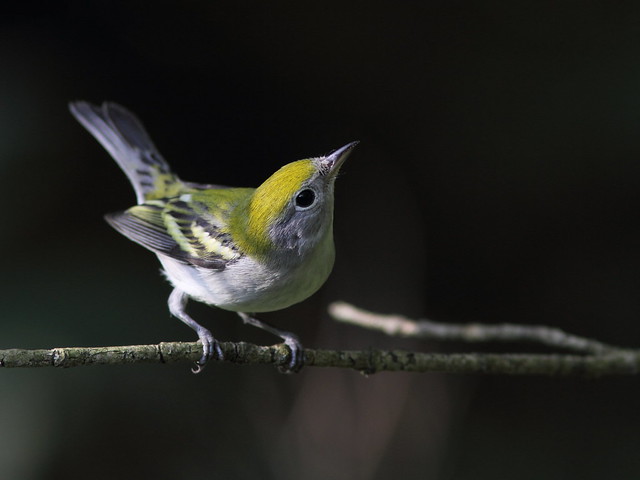
Of course, some photos seem to be gifts from the "warbler gods." Last week, this female Chestnut-sided Warbler posed in perfect light, so close by that I had to back off to focus on her. (This image is cropped directly from the RAW file without any other editing)

Chestnut-sided Warbler SOOC cropped 20120824

Why do I now have this compulsion to package birds' images into files that consist of nothing but ones and zeroes? The world does not need any more bird photos. Birds must be the most photographed natural objects other than babies and waterfalls. If I want to see a great bird picture I can just Google for it.

It should be enough for me to simply take in the great beauty of plumage, song and movement. And it always was, until a 300 millimeter image stabilized lens attached to a 1.4x extender and a progression of three generations of digital single-lens reflex cameras with a monopod and accessory pack were added to the weight I carry into the field. Why do I wish I were carrying this burden when an eagle flies over as I am walking to the supermarket? It is just another eagle, and pretty far away at that.

I will not attempt to answer my rhetorical questions except to say that photography has added an important dimension to my appreciation of birds and nature. For one thing, it has allowed me to start my life list of bird sightings all over. I don't tabulate them or keep a spreadsheet, but I copy them into a set on FLICKR. My "Life List of Bird Photos" contains 261 images, including some omissions and some duplicates that I must weed out.

Many of the images are poor, and I plan to replace them with better shots if I get them and remember to go back to the photo set. It is less than half way to the total on my ABA area list of species sighted. Of course it sets out an impossible challenge, as I am running out of time to try to match both lists. But the quest goes on, to find new species to add.

As I write this, I realize I have omitted this Yellow-breasted Chat.

Yellow-breasted Chat 20101231

Binoculars can somewhat compensate for back-lighting that causes my camera to produce monochromatic silhouettes. With binoculars it is possible to piece together momentary glimpses of a bird as moves through the branches. On the other hand, photos sometimes reveal details missed in the real-time sighting. More than once, I found a "new" species after I looked at the photos back home. That is what happened when I took the above photo of the chat. I heard a strange call in the dense shrubbery, but all I saw was a Prairie Warbler. Only after I got home did I find that one of my shots of a partially obscured yellow blob actually revealed the chat.  (Click on photos for more details and additional views).

My first "real" sightings are seared into memory. As a kid, I did not need binoculars to witness the courtship of a pair of Rose-breasted Grosbeaks. From the seclusion of a thicket, I watched the male display on the ground in an open area, singing all the while. And so on-- my first Common Redpolls, Red-headed Woodpeckers, Peregrine Falcons ("Duck Hawks")... Now, I have a second chance to experience the thrill of "discovering" an old friend, and a few of my new species have been simultaneous additions to both the sightings and the photo lists.

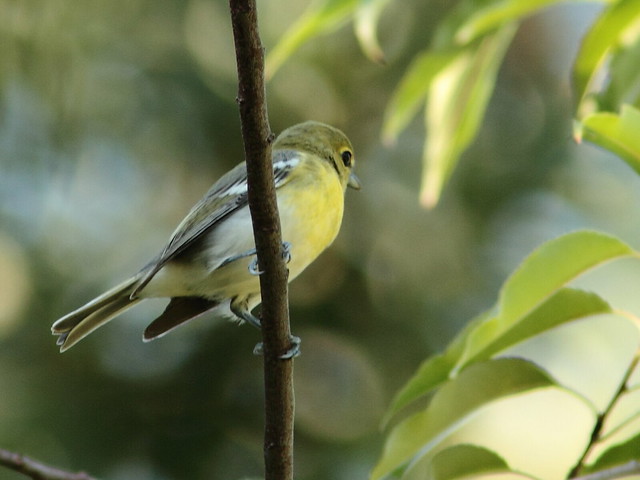
My most recent new "Life Bird Photographed" was this Yellow-throated Vireo, seen only a few days ago.

Yellow-throated Vireo 20120828 

New additions to the list usually reflect my travels to more distant places. Among other recent entries were a Rufous-crowned Sparrow, seen last November in the Albuquerque's eastern foothills...

Rufous-crowned Sparrow 4-20111114

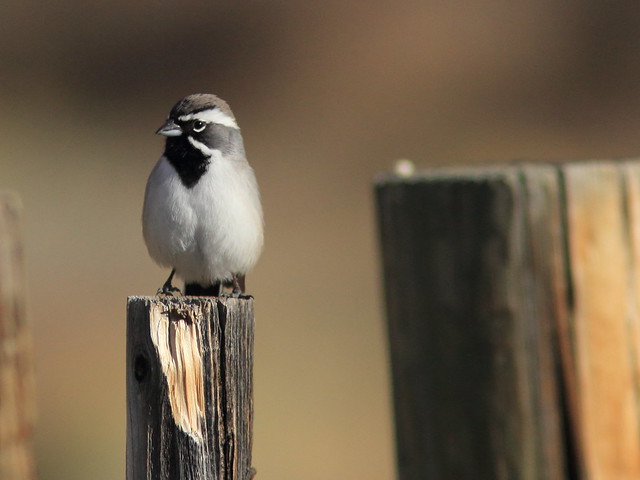
...and on the same day nearby, a Black-throated Sparrow.

Black-throated Sparrow 3-20111114

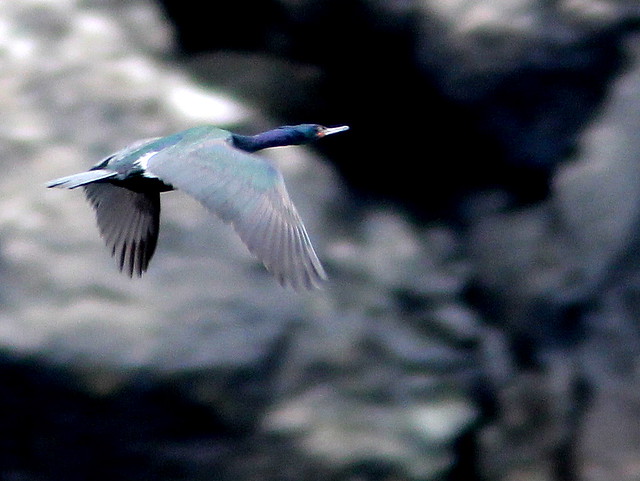
A spring visit to Alaska in 2011 added 16 newly photographed birds, but only one was also a true "lifer," this Red-faced Cormorant on Katchimak Bay.

Red-faced Cormorant - Phalacrocorax urile 20110622

I had seen Pelagic Cormorants before, but this one was special because it provided my first image of this species.

Pelagic Cormorant 20110625

Pigeon Guillemots seemed to be engaged in friendly banter on Gull Island in Katchimak Bay.

Pigeon Guillemots 20110622

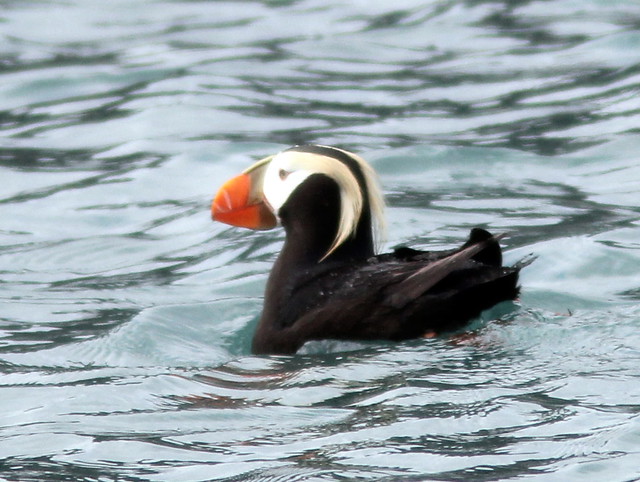
Though I had seen both common puffin species previously, I was able to get my first photos of a Tufted Puffin on Gull Island.

Tufted Puffin 20110622

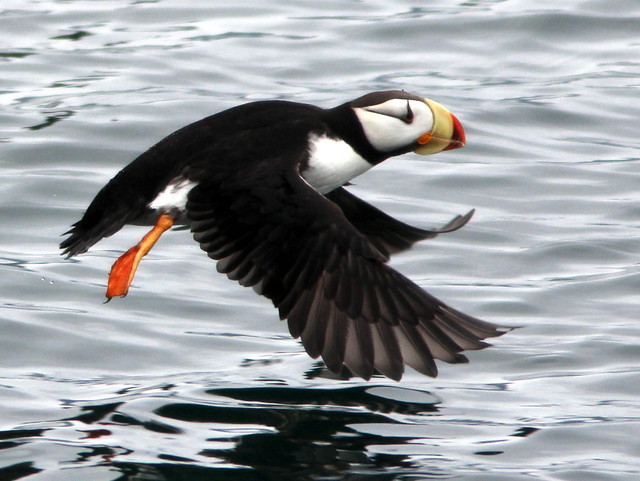
A Horned Puffin splattered across the bow of our sightseeing boat on Resurrection Bay, out of Seward.

Horned Puffin (Fratercula corniculata) 3-20110625

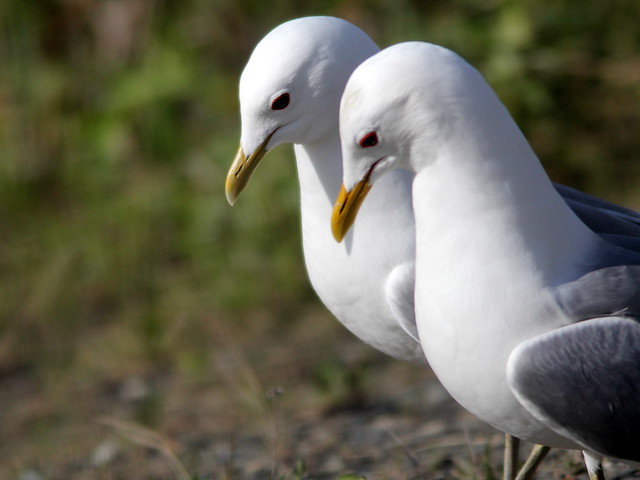
This pair of courting Mew Gulls in Denali National Park, shot through the side window of a bus, was one of my favorite new additions to the list.

Mew Gulls 20110619

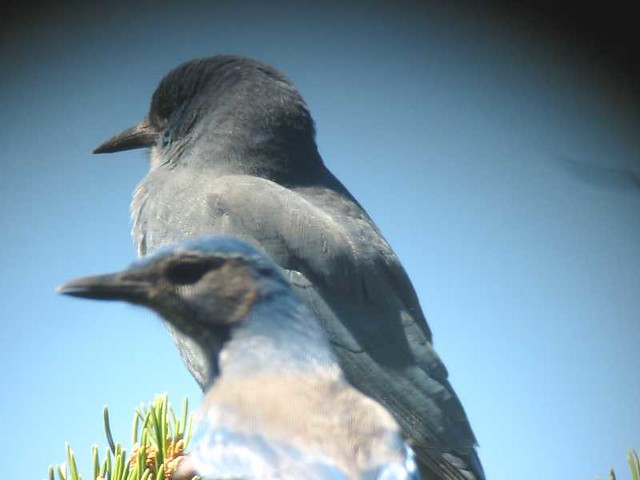
One of the earliest entries on my life list of photographed birds antedates my first DSLR. It is a "two-for" taken from behind the window of our former home in New Mexico with a 2 megapixel point-and-shoot through my Kowa scope-- a Pinyon Jay and a Western Scrub-Jay.

Pinyon and Western Scrub Jay Comparison

Visit ROSYFINCH RAMBLINGS

Sunday, September 2, 2012

A Peek at Beaks


The beak of a bird has a variety of purposes. Feeding is the most important function of the bill and it is shaped according to what a bird eats. This external structure is also used for killing prey, courtship behavior, grooming, fighting, feeding young, manipulating objects and many other actions. The size, shape and color of bird beaks vary greatly and can tell us much about their habitat and lifestyle.


Roseate Spoonbill
 
What is most distinctive about a Roseate Spoonbill is its long spatulate bill. These pink blushed birds lower their partially open spoon-like beaks into shallow waters and sweep it back and forth. Once small fish and crustaceans are detected, the bird clamps down on its prey.

 
Great Blue Heron
 
Herons have long, thick bills adapted for foraging. They stab their spear-like beaks at fish, frogs and shellfish. Once the prey is captured, the heron lifts the creature out of the water and swallows.

 
Brown Creeper
 
These diminutive birds use their thin, downward curved bills to probe for insects and spiders found in and under tree bark.

 
Yellow Warbler
 
Most warblers have slender, pointed beaks. They use their thin bills to glean insects off of leaves, bark and twigs.

 
Great-crested Flycatcher
 
Tyrant Flycatchers snatch insects while in flight. Their beaks are flat and wide at the base. Flycatchers have spring-like ligaments that help snap their jaws shut when an insect is captured.

 
Ruby-throated Hummingbirds
 
Hummingbirds have long, fine, tubular bills which they use to probe into flowers. These tiny birds lap up the nectar with their tongues. They also rely on insects for sustenance. When feeding on bugs, they will often snare the insect at the base of its widened beak rather than the tip. This allows for an easier, shorter path to the throat.

 
Cinnamon Teal
 
The edges of many ducks bills are flat and fringed so they can strain seeds, plants and aquatic insects from the water. The edges can also be soft, filled with touch receptors to aid in locating food.

 
White Ibis
 
 Ibises seek food by wading slowly in shallow water, sweeping their heads from side to side and probing the bottom soil with their curved bills. These stunning birds forage in mud and on grass as well, finding food by touch, sight and rooting. Their diet consists of crustaceans, fish, frogs, insects and various water creatures.

 
Yellow-bellied Sapsucker
 
Woodpeckers have strong, chisel-like bills which taper to the tip. They use their beaks like a drill to excavate holes into trees for food or bore cavities for nests.

 
Osprey
 
Birds of prey have sharp, hooked beaks used to hold and tear into the flesh of prey. They rip the food into pieces small enough to swallow. 

 
House Finches
 
Finches, Northern Cardinals and grosbeaks have short, stout, conical beaks used for cracking seeds.

 
Black Skimmers
 
Black Skimmers have a most unusual beak. It's lower mandible is quite larger then its upper jaw. This assists the bird in its manner of feeding. When searching for prey, skimmers fly inches above the water slicing their lower bills just below the surface. When a fish is located, the skimmer scoops the fish up, tilts its head and ingests the fish while flying.
 

Posted by Julie Gidwitz