Friday, July 6, 2012

Birding Glacial Montague Sandplains IBA

Shivers were running down my spine. I was standing on the very sand deposited some 10,000 years ago, as a delta at the mouth of a melt water stream into the giant ice age lake, glacial Lake Hitchcock. Eventually as the climate warmed the glaciers disappeared and the lake shrunk back into what is now the Connecticut River bed.

The sand delta forms the heart of the Montague Sandplains IBA. The almost impenetrable thicket of scrub oak, intermingled with pitch pine, covering the plains. forms a haven for several bird species, among them Prairie Warblers,  Eastern Towhees, Brown Thrashers, Field Sparrows and Whip-poor-wills. It's a unique habitat, even for the insects and turtles many of which would be more at home on Cape Cod.

I had arrived late in the evening and stayed till after dark to hear the Whip-poor-wills, but no such luck. However from all directions Prairie Warblers were singing.
Several of the Prairie Warblers were banded. I saw them on separate occasions, and don't believe they were the same bird.
A Prairie Warbler singing his heart out


Eastern Towhees were popping up from the vegetation to survey their terrain.


Male Eastern Towhee with brood patch

The females were staying out of sight. This one quickly scrambled into the undergrowth when she saw me.

Field Sparrow


That evening I saw at least 4 Brown Thrashers but none stayed long enough or come close enough for a good picture.


Sand, scrub oak and pitch pine
Here you can read more about the habitat, the ice age, and the glacial geology of the Connecticut River Valley, and glacial Lake Hitchcock.

This is my first post on Birding is Fun and I would like to thank Robert Mortensen for asking me to become a contributor. It's an honor for, as we all know, this is the best birding blog on the planet.

Thursday, July 5, 2012

Butterflies for Birders

When the birding slows down look for butterflies! Here's a Monarch Butterfly. They lay their eggs on milkweed and their caterpillars feed on this plant.
Great Spangled Frittillary on Purple Coneflower
Close-up of Great Spangled Fritillary
American Lady Butterfly, told by the two eye spots on underside of the hindwing
Tiger Swallowtail Butterflies are unmistakable 
Spicebush Swallowtails can be told from other big, dark swallowtails by their single row of prominent white dots inside the margin of their forewings. The larvae of Spicebush Swallowtails feed on spicebush and  sassafrass.
Pearl Crescent butterfly. Scores are feeding on white clover on our path so we keep the path mowed high to preserve the clover flowers for them.
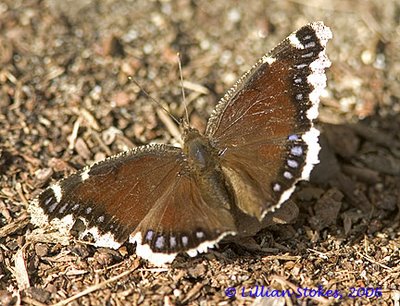
Mourning Cloaks are widespread across much of North America. They are one of the few butterflies who overwinter as adults, finding protected places in log piles, nooks, or under loose bark, and when they emerge in the spring they look worn, as this butterfly does. They are one of the longest lived butterflies and some may live as long as 10 months. Mourning Cloaks feed on sap and fruit. 
Our butterfly bushes will bloom soon and they're magnets for the butterflies . Here's a Great Spangled Fritillary butterfly on one of them.
We've written two books to help you attract and identify butterflies. Stokes Beginner's Guide To Butterflies, has an easy ID key to help you quickly identify the butterflies you see by size and shape.

Stokes Butterfly Book gives you plans for a butterfly garden, lists and photos of butterfly plants, and chapters, with color photos, on the identification, behavior and caterpillars of common butterflies. Both are available at amazon.com and stores.

In the middle of the day, when birds become less active, a wonderful thing for birders to do is look for butterflies. Butterflies are colorful flying creatures, just like birds. The identification skills birders already have can be transferred to identifying butterflies. Look at butterflies through your binoculars, no need to catch them in a net. The hot weather favors butterflies as they need to warm their bodies to fly. They need to get their body temperature up to 85 to 100 degrees Farenheit in order to fly well. Adult butterflies come to flowers for nectar, lay their eggs on special host plants, which can be unique to each species of butterfly. The eggs hatch, larva feed on the plant then turn into a pupa or crysalis from which the adult butterfly will emerge. A complete cycle or generation is called a brood, and butterfly species can go through from just one to as many as four broods per year, depending on the species and the number of warm months. Different butterflies are on the wing at different times during the summer, so you will continue to see new species.

There are about 17,000 species of butterflies in the world. In North America there are about 700 species but only a small fraction are common and likely to be seen by the average person.

When you see a butterfly watch it closely for several minutes. Observe how it flies, its size, shape, and the colors and patterns on its wings, both above and below.

Start by knowing the major families of butterflies that are distinctive. Below are some:

Swallowtails - are our largest butterflies and most have long tails coming off their hind wings.

Whites and Sulfurs - these are all medium-sized butterflies that are predominantly white or yellow

Gossamer Wings - this group is easy to identify since it includes all of our smallest butterflies, such as the blues, coppers and hairstreaks, and metalmarks. The blues tend to be iridescent blue, coppers are often copper, hairstreaks often have hairlike tails on their hind wings, and metalmarks often have metallic spots on their wings.

Brush-footed Butterflies - this is a large and varied group of medium-sized, generally dark-colored butterflies with such strong and rapid flight they are hard to follow. Their is no one field characteristic, besides their flight, that makes them easy to identify as a group.

Satyrs - these are medium-sized butterflies that are almost all brown, often with darker eye-spots on their wings. They have a weak and bobbing flight and are often seen at woods edges or among grasses.

Skippers - are small butterflies whose flight is extremely rapid and erratic. They are mostly rich brown or orange-brown.

Enjoy the butterflies!

Wednesday, July 4, 2012

America the Birdiful


It's been a turbulent year and a torrid summer, but still in America we have much to enjoy and much for which we are grateful. The Fourth of July is a day set aside to stock our coolers and stoke our grills, celebrate our freedom, and also appreciate our beautiful American landscape and all of those with whom we share it. 

Let's be honest birders. Today, when we're outside talking with friends and family, tending the BBQ, or enjoying some 118 degree heat, we'll have one eye on the sky. Not just for the fireworks, but for whoever else happens to be flying by. Our beautiful birds are part of our American heritage, so why not include them with a bit of good ol' American nostalgia!?


God bless America,

Photo courtesy of Moe Motto at Iowavoice.com
Land that I love.

Photo courtesy of Seagull Steve at BB&B.com

Stand beside her, and guide her


Through the night with a light from above.


From the mountains, 

Mountain Bluebird courtesy of  BiF contributor Mia McPherson at onthewingphotography.com

To the prairies,

Prairie Warbler courtesy of BiF contributor Scott Simmons at learnoutdoorphotography.com 

To the oceans, white with foam


God bless America, My home sweet home.


Happy Independence Day. Enjuly the 4th!

Posted by Laurence Butler
Butlers Birds and Things

Tuesday, July 3, 2012

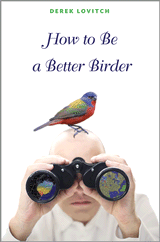
Review: How to Be a Better Birder by Derek Lovitch

Review: How to Be a Better Birder
by Derek Lovitch
Princeton University Press
208 pages, 53 color illustrations, 10 maps  


Look inside on Amazon.com

It's easy to judge a book by its title. This one is "How to Be a Better Birder." Not how to "Become," but how to "Be." Me, I'm always "becoming," but I must admit that I have not yet arrived. I'd be too embarrassed to tell you my worst stories, but here are a couple that are not near as bad as those.

Before leading a Saturday morning bird walk at Rio Grande Nature Center in Albuquerque, I scouted out the area adjacent to the starting point. In a Cottonwood conveniently situated near the entrance trail I found a Greater Roadrunner moving about high in the branches, probably searching for a meal of hummingbird eggs or Mourning Dove nestlings. About 15 minutes later, as I led my charges along the path, I casually looked up at a brown blob moving between the green leaves and began to expound on the interesting behavior of the roadrunner. Well, one of the young participants pointed out that I was looking at a squirrel!

The first chapter of Lovitch's book is subtitled "The 'Whole Bird and More' Approach." Ho hum-- Oh yes, I've heard this so many times, but what's that about "More?" Maybe my approach requires fine tuning.

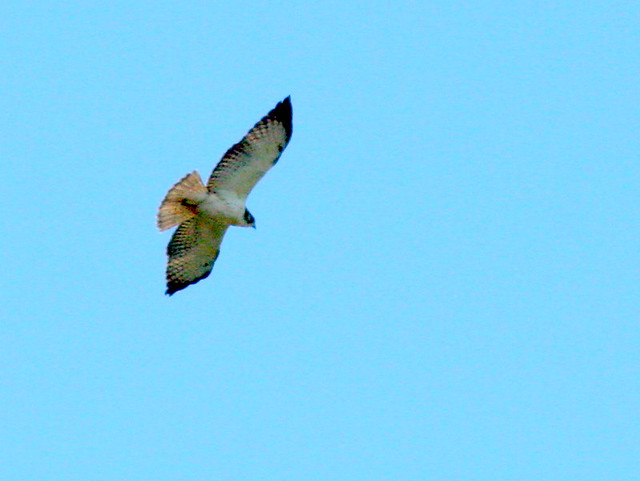
While walking a trail in the wetlands near my new home in south Florida, I spotted a bird soaring quite high in the sky. Easy call. Flying Bird → Hawk → Buteo → red tail → ? Duh, stop here, take its picture and move on to the next bird.

Short-tailed Hawk Light Morph 20100108

If I had applied some of the "More" that is packed into this compact handbook I would have noted that, in addition to its somewhat smaller size, this hawk presented a more graceful silhouette, and shorter pointed wings with comma-shaped light areas just inside their black tips. It wheeled in tighter circles, lacked dark patagial marks and had no belly band. The red in its tail was caused by diffusion of sunlight from above, not the red pigment of a Red-tailed Hawk. It was the first light morph Short-tailed Hawk I had ever seen, and I did not identify it until I looked at my photos on the computer screen back home.

I found the first chapter so interesting that I just had to try out some of Lovitch's advice. Especially interested in the sparrow clan, the author provides two facing pages that illustrate the profiles of each genus. Everybody knows that Song Sparrows (Melospiza) are shaped differently than Chipping Sparrows (Spizella) and Swamp Sparrows (Passerculus). Yet we are encouraged to go beyond "general shape and size" and analyze the subtleties of size and shape of head, bill, tail, chest and belly. Don't be fooled by some markings, such as chest spots. Lovitch provides an interesting artistic interpretation of plumage details:

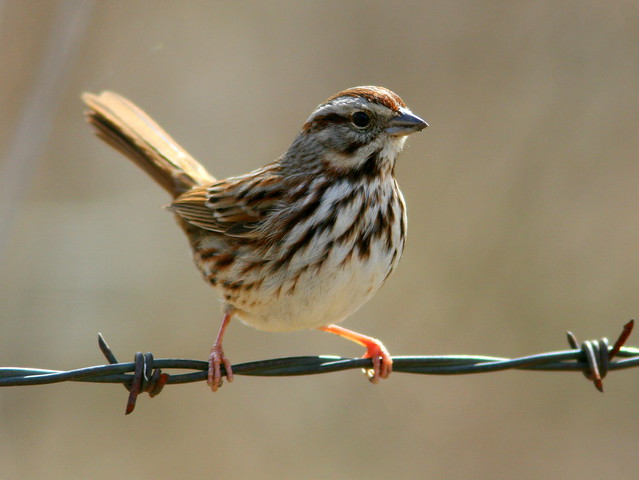
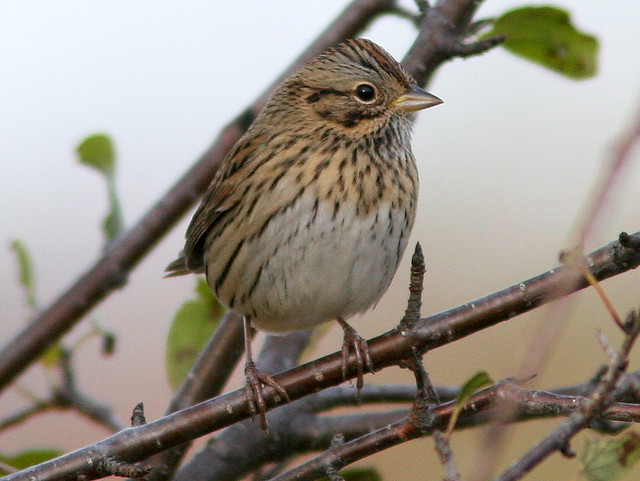
"A Song Sparrow is an oil painting... Lincoln's... is akin to a pen-and-ink drawing, while the washed-out, blurry streaking and more subtle contrasts of the Swamp Sparrow are like a watercolor."   

I set out into the field and found my Oil Painting...

Song Sparrow 20100314

...a Pen-and-ink Drawing...

Lincolns Sparrow 5-20101029

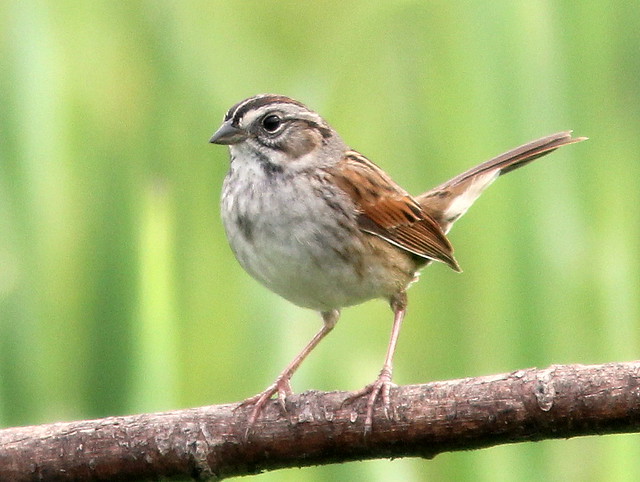
...and a Washed-out Watercolor.

 Swamp Sparrow 2-20110512

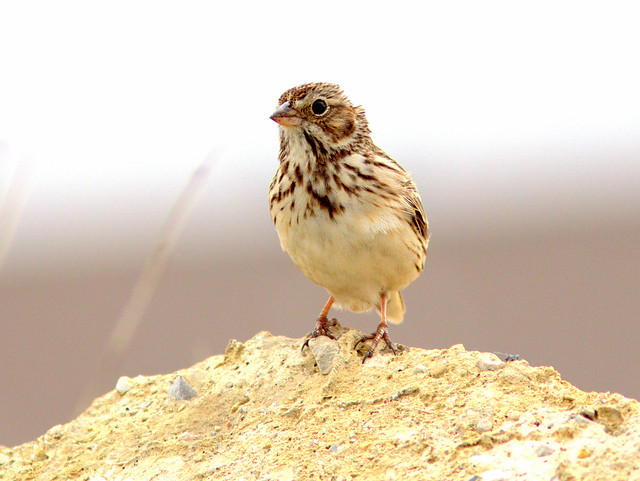
Lovitch cautions us not to rely on the infamous breast-spot to identify a bird as a Song Sparrow. All three of the above sport one, as does this Vesper Sparrow...

Vesper Sparrow 2-20120506

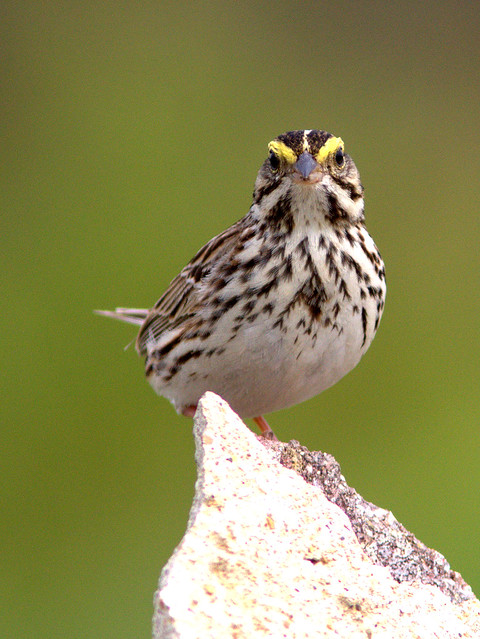
...and of course, the Savannah Sparrow.

Savannah Sparrow 20120506

I have misidentified all of the above sparrows in the past, and probably will continue to do so, but perhaps with less frequency. It was time to move on to the next chapter, "Birding by Habitat."

Sure, we all know not to look for Sage Sparrows in a swamp, but Lovitch goes beyond the basics and  challenges us to learn more about vegetation types and micro-habitats. Know the plants and you will know which birds are looking for food and shelter there. My aging brain simply does not retain all the names of the various grasses, shrubs and trees (and this is also true for butterflies, dragonflies and other insects, not to mention the last ten people who were introduced to me at a party), but it is nice renewing my acquaintance with the same ones over and over again!

The book addresses the importance of geography in the movement of migrating birds and predicting where they may concentrate in various seasons and weather conditions. Lovitch explains the importance of weather-related "overshoots." On a macro scale, migrants may end up far out of their normal range because of such factors as faulty navigation, hurricanes or weather systems. Locally, overshoots occur most often over water, when migrating land birds must reverse course to seek the safety of the shoreline. 

I found the chapter on "Birding by Night" to be captivating, as I read it when spring migration was at a peak. This is not only about listening to chirps in the night and watching the moon. It contains detailed instructions for constructing your own personal radar display to capture and interpret images from the previous night.

"Birding With a Purpose" emphasizes the importance of contributing to the greater fund of birding knowledge, whether through individual record-keeping and reporting on e-Bird and RBAs, participating in organized counts, census and banding activities, or even seeking volunteer opportunities or employment in scientific research endeavors. As is the case in earlier chapters, the book provides a wealth of pertinent references.

After a discussion of vagrants, Lovitch presents  "A New Jersey Case Study," which details the successes and failures of his birding trip to Cape May. He applies some of the concepts set out in his book, particularly relating to the ability to predict where the birds might show up under sometimes challenging weather conditions. 

Finally, he extolls the benefits and joys of patch birding, or more properly, "Patch Listing," strengthening my resolve to be more of a lister. It is so easy to neglect the value of properly recording the arrival, ebb and flow of species in a familiar spot. I resolve to improve in this aspect of my "Becoming" a better birder, even though I may never "Be" one. 


Ken Schneider
ROSYFINCH RAMBLINGS.  

Disclaimer: Princeton University Press supplied me with a review copy of this book. 

Monday, July 2, 2012

Hummingbird Delight


I have glorious childhood memories of summers spent at my grandparents' cottage in the lush, pine-filled northwoods of Eagle River, Wisconsin. My grandfather had a few hummingbird feeders placed outside the house, easily seen from windows. Often, while sitting at the dining room table, a hush would overtake our meal as we all sat in awe, viewing a tiny iridescent creature, delicately sipping the sugary maraschino cherry colored nectar (back then it was common to put red dye in the sugar water mixture).

More recently, my husband and I purchased a beautiful piece of country property in the summer of 2007. The following spring, I drove our tractor over to the orchard. The freshly budding peach and apple trees needed tending to. As I switched the ignition off, I was distracted by a whirring buzz and rapid movement near the side of the machine. My eyes opened wide in amazement and delight! A diminutive female Ruby-throated Hummingbird was examining the bright yellow John Deere decal on the tractor's lift arm. She hovered a bit, moved closer, backed away, took note of the other yellow tractor markings and zipped off. Ecstatic with my precious sighting, I put the tractor in high gear and sped back to the shop, bucket clanking and dust trailing behind, to tell Bruce the exciting news. A few days later we placed three newly purchased feeders out on our acreage. To our pleasure we had several hummingbird visitors during the summer of 2008.

The following spring, we hung seven feeders out in the country. Anticipating the hummingbird show, we packed picnic lunches and ate our meals down by the feeders. All summer long we were entertained and amused by the spectacular aerial displays and antics of the Ruby-throated Hummingbirds. We observed three or four tiny birds battling for ownership of each feeder. There were too many hummingbirds to count! Spring of 2009 arrived along with five new feeders. Our grocery bills increased too, with all the extra sugar purchases. Hummingbird eggs hatched and our numbers grew! Over the past few years we have had up to 15 feeders hung on our property. I have asked Bruce to stop me, no matter how much I protest, from hanging anymore feeders. So much of my time is spent cleaning and refilling them! I spot hummingbirds wherever I am on our land. With each sighting, a bright smile appears on my face. Many have become rather tame and will feed while I am only a foot or two away from them.

My most cherished memory of a hummingbird happened two years ago. I was sitting on our ATV trying to photograph some of the feisty hummingbirds perched in the pines. I heard a familiar hum close to my ear and felt several whispery soft puffs of air against my neck. An especially tiny juvenile male Ruby-throated Hummingbird hovered beside me and then landed a foot away on the lip of a five gallon bucket in the ATV basket. This little fellow sat next to me for two minutes as I stared in amazement at his beauty. He looked at me, I looked at him, he observed other hummingbirds as they invaded territories and whizzed on past, chittering profusely. My mouth agape, I sat and noted his faintly emerging red gorget (throat) feathers, minuscule size, itty bitty feet and boldness to trust me. My new little buddy, sitting along side me, on a lovely summer day.


A handsome male Ruby-throated Hummingbird pauses from feeding


A quick flick of the loooong tongue


All fluffed up!


The reason why I have to refill our feeders so very often


A tiny Ruby-throated Hummingbird shows of its stunning iridescent feathers


I did not know hummingbirds were capable of opening their beaks so wide until I witnessed this male exhibit the behavior several times


No vacancy


A chittering hummingbird warns others to stay away from its feeder


Action at the feeder


A little itchy ~ I marvel at the minuscule feet


Ready for departure ~ Take note of the small red feathers developing on the neck (gorget) of this young dashing male


Preening while on feeder watch duty


Two alert hummingbirds prepare to take on a rival


A ruffled hummingbird postures while defending its feeder


Trying an alternative diet plan


~ Postscript ~

I finished composing this hummingbird post on Friday of last week. While eating lunch at our home in Chicago yesterday (Saturday), I noticed a female Ruby-throated Hummingbird feeding from one of our two feeders just outside the window. She had her fill and flew to a nearby magnolia tree and seemed to perch herself on a limb. I kept an eye on her and noticed she sat in the same spot preening for quite some time. I asked Bruce to take a peek and he thought she looked rather rotund. We brought out the binoculars to get a closer look. What we saw surprised and delighted us so! The female hummingbird was tending to her lone baby in a perfectly constructed nest. Joy!

 Baby Ruby-throated hummingbird ~ Note the tiny pin feathers on its back


Ruby-throated Hummingbird nests are made up of material such as soft plant down, spider's silk, thistles, leaves and fireweed. They also weave lichen and moss into the nest and attach it to the outside. This nest and diminutive hummingbird withstood recent tempestuous thunderstorms and gale force winds.


Posted by Julie Gidwitz