Monday, July 23, 2012

Photographing American Woodcocks and a Shorebird Challenge

About a week ago my brother, Eric, and I were birding at Eagle Creek Park in Indianapolis when some other birders mentioned that they had found a couple of American Woodcock feeding in the open on a mudflat in the park. We went down to check it out and found the two birds right where they told us. We were hoping to photograph them, but there were too many people around for us to get decent photos.

We went back to the park on Thursday, hoping that the woodcocks would still be there and that they would be in a good position for photographs. We found one woodcock on the mudflats, but it ran for the woods immediately when we walked up. After scanning the rest of the mudflats for awhile, the woodcock came back out into the open and seemed pretty comfortable with us being near it. Eric slowly moved closer and closer and I followed a few minutes later. We settled into position and waited for the woodcock to move in towards us.

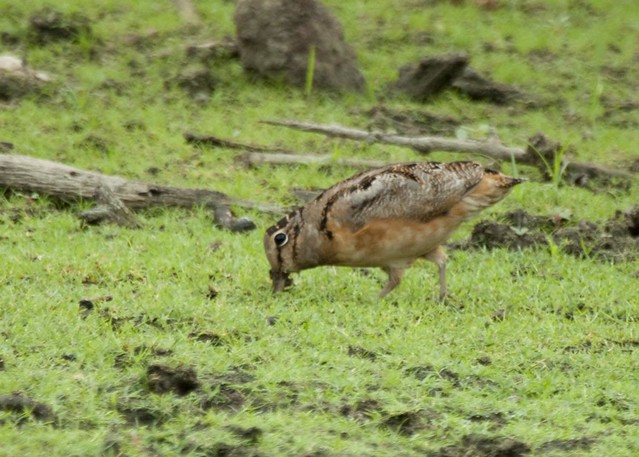
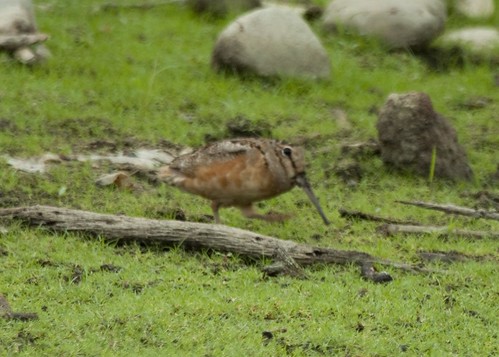
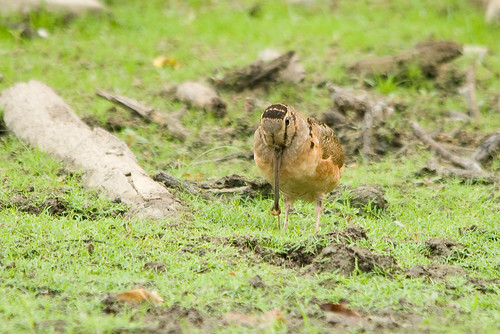
Surprisingly, the woodcock moved in extremely close and seemed completely oblivious to the fact that we were sitting there watching it. We spent the next 30 minutes photographing the bird feeding and even catching a worm. Below are the best of the shots that we took during our time with the woodcock.
American Woodcock
The woodcock probing for food in the mud.
 American Woodcock
American Woodcock (Scolopax minor)
One of Eric's shots showing the American Woodcock with a worm.
In addition to the woodcocks, we found that shorebird migration is well underway in Indy. We saw five Stilt Sandpipers as well as some of the more common shorebirds, including Least, Pectoral, Spotted, and Solitary Sandpipers.

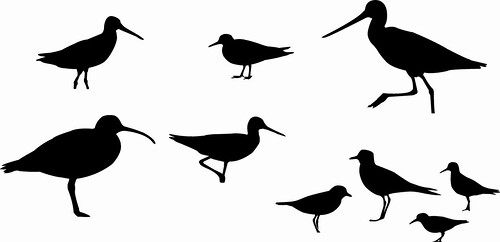
To prepare everyone for the arrival of even more shorebirds, I’ve created a little quiz on the silhouettes of shorebirds. Can you classify these silhouettes into these groups?

• Large Plovers
• Small Plovers
• Yellowlegs
• Curlews
• Large Peeps
• Small Peeps
• Dowitchers
• Phalaropes

Shorebird Silhouettes

You can use this post on Nutty Birder to help you figure out the groups and then find the answers to the quiz here!

-Rob

Sunday, July 22, 2012

Common Whitethroat - The 'Angry' Warbler

The Common Whitethroat is another migrant warbler to the UK which tend to arrive in my local area from around mid-April. Generally they are a bird that loves to skulk around in low shrubs and deep vegetation. However, when they first arrive the male will take up song perches to establish their territory and attract a mate and this is the key short time window for taking photographs. They often give away their location by a noisy fluttering song flight between their regular song perches.

One feature of their behaviour which is in the photographer's favour is they seem to have an insatiable curiosity. If we take an example, try and picture yourself out at first light on a late April morning. You hear the distinctive scratchy warbling of a Whitethroat and spot the bird perched on a low shrub. No matter how careful you approach, the bird is going to see you coming and its first reaction is to dive in to the shrub and make a low churring sound, which is the alarm call. After a few minutes the churring stops and you will see a small head pop out of the foliage to inspect you. This goes on for several more minutes from various parts of the shrub until eventually the bird decides your not a threat and continues on with its singing activities on top of the shrub.

They are not the most colourful bird but are still attractive with their muted colour palette of a chestnut coloured back, buff breast, grey head and of course that prominent white throat patch from which they derive their rather unimaginative name.

Another feature of Common Whitethroat, like many other Sylvia warblers, is that they always give the impression of being an 'impaitent' and 'angry' bird. I don't like to assign human emotions to wildlife but 'angry' fits this birds character perfectly, particularly when in song. I think its the combination of that hesitant scratchy song combined with the look of the bird that gives this impression.  I think the red / orange eye colouring complete just adds to the whole surly image.
The bird in the photograph below, from a couple of years back, I found in late May and it had taken up residence on the edge of a car park and seemed to be generally unhappy with the whole world around him. There were many people coming and going in the car park and it appears he was less than impressed by all the activity given that his young had fledged and were hopping around the cars.

As I have quite a large library of Whitethroat photographs, I do not tend to target them as much as I once did with my attentions turned to other species. However, I still like to have a least one short session with the birds each year are they are great fun to watch and photograph. This last photograph is an obliging bird that I spent a couple of hours with this spring and I sure next year is unlikely to pass without at least one of these 'angry' warblers putting in an appearance in front of the lens. As always I will look forward to that encounter.

Saturday, July 21, 2012

Pledge to Fledge

A personal invitation to me and readers of "Birding is Fun!" from Richard Crossley. Richard actually called me on my cell phone...can you believe it?! I am honored to participate in the Pledge to Fledge movement. Won't you join us?

Coming up this August 24th-26th, all across the world, enthusiastic birders are invited to share their passion for birds with friends and other non-birders. These birders will share their efforts with the world through photos, videos, and stories on the Pledge to Fledge (P2F) website and social media channels. Be a part of P2F 2012 and make your “Pledge to Fledge” a new birder TODAY! Visit the website to learn more.
On the 10th of January, 2009, as indicated in the photo above, I led my first bird-walk in my neighborhood in the Boise foothills. Every person attending was a non-birder, except me. It was awesome! I think we only saw nine species that morning and one of the "non-birders" found a roosting Great Horned Owl which instantly captured the hearts of everyone there. Bam! A dozen new fans of birds and birding.

Here we are, about three years later, and I still remain in contact with several of those first attendees. While not all of them are passionate seekers of birds, they all remain interested in birds and most have backyard feeders and are excited to tell me about each new bird that arrives. (I thought these winter scenes might also help us cool down a bit in the blazing dog days of summer).
Birding is one of the greatest pastimes of all time! It can be enjoyed on so many different levels pretty much anywhere in the world. Sharing birding with others is often more rewarding than seeing new life birds.

Click here to take the Pledge to Fledge!

Friday, July 20, 2012

Confessions of a Bad Lister and Wanna-be Birder Poet

As birders, we all keep records of one kind or another. Some of us are daily dairy fanatics, writing down species by species, the numbers, places and conditions under which we observe our feathered quarry. Others have fallen fully into the "eBird" rage, documenting important information that quickly goes out on the quicksilver internet airwaves. I understand the importance of all of this and admit that I am not as dutiful a documenter as I probably should be. No, I am sometimes lazy with my lists and guess what? Sometimes I forget to write down what I saw and when I saw it!  I have a life list but at the moment cannot tell you how many birds there are on it--exactly.  Somewhere around 650---ish---I think here at home and maybe add in another three hundred or so on a couple of trips abroad?  My last lifer was a beautiful Kirtland's Warbler. I shared the sighting with a few hundred of my closest friends at Magee Marsh. And so I do have a date and time stamp for most of my birds. But just not obsessively so. I used to chase and list every single one but then something changed. Yes, I know. It is a shameful thing for an upstanding birder to admit to.One of these days I will count them all up. I have even promised to be a better eBirder. One day. I promise.  But I know that  my secret is safe with you all, right?

Another admission here. I journal in lyrical prose and verse. I am like many creative writers (perhaps most but among the few who will admit it) a wanna-be poet. I'm not sure why but so many of us want desperately to have the verse that dances in our brains be accepted just like the other stuff we write. There of course is plenty of precedence for birds in verse--from Poe's "The Raven" to Frosts "mid-summer and mid-wood" ovenbird, poetry gives us a way to express the wonder we all see in birds in a different and evocative way. I love the way Julie Zickefoose let's her verse fly from time to time. Nature sound maestro Lang Elliott and my artist friend John Muir Laws also write poetry that imagines birds in a very different way. Poetry lets me see, hear and feel the birds. I think that poetry is one of the most efficient ways to write in that it boils what we see, hear, smell, touch or even taste down into a concentration of words. Poetry, if done right, delivers a lot of emotional bang for the buck.  I want my poems and prose to still give you the data--what a bird looks like, sounds like,habitat, behavior or maybe some gestalt that makes the i.d obvious. More than that though, I want  to feel the bird in a different way. I want to remember some emotion outside of the ornithology.  And so here, as we settle in to the heart of summer. I've revisited some of my stuff and  thought I would share a little bit of  how I see a few of our feathered friends.

Ummm...again, if you don't mind--keep this little secret between you and me. I wouldn't want this getting out!

Here goes!

Warning to a Warbling Vireo
A nondescript vireo
Wearing a drably cryptic gray-green disguise
(speaking on condition of total anonymity)
Told me…
If I see you I will seize you and then squeeze you till you squirt
Rattled and a bit intimidated by the persistent threats
I left him alone to hoard the cache of brown bespeckled ovoid treasures
Safely nestled in a carefully crafted woven grassy vault.

My reply to the vexing vireo:
IF I see you - I’ll I.D. you -and then I’ll list you in my book!


Summer Swifts
A squadron of chimney swifts
Twelve o’clock high!
Focuses twittering attacks on a ruddy brick and mortar edifice

Reconnoitering a slatey summer sky
Targets for today – mosquitoes, mayflies and midges

A flight of three – breaks right, tight –
then rolls left-
a lead and two wingmen
Banking, climbing, diving!

Feathered fusiform fuselages move as one –
Dark forms piercing the heavy August air
Bring grace to the dog days of summer

 
The Lumper's Lament
An ornithologist on hearing
That the mighty A.O.U.
Had split a single species
Into twenty-two
Rejoiced in his longer list
Called a lab-coated friend
To thank him for the hair-splitting blade
Of the molecular –naming trend
“Old Darwin would be proud!” he said
To know that things have changed
We no longer need to see the beak
To know that things are strange!

A short three years later
At a meeting far away
The multiple species that had come to be
By vote---they went away.

The Union in its "wisdom"
Made many species one
Choosing to ignore the old idea
Of sexual isolation.
 
As tanagers become grosbeaks
And  the warblers re-arranged
He counted and reassessed his feathered tally
That waxed and then had waned

Other birders hearing the tragedy
All cursed the lumping shift
And vowed to find some other birds
To fill their waning lists.


Caesar’s Head Corvids (3.23.12)
Two Ravens
Hang on to the edge of the world
Daring the coldest north wind to blow them from it
With their dagger -toed feet grasping the clouds
They tilt an obsidian feathered finger -- just enough to make time stand still
They croak and tumble in the violent uplift like acrobats—
Coaxing gravity to pull them down to the reality that mires me to rock
soil 
and earth

Playing on wings borrowed from a buteo and emboldened by fearlessness foiled from falcons
They dance between the ethereal of ancient myth and the necessity of persistent legends
Tricking the zephyrs to take them where they want to be
I watch and worship their bold black being
Envying their freedom without fear
 and joy taken without regret

Thursday, July 19, 2012

Birds Flocking Together

As a bird photographer I am usually trying to isolate a single bird or small group of birds to photograph but I'm also unable to resist taking images of small or large flocks of birds.
American White Pelicans soaring in the thermals above the Great Salt Lake
 The Great Salt Lake attracts many species of birds and quite often they can be seen in flocks on the salty water of the lake, in the freshwater areas surrounding it or in the sky above. American White Pelicans breed in this area and it is simply amazing to see hundreds of these huge white birds soaring on the thermals.
Massive flocks of Eared Grebes on the Great Salt Lake
Eared Grebes are attracted to the Great Salt Lake because of the availability of brine flies, their larvae and brine shrimp which are their preferred prey. These birds fly at night thus are rarely seen in flight but they bob and danced around in the water in numbers well over the thousands.
Northern Shovelers blasting off
From fall through late spring the surface of the Great Salt Lake and surrounding freshwater areas are covered with waterfowl that number in the millions. These Northern Shovelers blasted off from the surface of the lake because a Bald Eagle flew over them. Hearing their wings, the sound of the splashing water and seeing the sheer number of the ducks caused me to catch my breath before I started clicking away at my shutter button.
Wilson's Phalaropes mass lift off
A few weeks ago there were thousands of Wilson's Phalaropes along the causeway to Antelope Island and the large construction trucks present at the time would cause repeated mass lift offs of these small shorebirds when they rumbled by. The sound of the wings reached my ears as I was mesmerized by the Phalaropes flashing from dark to light in what appeared to an undulating continuous wave of birds.
Wilson's Phalaropes in flight against a rainbow
I've also photographed large flocks of Wilson's Phalaropes at Red Rock Lakes National Wildlife Refuge in southern Montana. I was photographing from inside a vehicle during a rain/hail storm at the Lower Lake then when the rain stopped for a few moments and the sun peeked through the clouds a rainbow appeared and the Phalaropes flew in front of it.  How delightful was that?
A mixed flock of Brown Pelicans, Black Skimmers, Laughing Gulls plus Royal and Sandwich Terns
While I lived in Florida I was delighted to see this mixed flock of birds during a feeding frenzy caused by large schools of bait fish swimming along the shore of the Gulf of Mexico. There were birds everywhere!
Mass Chaos - Red Knots and Black Skimmers
There are times when human disturbance causes large flocks of bird to lift off at once from where they might have been resting or when predators approach and cause chaos like what is shown in the image above when a Peregrine Falcon flew over. I'm not sure how these birds don't crash into each other in mid air. These Red Knots and Black Skimmers were certainly startled!

Seeing birds in large flocks; whether they are on the land, water or in the air, is a joy and great birding fun!

Mia
OnTheWingPhotography.com

Wednesday, July 18, 2012

A Return to Bitter Lake

Bitter Lake National Wildlife Refuge is a relatively unknown wildlife refuge located on the Pecos River near Roswell, New Mexico. Because I am from Roswell, I grew up going to Bitter Lake on a regular basis. In May I went to Roswell to visit with some friends, and of course I could not wait to make a trip out to the refuge. Bitter Lake is a winter home to many Sandhill Cranes, Snow Geese and other winter migrants. My Birding is Fun! post last month was about my trip to Bitter Lake in February.

I was surprised by the number of Black-necked Stilts that were at the refuge when I returned. It appeared that there were at least 100 of them in the ponds. I had a lovely time watching and photographing them. Here are some of my favorite photos:


What lovely birds! I love their elegant black and white plumage and their long pinkish-red legs.

There were other birds present as well, although many of them were in areas that were too far away for photographs. I am accustomed to seeing White-faced Ibis there, and I love the way that the sun highlights their plumage.


There were quite a few Killdeer running around on the refuge, and I was disappointed that I did not see any little fluffy chicks.


Red-winged Blackbirds sang from the marshy edges of the ponds.


Western Meadowlarks sang in the grass.


I enjoyed watching Turkey Vultures walking around near one of the ponds.


And it is always a delight to see Great Egrets.


Bitter Lake National Wildlife Refuge is a very different place in summer than it is in winter. It is a lovely place to visit any time of year.

All photos © Linda Rockwell. Contact corralena@gmail.com for permission.

Tuesday, July 17, 2012

Oriole flegdling

Baltimore Oriole male - From 6.12
On one of my recent small birding walks, I noted the usual Baltimore Orioles flying about. I had not seen them as much the last few weeks, due to sitting on their nest (I presume). May and June get a bit quiet compared to April and early May, as all the birds stop worrying over getting mates and are sitting on their nests. Where-ever this female went, I heard almost a pishing sound, and saw it was a juvenile whining/crying for food. I now know the "song" of the juvenile Balitmore Oriole (i am sure not too specific) Sad to say I had no shots of the actual feeding process, but these are such pretty birds I had to share.
Mom has a juicy breakfast - From 6.12
youngster is excited for the food - From 6.12
Dad watching to make sure all is safe, he has his eye on that odd guy in a hat who keeps watching - From 6.12
From 6.12

Monday, July 16, 2012

Guest Post: Summer Birds of Golden Gate Park

This article is dedicated to Joseph Mailliard who wrote "Birds of Golden Gate Park" in 1930. A sincere thanks to "Birding is Fun!" which has hosted countless articles that have generously passed on the essence of what makes birding fun. - David Cruz

Golden Gate Park, the flagship park of San Francisco, has become a visiting ground for bird lovers of all ages. A thousand acres, beginning from the sand dunes of Ocean Beach/Pacific Ocean and stretching three miles into San Francisco, Golden Gate Park has become an outdoor aviary where birds enjoy its beauty as they come and go. Below are pictures and observations from my favorite park in the world.

A Robins nest I had been watching taught me about natural selection when I saw this egg on the ground directly under it, luckily one chick made it:
100 years ago these birds were abundant in the park (numbers in the thousands) now they are down to around a dozen, a California Quail. (The cover of Mailliard's "The Birds of Golden Gate Park" of 1930, features a cover illustration depicting a family of CA Quail hatchlings enjoying the park):

The classic Mallard and Canada Geese nest and stay around year round: A gosling drinking water at Stowe Lake:
A Great Horned Owl Nest overlooking the Buffalo family at the Bison Paddock:
An Allen's Hummingbird during an early morning bath:
A Song Sparrow Taking Flight in Golden Gate Park:
Some of the most exciting experiences have come from watching raptor families such as Red Tail, Red-shouldered and Coppers Hawks which also nest here in the summer, here is a young Red-tailed Hawk seconds before a successful swoop on a pocket gopher:
A Young Chestnut-backed Chickadee, calling for food:
A summer rarity, a Green Heron visits the park:
The most common bird associated with Golden Gate Park are its beautiful Great Blue Herons which also live and nest here in the summer. Park visitors enjoy watching these birds hunt for pocket gophers, flipping them in the air before gulping them down:
Here are colorful Coot chicks that hatched recently, the cycle of life continues:
I would summarize my birding adventures in this park as mostly learning experiences. Surprises around every corner, make every day a new day worth adventuring. I am 25 years old and although I don't consider myself an expert, I do try my best to understand and coexist with these birds as best I can. I feel energized and fulfilled when I share a moment with a bird, knowing a bird is here with me sharing this beautiful San Francisco, California habitat.

David Cruz

Sunday, July 15, 2012

Dam Birds

It’s been a hot summer, this year, here in Arkansas, in the low 100’s. As a Wildlife Photographer, I try not to disturb wildlife in the woods, as it’s so hot and I don’t want to stress them. I will at times, photograph from my vehicle if given the opportunity. During these hot summer months, I enjoy photographing shore birds. I find most of them along river and lake dams. Herons and Egrets are easy to photograph in these areas while foraging as they are used to being around the fisherman which also present food for them from the bait the fisherman use. Even an amateur photographer can get some great shots of these shore birds along the banks and below the dams. You don’t have to worry so much about spooking the birds while setting up your equipment because they are so used to people being around.

You will find a different variety of shore birds throughout the different seasons of the year. In the hot summertime, I find Herons and Egrets, and at other times of the year, I find Pelicans and Gulls.

Below are a few of the photos I’ve taken:

Saturday, July 14, 2012

The Welcome Presence of the Evening Grosbeak

Evening Grosbeak, male
When we lived in Pennsylvania, some winters our yard was visited by thieves who descended upon the bird feeders in a flock of ten to twenty birds, cleaned the seed from the feeders, then flew on. The attack was repeated every two or three weeks, until Spring finally returned. Then they would be gone, not to be seen again for another two or three years.

Evening Grosbeaks were irruptive winter birds in my previous home. In spite of the spike they created in the bird seed bill, they were welcome visitors. The male’s gaudy plumage, dominated by bright yellow, was a spark of color against the gray-brown winter landscape.  The sudden appearance and equally sudden disappearance of the nomadic flock - the enthusiasm of their voracious appetites - the energy with which the flock seemed to do everything - all helped to chase the winter doldrums.

Evening Grosbeaks also empty the feeders in my Vermont yard, but they do not disappear. They stay in the neighborhood, and as soon as I refill the feeders, they are back, cracking one sunflower seed after another with their massive bills and sending my seed bill soaring.
Evening Grosbeaks in January
As common as the Evening Grosbeak is in my yard, for many birdwatchers it is a rare, sought after species. Last year a young birder who reads my blog emailed me; he was going to be in southern Vermont for a weekend. Could he come by to see the grosbeaks? Unfortunately, that Spring weekend was the one weekend when the grosbeaks decided to go elsewhere. As soon as he was safely back in New Jersey, the grosbeaks were back in my trees.

When the European colonists were settling the Atlantic coast, the Evening Grosbeak was not present. It was primarily a bird of the western mountains, Northwest, although one of the earliest specimens was collected at Sault Ste. Marie, Michigan.

When first discovered, the Evening Grosbeak was observed to sing in the evening - hence its name. This observation was incorporated in both its common name and its scientific name.

Scientifically, the Evening Grosbeak has been named (until recently) Hesperiphona  vesperina. Hesperiphona refers to the Hesperides, the “Daughters of the Night,” who dwell on the western edge of the world where the sun sets. The Evening Grosbeak was first observed in the far west where the sun sets. Or perhaps more precisely, as one source suggests, the name comes from the Greek hesperios, “at evening,” and phona,”voice” - hence “evening voice.”

With scientific redundancy, the species name is vesperina, from the Latin meaning “belonging to the evening.”

Male cracks seeds and feeds a fledgling.
Scientists have recently reclassified the Evening Grosbeak. It is now Coccothrautus  vesperina. It shares its Genus with the Hawfinch of Europe and the Hooded Grosbeak of South America. Coccothraustes is from the Greek to “shatter,” a reference to crushing fruit pits. But it is still “vesperina” - the bird that sings in the evening.

The name is poetic, but untrue. The Evening Grosbeak sings any time of the morning, afternoon, or evening. The song is sometimes described as a loud “peeyr” with a ringing quality, but that is a generous description. The Evening Grosbeak is not much of a songster.

Historically, the Evening Grosbeak was a western species. Until the late 1800s, the bird was rarely seen east of the Mississippi.  Eastern expansion is commonly attributed to the  widespread planting of box elder trees in prairie windbreaks and as an ornamental tree in northeastern cities.  Seeds of the box elder persist on the tree through winter, which allowed erratic winter flocks from the west to overwinter (Forbush 1929). Some overwintering birds remained to nest, leading to the expansion of its breeding range. The first recorded nesting in Vermont was in 1926.

The large, powerful beak accounts for the folk name, "English Parrot."
The Evening Grosbeak is a bright and conspicuous bird. Such bright colors are usually associated with tropical birds such as the Baltimore Oriole, Scarlet Tanager, or Rose-breasted Grosbeak. Parrots are almost entirely tropical or sub-tropical birds; the Evening Grosbeak has sometimes been called the English Parrot, on account of its plumage, big beak, and occasional feeding habits. However, the Evening Grosbeak is anything but a tropical bird. It is a bird of northern and western forests. Its range straddles the U.S.-Canadian border. How then does it come to be so colorful?

The answer is found in the Evening Grosbeak’s original homeland in the Northwest. Arthur Bent in his 1968 life history of the western Evening Grosbeak writes that it  “is largely a bird of the higher altitudes whose plumage is a blending, a chiaroscuro, of the high-lights and shadows of the great hills.” He cites Enid Michael who wrote from Yosemite in 1926: “The Evening Grosbeak ... furnishes a splendid example of protective coloring in birds. It is brilliantly colored white, yellow, black and olive. It would seem to be one of the most conspicuous of high Sierran birds. Yet its brightest color is almost identical with the lemon color of the lichens found throughout our high Sierra.”

Evening Grosbeak, female
Another writer in 1902 wrote: “While watching the birds on Mt. Shasta one day, I was struck by the conspicuousness of one that flew across an open space. As it lit on a dead stub whose silvery branches were touched with yellow lichen, to my amazement it simply vanished. Its peculiar greenish yellow toned in perfectly with the greenish yellow of the lichen.”

These accounts remind me that when driving our dirt roads in the summer time, I have seen the gravely road in front of me suddenly burst into flight. Evening Grosbeaks, picking up grit and salt, blended into the roadway until my vehicle came to close. Then at the last moment, they flew.

The Evening Grosbeak is a big, stocky finch with a bearing that makes me think of a pugnacious street fighter. But appearances are deceiving. When food is plentiful, most observers use adjectives like quiet, sedentary, gentle, and unafraid. When unmolested, they can become almost tame. They approach backyard feeders from a high perch, where they check things out before coming in to share freely with others birds.

Courtship display by male Evening Grosbeak
As conspicuous as the Evening Grosbeak is when present, comparatively little is known about its life history. During the breeding season, it is secretive. It prefers mature, open-canopy mixed forests. It builds a flimsy nest high in a tree, a practice which makes it very difficult to study.    So ... when I spend a sultry summer day sitting on my back porch, I am not just idling away my time when its too hot to do anything else. I am doing research. I am observing the Evening Grosbeaks.

Good birding!