Sunday, August 26, 2012

Pledge to Fledge Experience

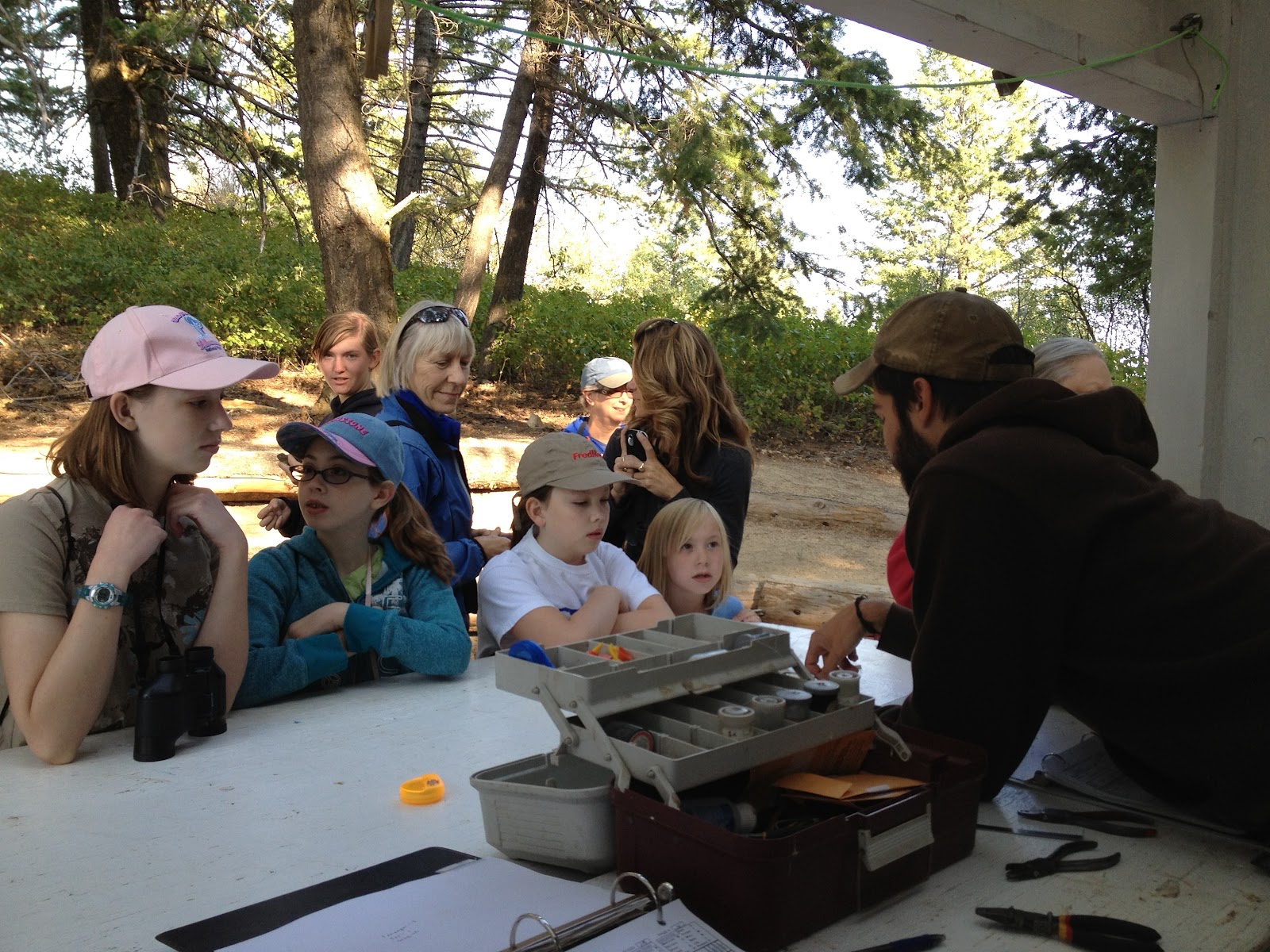
As part of my Pledge to Fledge this weekend, I took friends and family up to the Idaho Bird Observatory on Lucky Peak above Boise and encouraged the Idaho birding community to invite non-birders and come and join us. Birds seen through binoculars are amazing and chasing them all over the country side is a blast, but birds in the hand can spark the interest of a whole different group of people.

Here's a little video clip I put together:

The Golden Eagle Audubon Society also had a scheduled field trip to the IBO and I was delighted to see that there were lots of youth and several non-birders in the group. I counted at least 30 visitors in the few hours we were there. Kids and adults alike were asking loads of great questions. There is no question in my mind that they were fully engaged in the wonderful world of birds. The IBO team was fantastic with all the guests, especially the kids.
Heidi Ware educating the public about the awesomeness of birds at the IBO banding shack.
IBO staff members Ashley (MT), Zack (MI) and Mitch (WI) work quickly to measure and band the birds and get them back into the wild while visitors observe and riddle them with questions.
Mitch does the blowing test on a bird to look at muscle, fat, and bone mass setting up a photo up for a superstar bird.
In the hand comparison of a Dusky Flycatcher and Western Wood-Pewee
Here I am about to release a Warbling Vireo
Zack teaches fascinated young ladies about the banding process.
Garret (WA) and Heidi (ID) banding birds. Heidi has a Wilson's Warbler. I think she determined it was a young female.
One other highlight that I didn't realize until I returned home and entered sightings into eBird, I cracked into the 200+ bird species for my home county here in Idaho. Birding is fun!

Saturday, August 25, 2012

Random Reviews of Birding Stuff

Setting up a Vortex Viper 15-45x65 Angled Spotting Scope to show family members and random passersby the Tufted Puffins, Common Murres, and gulls on Haystack Rock, Cannon Beach, Oregon Coast.
Vortex Viper 15-45x65 Angled Spotting Scope

I had a great opportunity to put this scope through its paces recently along the Oregon Coast. Through it I observed six life birds. I found the clarity of the optics to be very good, especially at the lower power levels. At the higher power levels the image was significantly darker, but still okay in good light conditions. The eye-piece and focus wheel were very easy to use and a good focus was obtained very quickly. I particularly enjoyed the fine-tune focus ability. The protective case is also very well done and user-friendly. This is a great scope at just under $500. If you can save up a bit more money, it would probably be worth it to hold out for the same scope with HD glass.

Swarovski EL Swarovision 12x50 Binocular

Mike Bergin of 10,000 Birds and I almost had to wrestle over who got to use the Swarovski 12x50 Binocular during our recent bird-blogger confab in Tucson, Arizona. Sharon Stiteler, the BirdChick, was a strong advocate for the wrestle-off, but alas Mike was a gentleman and allowed me the chance to use them as he had had his taste the day before. The first bins I ever purchased as an ignorant beginning birder were 16x50's for $60 at KMart, so I had learned my lesson several years ago that more magnification power is not always better, so I had my doubts about a 12x50 binocular. True to Swarovski form, this binocular performed marvelously and delighted. It was perfect for viewing that fairly distant Band-tailed Pigeon getting dive-bombed by a Zone-tailed Hawk from the top of Mt. Lemmon.

Now after huffing and puffing up some terrain, I did find that my heavy breathing and additional hand-shake diminished my viewing experience as higher power magnification is wont to do. The next day, knowing we would be doing a lot of canyon hiking, I passed the 12x50's back to Mike and enjoyed using Swarovski's 8.5x42's, the best and easily my favorite binocular that I have ever used for birding. Under normal bird walking conditions the higher power magnification combined with the greater diameter objective lens gives you a ton of light and wonderful close-up views. It even has a close focus of less than ten feet, which is pretty amazing for a 12 power binocular. At over 35 ounces, this is a bit of a heavier binocular.

I happily recommend the Swarovski 12x50 Binocular to outdoor enthusiasts with a steady hand and for those viewing situations like wildlife viewing that are enhanced by the greater magnification.

BirdCallsRadio

My involvement with Pledge to Fledge made me aware of BirdCallsRadio when Michelle Mohilef, Danielle Mohilef, and Dave Magpiong were guests on the radio show/podcast hosted by Chris Bosak on a southern Connecticut radio station. Since then, I've downloaded several of the podcasts to my iPhone and have been listening to a couple each day while I'm driving around for work. The show has had some fantastic guests and interesting conversations. The show does well with the difficult task of balancing the appeal to the local radio listenership while still being relevant to an international podcast audience. I would like to hear more confidence from the host as he articulates his questions and guides conversations with his guests which I'm sure that will come with more experience. What a great platform for spreading the joy of birding that I hope more birders around the country, and the world for that matter, can emulate.

Planet Finder App

Upon receiving the Vortex Viper scope in the mail, one of the things I most wanted to do was show my kids the rings of Saturn. I immediately downloaded Planet Finder, a free app, to my iPhone. My kids and I were delighted at how this app showed us the planets visible in the night-sky. You simply hold your smartphone up and turn every which way and the app superimposes on your screen an image of the planet as you are aimed in that direction. It is just so cool! You have to try it!

This app has additional functionality which can be purchased inexpensively to learn to recognize starts, constellations, and even satellites. And yes, I succeeded in showing all four of my kids the rings of Saturn, no matter how many times they bumped the tripod and I had to re-find and re-focus the scope.

Birding News

The bird-blogger meeting in Arizona put on by Swarovski also had many interesting and informative side conversations about the relevancy of the American Birding Association. The conversations were delightfully candid even with ABA-insiders like Nate Swick and me being there. Birding News is a new and powerful way that the ABA is showing its important place in the birding world.

Jack Siler established BirdingOnThe.Net years ago aggregating bird reports from all the birding listservs in the United States, Canada, and even many from around the world. Jack has now passed the torch of managing this beast on to the ABA. The ABA has basically re-built this tool from scratch with new programming, which has enhanced the experience a hundred fold. The interface is now more snazzy, but still simple, super user-friendly and easy to navigate. I love that it is now searchable by state, by listserv, by bird species, and even by whatever random word or topic you would wish to search. It even includes the listservs for the bug and butterfly fans. The ABA has put a lot of time and effort over the last year to get this up and running, so many kudos to Greg Neise and David Hartley and anyone else behind the scenes who worked on it.

Interestingly enough, listening to a 2012 New Year's Day BirdCallsRadio interview with ABA President Jeffrey A. Gordon, Jeff talked openly about Birding News as if it was about to be released. It was easier said than done, but now we have this great free resource courtesy of the American Birding Association. If you love Birding News, please consider supporting the ABA by joining as a member.

Friday, August 24, 2012

My Backyard Bird Photography Studio

Its amazing how this topic seems to be on the minds of so many people.  I bet I get a few emails a month from folks asking for help designing and/or building a backyard bird photography studio.  I have tried many different gadgets and setups for my backyard bird photography studio, both home-made and purchased.  In fact I have tried as many setups as I have camera bags!  Just like camera bags, different yard setups present different solutions and complications depending on weather and time of year.  What I will attempt to do in this post is talk about and show you how I have generated the most consistent results in my backyard bird photography studio.  I will give you one warning before you read this post.  I follow the KISS method in my photography.  KISS stands for Keep It Simple Stupid :-).  If I had a dollar for every time someone asked me how many lights I setup in my backyard or how big or what kind of a tent I use for a blind, I would be rich.  The simple answer is I don't use any of these things.  I know, I know, some of you will say you have to use lights if you are going to stop the action of a hummingbirds wings or counteract the effects of the harsh mid day sun and this is true, in some applications.  I will give you that using a flash when photographing hummingbirds is helpful but not required.  As it relates to using a flash to help counteract the harsh midday sun my response is I don't photograph in the harsh midday sun.  Have I used flash in the yard for special effects, yes.  Do I use it often, no.

So lets talk about the basics of backyard bird photography studio.  What do you need for this to be successful?  The first thing is you need to be able to control your background.  There is nothing worse than a beautiful bird on a branch, with 20 other branches in the way or a sky scraper in the picture along with your subject!  What you also need to consider before you select a location for your feeder is the angle of the sun and where you will be standing in relation to the sun and your feeder.  Ideally, you want the sun to always be behind you (over one of your shoulders) so that you will be between the sun and the perches/branches you will be photographing.

Basic Setup
In the picture above you will notice 3 locations for birds to land, eat and drink.  All 3 are highlighted by white arrows.  I will show you closeup images below to help.  If you notice, I have placed the feeders, bird bath and large perch in locations where the birds can fly in and out to the woods easily.  I have also made it easy for little song birds to hide in bushes and make their way to the feeders using the cover of the shrubs for safety.  You should also notice that I do not place any of the feeders near windows in an attempt to limit window strikes.

The feeders and stands I am currently using are made and sold by a company named Wild Birds Unlimited (WBU Link).  I have found their products to be excellent and the store employees to be very helpful and friendly birders.  I use the APS System (APS Link).

Here is a view of the main feeder from the driveway where I usually shoot from.  Notice the clean background behind the perches.


Providing water is an essential element to having happy birds at your feeders.  In fact, water is often more difficult for them to find than food so if at all possible, try to provide this.  I am actually considering burying a water feature in the ground nest spring for a different angle from which to photograph my birds!

Hopefully this post gives you some ideas on how to layout your feeders and perches on your property in order to give you the best opportunities to photograph the birds in your backyard.

Notice all my feeders have Squirrel and Raccoon baffles.
Second Setup with Ranch Style Feeder

Ranch Feeder
Clips sold by WBU to hold branches/perches

So I thought that I would provide some examples of images you can take in the yard with and without special effects.  The two images of a Ruby Throated Hummingbird were both created without using flash.  Nope, just plain old fashioned sunlight.  Its just how you use that sunlight!  The bottom image is taken using flash.  The intent was to try and give the viewer the impression that the bird was actually photographed in front of a black background.  It was actually photographed in front of a tree.  Its amazing what you can do if you use your imagination when it comes to photography.  Don't be afraid to experiment with your photography!


Ruby Throated Hummingbird with an itch
Ruby Throated Hummingbird looking for some nectar

American Goldfinch photographed with flash to blacken background and make his colors pop!

Thursday, August 23, 2012

Why Fledge New Birders?

With the Pledge to Fledge (P2F) starting up tomorrow, I thought that it would be fun to write about the wonderful reasons to fledge new birders for my post this month. I think that all of us as birders, whether we have been birding for years or are relatively new, have a responsibility to try to introduce new people to birds. It doesn’t matter whether it’s your neighbors, non-birding friends, or a random individual that stops to chat while you are out birding.  Any one of those people may be missing out on a love of birds that they are unaware they have.

Why do I feel this is so important?  To me, one of the most fundamental aspects of introducing new people to birding is the profound effect that these people can have on the birds. The more people that there are that understand both the beauty that birds bring to this world and the dangers that our birds face, the more support we will have when we try to address these issues. Our birds are always under some type of threat, and those threats are growing all the time. Recently in Indianapolis, we have had to fight against a local park’s proposal to create mountain biking trails through an area that will destroy prime nesting locations for many of our woodland birds. While we still do not know what the outcome will be, the amount of support that was generated by the birding community has hopefully helped to stop this trail from being created. While local birders did a fantastic job of coming together to fight this, what would have happened if two or three times as many birders lent their voice to this cause? I completely believe that the more people we can introduce to birding, no matter how casual their interest, the farther we can go toward accomplishing our conservation goals. Education is the key, and that is what P2F is all about.

Not only will new birders have the ability to help spread the word about these issues, they will likely also support conservation initiatives with their money in some way or another. Let’s face it; we need more money for conservation. It seems that no “protected” lands are safe anymore. Hopefully with more conservation dollars, more critical bird habitats can be brought under the control of land trusts and other organizations that will protect them for years to come. While none of us actively fledge new birders for this specific reason, it’s a pretty awesome side effect!

A group of young birders at an Indiana Young Birder's Club event.
I also believe that these newly fledged birders are the future of birding. If we really want this hobby (and for some of us, this profession) to continue to grow, we must recruit new birders. You never know what the individual you took out birding yesterday might end up doing for birds and conservation in the future.  This is especially true when working with kids and young adults. I think every birder should regularly take a child or teenager out birding. It’s good for you, it’s good for the kids, and it’s good for the birds. The young birders of today are the ornithologists and conservationists of tomorrow.

I have introduced my in-laws to birding.
This was one of their first birding experience in Alaska! In fact, these
were the only two pair of binoculars we had with us,
 and my wife and I pretty much lost them to everyone else.
So what are you doing this weekend to help the P2F? Do you have a friend or neighbor that has expressed an interest in birds? Start off slow by just taking them out for an hour or two. Even if they don’t become birders, you will at least have shared your love of birds with them and helped them appreciate and be more aware of our feathered friends.


Wednesday, August 22, 2012

'Storm Bats'

I am a lucky person or more correctly I am very lucky where I live. I live at the end of the Wirral peninsula in NW England and this is one of the very few places where it is possible to photograph Leach's Storm Petrel from the shore. As September is nearly upon us, it has reminded me that  the brief window of opportunity to photograph these birds is fast approaching.

Leach's Storm Petrel are pelagic birds only coming to shore to nest at remote islands and spend the rest of the time out at sea. During September, in their migration southward, some birds pass down through the Irish Sea with peaks numbers passing Liverpool Bay towards the end of the month. To photographic these ocean wanders from the shore requires a whole set of conditions to coincide which means that some years, like 2011, only one or two birds may appear briefly battling their way through the waves. The necessary conditions are that gale force winds from the North-West blow for at least 3 days. This pushes the birds landward and they are funneled in towards the mouth of the River Mersey. The birds linger in the mouth of the river then as the tide ebbs, head out and move along the top of the peninsula. Given the alignment of the river mouth with the coast there is one particular spot about 4 miles from my home where numbers of petrels can hit the shore. Obviously for this to come together the tide also needs to be at the right time of day for light direction to allow photography.
The benefit of living local is that I can keep a close eye on wind and tide conditions, and get myself quickly into the right place at the right time.
Even when all these conditions coincide photographing the birds remains a big challenge. I managed to find this video on YouTube which is actually shot on my local coast (not by me I hasten to add)  and will also give you an idea of the birds and conditions - Petrel Video .

The challenge for photography is that you are being buffeted by a 30 - 40mph wind that is laden with camera unfriendly salt and sand, trying to photograph a bird about the size of a starling in flight that keeps appearing and disappearing behind large waves. Believe me it is not easy but it is a very rewarding experience being up close to these enigmatic sea birds and I have had them so close that they were inside minimum focusing distance for the camera.  They appear very bat like as they flutter low across the waves and patter across the wave tops as they battle their way back seaward into gales. All you can do is admire these delicate looking birds as they struggle back out undeterred in to a raging sea of spray and foam.

The birds rarely actually land on the water, as this bird below has, unless the kind a quick and easy meal. The tube nostrils of these birds are very effective at sniffing out food over vast ocean expanses.
Unfortunately sunlight is also rare under these stormy conditions and so you often struggle with the quantity and quality of the available light.

It is great to watch them as the walk across the wave tops in their buoyant flight. Superbly adapted to their life on the ocean swells.

My favourite image of this species to date is the one below of a banking juvenile bird which is a particularly difficult photo to capture in the howling winds. This photo recently appeared in a book dedicated to storm petrels. However, as any bird photographer will tell you there is always room for improvement which is what keeps us going back.
Will they arrive this year? Well its in the hands of the wind and tides. As you can see from the dates on the photos here the last good year was 2010, so we must be due one. All I can do is hope they will make an appearance as it is always a pleasure to have a brief glimpse of these birds that normally reside beyond the horizon.

Tuesday, August 21, 2012

Kenn & Kimberly on Pledge to Fledge

Great tips on "How to fledge a birder" now up at Birding with Kenn and Kimberly!

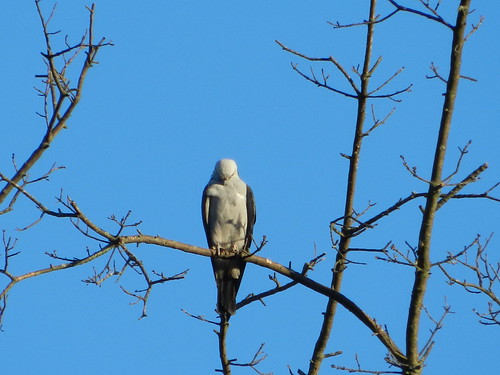
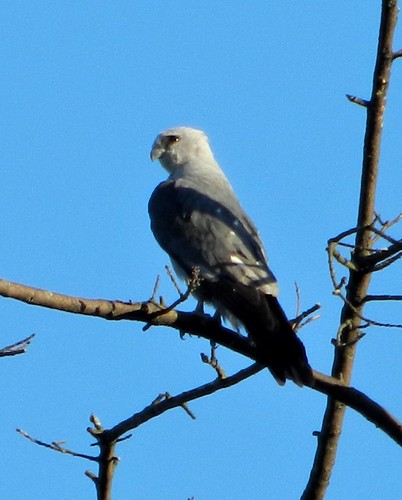
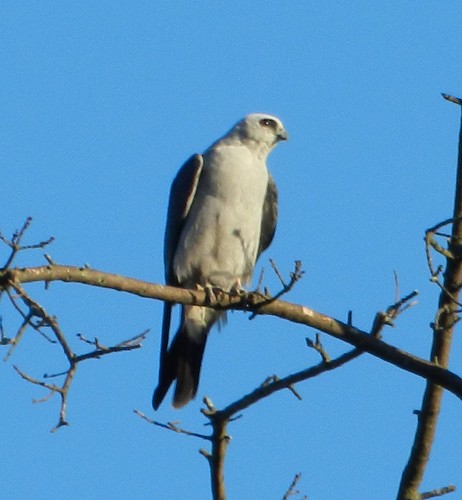
The Loveland Mississippi Kites, A lifer at last!

With the recent above normal temperatures and my work schedule, I haven't been able to get out birding much as of late.  So with word that someone has been seeing three Mississippi Kites at a park in Loveland, OH, I had to try my luck in finding them.  I have missed this bird quite a few times, once only by minutes not too far from my home.

Mississippi Kites are rare in Ohio, still a write up bird with the Ohio Bird Records Committee.  There is only one confirmed nesting of them in Ohio, the nest being in the Hocking Hills region.  However, they are expanding their range in Southern Ohio.  There are reports of probable breeding birds from the Milford area, which is very near the Loveland location.

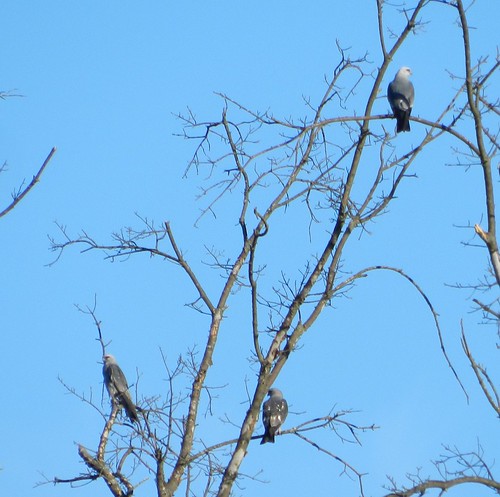
After work last Monday, I decided to try to find them since I had to go up that way anyway.  My girlfriend Ashley checked the Cincinnati Bird Sightings log on her cell phone to make sure that the birds were still in the area.  At the time that I arrived in the area, the last place that the birds were seen was another park nearby called Symmes Park.  We got out there and searched around with no luck.  Ashely checked the sightings log again, only to find that the birds had moved across the street to another park called Home of the Brave.  So, we went over there and checked around.  Still no kites.  Found a Red-tailed Hawk sitting on a cell tower, but no other raptors in sight.  So, Ashley checked the bird sightings log again to find that the birds were currently being seen at the original park location.  I started getting the feeling that I was going to have to chase these birds for a while.  Upon arriving at the original location were the kites have been spotted, Lever Park, I spotted a small crowd of birders looking at something in their scopes.  I heard someone say the kites are right there in that tree.  Sure enough, there they were, perched in a dead tree across the road from the park in someone's front yard.  Wow!

Loveland Mississippi Kites


Looked to be one adult bird and two juvenile birds.  Wasn't expected them to be so close.  Ashley and I watched the birds for about an hour.  Other local birders were coming and going while we were there.  I couldn't believe that I was finally looking at Mississippi Kites!  They were as cool as I imagined.

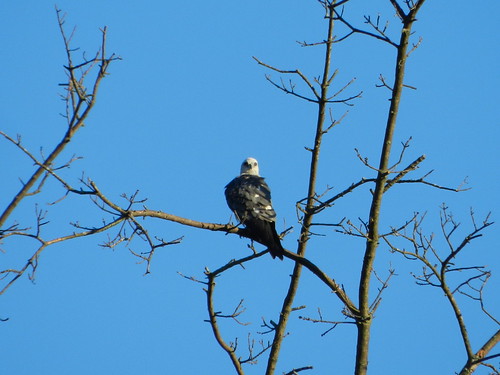
Loveland Mississippi Kite


The adult bird was the most active and cooperative photo wise.  Nice lighting was helping.  Couldn't ask for much better views of such a cool bird.


They continued to preen for while I was there, as soon as the adult looked up, it went back to preening.

Loveland Mississippi Kite


Cool red eyes!

Loveland Mississippi Kite

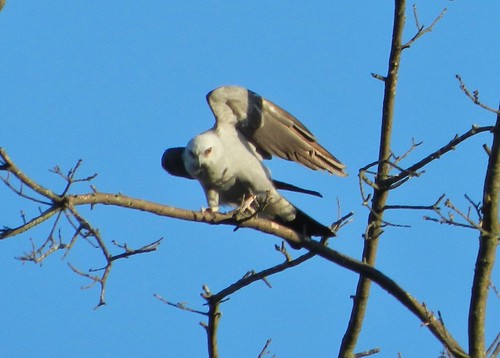
As we watched the birds, they started getting antsy as they homeowner fired up a lawnmower.  The birds started stretching their wings.  I was hoping to get to see what they looked like in flight for future reference in ID.  I was able to get this cool shot of the adult minutes before they were spooked off by the lawnmower backfiring.  

Loveland Mississippi Kite


The kites made my day.  They even looked cool in flight, like a giant nighthawk!

I would like to thank all the birders who kept updating the status of the birds to the sightings log.  And especially to the birder who originally spotted these birds and got the word out!  

Monday, August 20, 2012

Reveling in the Regular - Pledging to Make a Difference

With the end to the summer swelter in sight, things are beginning to push past the summer doldrums. Shorebirds have long since been making their way back to winter quarters and migrant passerines are trickling through to quench the ticking thirst of birders anxious to cast their eyes upon something new and maybe even rare. As we all look towards the streams of migrants that will fill the fall fields, woods, and wetlands it is easy to overlook the common things that sustain or perhaps even lit the fire that set us on the birding path. As birders, many of us have spent more time and money than we might like to admit chasing the rare thing that blows in on an ill wind. Way back “in the day”, before the advent of the eBirding craze and instantaneous capability of social networking, I used to pick up our old land-line phone (remember those?) and call something called the Rare Bird Alert. As the voice on the other end slowly (and sometimes excitedly) rattled off the occurrences of birds in spots hot and not, I would hone in on the unusual; a Black-billed Cuckoo skulking around in a city park or a Buff-breasted Sandpiper seen at a sod farm. If the report was within an hour or two of home, I’d often find a way to get wherever “there” was to add the new bird to my list.

In the process of growing my life list, I would zoom past perfectly birdy places and potentially birdy people to see that one bird. I did that for years. Go to the hotspot with the same bird-nerd friends and see the rare thing. But in the midst of my birding evolution something has (is) changing. Don’t get me wrong. If I get wind of a something showing up where it shouldn’t be, I will usually make my way to see it –within the reasonable constraints of responsibility and the willingness of a bird-nerd friend to share the ride. Finding a Scissor-tailed Flycatcher in a nearby pasture was like lost treasure. So I still seek the odd thing. More and more though, I’ve begun to think about how to bring others into the fold. I know that sometimes it is a rare or spectacular thing that captures someone—a kettle of Swallow-tailed and Mississippi Kites floating above a hayfield and hawking dragonflies and grasshoppers will hook almost anyone with a heart. Can anyone ignore the pigment-splattered palette of feathers that is a Painted Bunting?

But then, I am willing to bet money that many of you weren’t pulled in by the rare thing or the unusual. No, many of us were first “sparked” into the hobby by the common. I was intrigued as a child by the snowbirds - juncos in slate-colored tuxedos - that fed voraciously on the coarse grits my grandmother scattered in the yard. The mysterious bawls of Barred Owls that called from the creek bottom scared and fascinated me at the same time. I sought to discover the hiding spots of Bobwhite quail as if they were the rarest birds on earth.

The vermillion brilliance of a Northern Cardinal in a suburban backyard or the mellow warbles of an Eastern Bluebird along a rural fence row has probably hooked thousands of birders alone. Cardinals are common in many places and eastern bluebirds too.

Watch an American Robin hunt for earthworms and you’ll be impressed with its predatory efficiency. A “V” of Canada Geese on an autumn wind is still stirring even if the flock is only moving from golf course to city park pond. Roger Tory Peterson told the story of being hooked by a Northern Flicker that exploded from a mass of feathers he reached out to touch. If the Dean of American birding could be caught by what was known at the time as a “common flicker”, then I think perhaps we might all stand to pay more attention to the things that regularly show up. It is in the recognition of the common that we re-learn that all birds are miraculous creatures and deserve our appreciation. There’s really nothing common about flight, feathers or the wonderful things that birds do.

In the midst of appreciating the ordinary we birders have an extraordinary opportunity to do something special. Next week, August 24-26, the first global initiative to “grow” birding will take place. The Pledge to Fledge (P2F) initiative, a brain child of Dave Magpiong, Danielle Mohilef, Michelle Mohilef and innovative field guide author Richard Crossley, is to bring birding to new and diverse audiences all over the world. In that effort, it is not so much about seeking rarities and visiting hotspots. No it is about showing our passion to others who otherwise might not realize how important birding can be to their well-being as well as that of their communities and the world at large.

Think about how felt with the first bird that pulled you in; heart all aflutter and brain abuzz with the possibilities of that next discovery. From waterfowl to warblers there's something out there to "flip the switch" of folks who may have just passed birds by. How you feel when you watch a Red-tailed Hawk tracing circles in a blue sky or hear that first Wood Thrush of spring? Do you ever cease to stop in wonder at a hummingbird’s hover? So now take those feelings and grab someone who doesn’t bird—maybe it’s a younger family member, perhaps it’s an older church parishioner. Of all the rare and wonderful things one might see at places like Magee Marsh during The Biggest Week, warblers, thrushes, vireos and the like, I will never forget that one man who was reveling in the beauty of a Red-winged Blackbird, certainly not anything approaching a rarity. It was a beautiful thing!
Whoever it is, stretch yourself just a little bit to go outside of your normal circle of birder friends. Take the opportunity to “preach” to a different choir. Maybe it’s watching pigeons and sharing an appreciation for the oft-overlooked Rock Pigeon’s aerial artistry. Find a feeder and show someone how deftly a chickadee deals in the smallest treasure of a sunflower seed. Find a spot where the birds are easy—a backyard , a park, a pond, and the results could be astounding! Be patient, be passionate. Celebrate the common and don't drag your fledgling too quickly into uber-birder world. One new “convert” doubles the passion for each birder who pledges to fledge at least one person. You might not add any rarities to the list but maybe you’ll add a new comrade to the cause of conservation. Now that’s an investment in the common that will pay off for the birds and the birders!


Peace and Good Birding!

Drew

Sunday, August 19, 2012

A few images of breeding and nonbreeding shorebirds

Since the shorebirds that breed to the north have started migrating back to the south I thought I would post some images of shorebirds that look quite different in breeding and nonbreeding plumage.
Dunlin in nonbreeding plumage - Nikon D200, handheld, f6.3, 1/1000, ISO 200, Nikkor 80-400mm VR at 400mm, natural light
This is a Dunlin (Calidris alpina) in nonbreeding plumage, the image was taken at Fort De Soto's north beach in Florida during the month of December a few years ago. During the winter Dunlins have dull gray-brown backs and heads with light-colored streaked breasts. These hardy shorebirds winter along coastlines from southern Alaska south to Florida and Mexico.
Dunlin in breeding plumage - Nikon D200, handheld, f6.3, 1/640, ISO 160, Nikkor 70-300mm VR at 300mm, natural light
This image shows a Dunlin in breeding plumage also taken at Fort De Soto's north beach in May a few years ago about the time this shorebird would start its migration to Arctic and sub-Arctic areas of Alaska where it breeds on the tundra near ponds.

Dunlins exhibit a vast difference between nonbreeding and breeding plumage, so different that a novice birder might mistakenly believe that they were two different species.
Ruddy Turnstone in nonbreeding plumage - Nikon D200, handheld, f8, 1/500, ISO 200, Nikkor 80-400mm VR at 310mm, natural light
This is an image of a Ruddy Turnstone (Arenaria interpres) in nonbreeding plumage that was taken at Fort De Soto's north beach in Florida during the month of March a few years ago. The edges of the scapulars and coverts show wear, the face and back are brownish.
Male Ruddy Turnstone in breeding plumage - Nikon D200, handheld, f9, 1/500, ISO 160, Nikkor 70-300mm VR at 240mm, natural light
The image above shows a male Ruddy Turnstone in breeding plumage, this photo was also taken at Fort De Soto's north beach in the month of May a few years ago. Breeding males are brighter and more colorful than breeding females. The males are striking with their black, white and ruddy calico pattern.

During migration some Ruddy Turnstones do stop over in Utah but I haven't been able to approach them close enough to get quality images.
American Avocet in nonbreeding plumage - Nikon D200, f8, 1/750, ISO 250, Nikkor 200-400mm VR with 1.4x TC at 400mm, natural light
I photographed this American Avocet (Recurvirostra americana) in nonbreeding plumage as it foraged in Glover's Pond at Farmington Bay Wildlife Management Area in northern Utah a few years ago in the month of November.
American Avocet in breeding plumage - Nikon D200, f7.1, 1/1000, ISO 400, Nikkor 200-400mm VR with 1.4x TC at 400mm, natural light
This image of an American Avocet was taken in August of last year at Red Rock Lakes National Wildlife Refuge in southwestern Montana.  What a difference there is between the pale grayish head and neck of the nonbreeding Avocet to the apricot to cinnamon colored plumage that a breeding bird displays.

Personally I believe that American Avocets are stunning in any season of the year. (Okay, it isn't just Avocets I feel that way about, it is all birds)
Red Knot in nonbreeding plumage - Nikon D200, handheld, f5.6, 1/640, ISO 320, Nikkor 80-400mm VR at 400mm, natural light
 I photographed this Red Knot (Calidris canutus) in nonbreeding plumage in early morning light at Fort De Soto's north beach a few years ago in the month of September. I've heard people call them "dull" little shorebirds.
Red Knot in (near) breeding plumage - Nikon D200, handheld, f7.1, 1/640, ISO 250, Nikkor 80-400mm VR at 400mm, natural light
This Red Knot is almost in breeding plumage, the image was taken in May of 2008 as it foraged along the shore of the Gulf of Mexico in Florida. I very rarely saw Red Knots in full breeding colors there, but you can see the pale salmon color of the head, neck, chest and belly.
Sanderling in nonbreeding plumage - Nikon D200, handheld, f6.3, 1/1000, ISO 200, Nikkor 80-400mm VR at 400mm, natural light
I would not call a Sanderling (Calidris alba) in nonbreeding plumage dull but the soft grays and whites aren't very colorful. I took this image at Fort De Soto in the month of September a few years ago. I really liked the little droplet of water below the bill that I caught in mid air.
Sanderling in (near) breeding plumage - Nikon D200, handheld, f6.3, 1/500, ISO 400, Nikkor 70-300mm VR at 300mm, natural light
Sanderlings look very different in breeding plumage, they are far more colorful with rufous on the neck, upper chest, head and back. This bird was photographed in a sea fog on Fort De Soto's north beach during the month of May. It is amazing how much difference a few months can make in how these tiny dynamos appear.
Black-bellied Plover in nonbreeding plumage - Nikon D200, handheld, f6.3, 1/1000, ISO 160, Nikkor 80-400mm VR at 370mm, natural light
This is a photo of a Black-bellied Plover (Pluvialis squatarola) in nonbreeding plumage taken in Florida during the month of December of 2008, they are beautiful shorebirds and the largest plover of North America.
Black-bellied Plover in (near) breeding plumage - Nikon D200, handheld, f6.3, 1/1000, ISO 200, Nikkor 70-300mm VR at 300mm, natural light
This Black-bellied Plover was photographed during the month of May in 2009 at Fort De Soto's north beach, it is pretty close to being in full breeding plumage and probably soon after this image was created the plover would have made its way to the Arctic to nest.

I find the plumage differences amazing in these shorebirds.

Mia McPherson
OnTheWingPhotography.com