Tuesday, March 4, 2014

Do Mute Swans Migrate in North America?

This Mute Swan was in a city park in Boise,
Idaho.  It is probably not countable.
Most birders in North America are familiar with the Mute Swan, a striking species introduced to our continent in the 1800s, and still widely and frequently planted as live ornamentation in private ponds and city parks around the continent.  The Mute Swan is considered an established species around the Great Lakes and in the parts of the northeast and east U.S. and southeastern Canada, and is "countable" by ABA standards.  Indeed, its population in that area has grown very rapidly in recent decades, roughly doubling every 7-8 years.  However, in much of the rest of North America, Mute Swans are not considered countable because they are not established.  They fall victim to ABA rule interpretation 2.B.iii: "an introduced species may be counted only where and when it meets the ABA Checklist’s definition for being an established population. An introduced species observed well away from the accepted geographic area is not counted if it is more likely to be a local escape or release rather than an individual straying from the distant population."

Sometimes, in the western U.S., I've seen Mute Swans in situations where I wondered if they might be natural vagrants from the established population centers to the east.  There was one Mute Swan that turned up on a local warm spring in northern Utah two winters in a row, but was not seen in the area during the summer.  Another mid-winter observation, in southern Utah, was miles from the nearest homes on a relatively remote reservoir.  The source of these birds is difficult to determine: local movements from feral releases? Or are at least some of them natural vagrants from established eastern populations?  Until a banded Mute Swan is documented moving from an established population, the best we can do is guess.  Most, if not all, of the Mute Swans in the west are just as they are thought to be: non-countable artificial transplants.  But if some of our Mute Swans were natural vagrants from the east, we'd expect that to be a result of migration within the east. Some references say that North American Mute Swans don't migrate.  Others, more accurately, say that there is post-breeding movement as a result of weather or local seasonal movements.  But few if any seem to indicate that there is a pattern of north-south movement in North America's Mute Swans that qualifies as a migration.


To assess whether there is any indication of seasonal migration in Mute Swans in North America, I looked at eBird data for each month of the year, then animated those 12 pictures into a looping gif:
Mute Swan distribution through the year according to eBird data accessed 3 Mar 2014.
While it is not dramatic, I think this map at least supports the references that mention "local" winter movements of the species, and I'd even go so far to say there is evidence that some birds seasonally migrate.  Watch how most of the records north of the St. Lawrence River (roughly a line between Toronto and Montreal on this map) disappear in the winter (perhaps due to a lack of open water).  Also, more obviously, watch how the southern edge of the distribution moves from around the Indiana/Kentucky border in summer to around northern Alabama and Georgia in the winter.  There is also an expansion of what looks like either a small migration or a pattern of vagrants in winter extending roughly from southern Illinois to central Texas.  Finally, look for lateral movement of the heart of the distribution: it is not just an even expansion and contraction around the range or post-breeding wandering.  The western border of the distribution is vague but seems roughly stable throughout the year around the Mississippi River, between Illinois and Iowa and between Wisconsin and Minnesota.

I think it is reasonable that some of these movements are resulting in natural vagrants to the west.  Of course, it is very difficult to identify them, and they will be greatly outnumbered by locally released birds.  But in the meantime, I encourage birders in the west to continue recording Mute Swans in eBird, even if they're not "countable," and to especially watch for any banded birds.  There might be more going on with North American Mute Swans than we realize.

This Mute Swan was photographed on a warm spring in northern Utah in December 2007 and January 2008, was not seen in visits to the location in March, April, and July, and was then recorded again in December 2008.  Where did it go?  Did it migrate? 

Monday, March 3, 2014

Burrowing Owl Tragedy

My grandfather raised chickens in his back yard. Growing up in New Jersey, our homes were adjacent and we shared a common driveway. I got to know Pop's laying hens by name and could often recognize their eggs by their size, color and shape and in which nest box they were deposited. His chickens caused me great emotional trauma on two occasions-- once when I killed one accidentally and then when I unknowingly ate "Biddy," one of my favorites (See: Chicken Killer).

By giving the chickens names I got to know their individual traits and personalities. They were like little people to me, like Bambi whose mother was so cruelly killed in a movie that traumatized many little kids. I hated the "Chicken Hawks" that sometimes took the pullets. Yet I eat my Big Mac without thought of abattoirs or anonymous bovines.

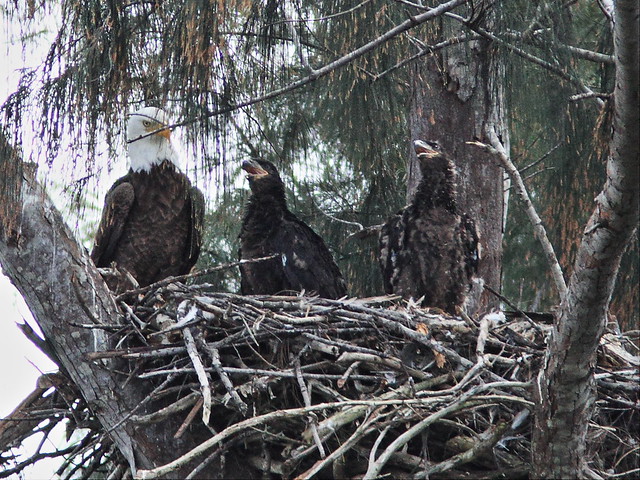
We have watched a Bald Eagle nest over seven breeding seasons. The eagle watchers gave some of them names. This year, Pride and Joy's 12th and 13th eaglets are named Honor and Glory (See them in my Bald Eagle FORUM). Naming them gives people a connection with these majestic birds and has often opened doors to a much greater appreciation of the natural world.

Here is Pride with his eaglets, Honor and Glory when they were about 5 weeks old:

Bald Eagles Pride Honor and Glory 20140220

Is it a good idea to name these wild creatures? School children conducted polls back in 2009 and 2010 to name the broods: twins Hope and Justice, and triplets Lucky, Chance and Courage. 

When eaglets fledge they sometimes disappear for a few days before hunger drives them back to the nest. Since there is a high risk of mortality at the time of first flight, their absence causes great anxiety. "Hope is lost!"  "Waiting for Courage!" These two returned, but two other fledglings (the 9th and 11th) disappeared and ground searches found no sign of them, dead or alive. They were mourned as departed friends (Pride and Joy's Family Album).

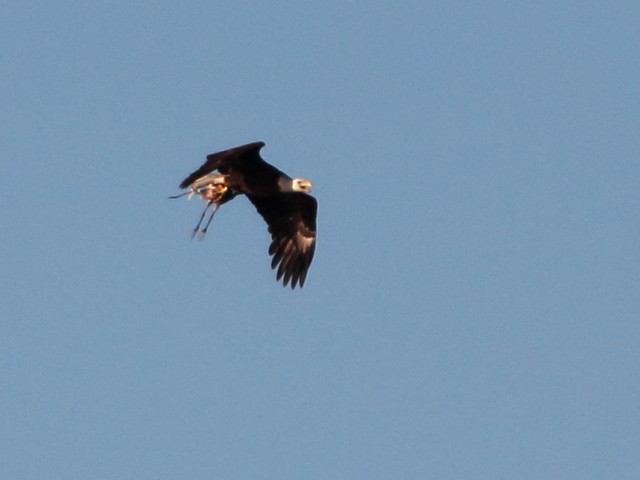
I took this photo of the male eagle (Pride) from about 1/2 mile away as he carried a Tricolored Heron to his two growing eaglets. Did I mourn the loss of this beautiful long-legged wader, a species  that often graces the shores of the lake in our back yard? Truthfully, I was indifferent as it had no name. 

 Bald Eagle with heron prey 20140216

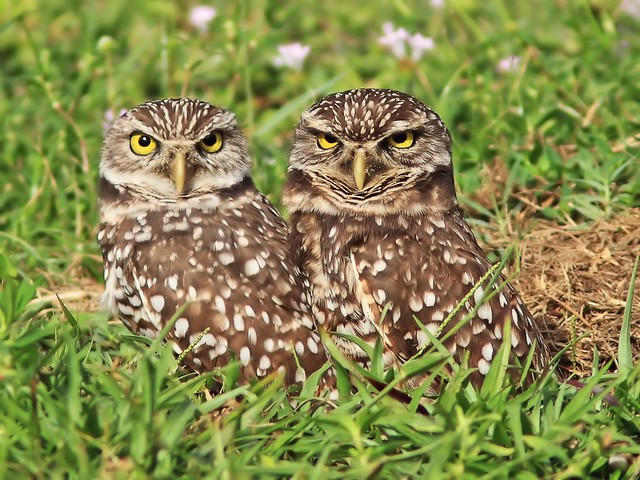
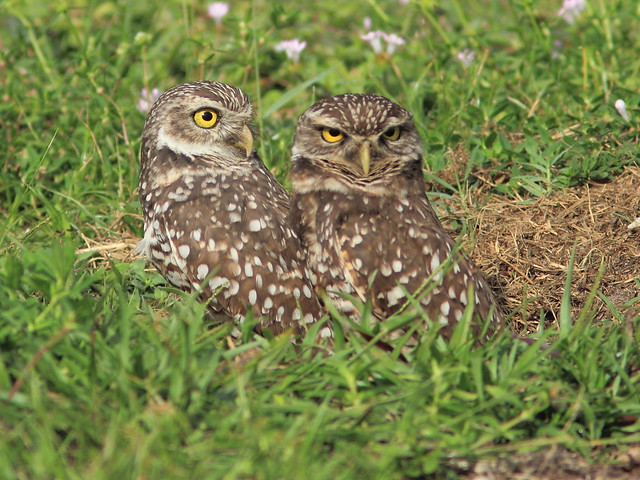
Burrowing Owls nest on 65 school properties in the Broward County School District. They have bred at one of the locations for at least 30 years. A nest camera has monitored their daily activities at one school for the past year. The owls were given names by the students and they avidly followed happenings at the nest. Last November I was asked to photograph the pair to provide images for fund-raising T-shirts and trinkets. 

The pair was very obliging, but rarely did both stare at the camera at the same time. Their faces are distinctive-- the male is on the right.

 Burrowing Owls 04-20131114

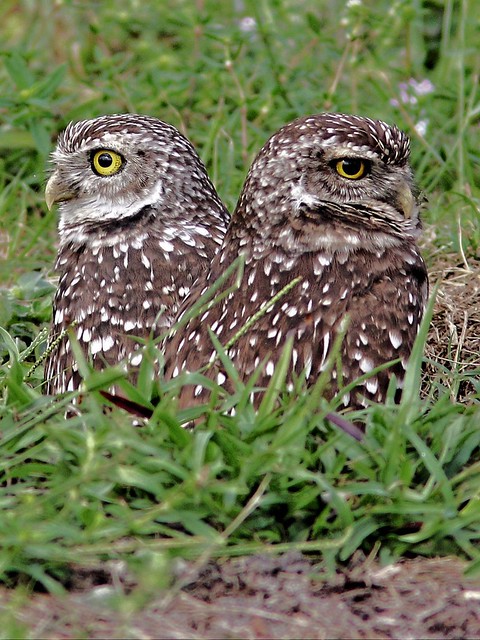
Most of the time they were always looking in different directions, ever alert because predators higher up on the food chain have learned to look there for an easy meal. Over the eons the fittest survive and the weak and unwary are weeded out.

 Burrowing Owls 01ch-20131114

They face the threat of bird hawks by day, and larger owls by night.

Burrowing Owls 03-20131114

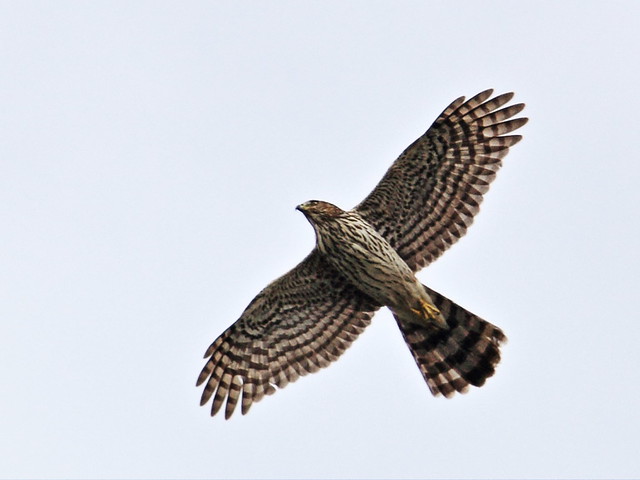
While I was photographing the adults a Cooper's Hawk flew towards them. They immediately saw it coming and dove down into the burrow well before it swooped low over the nest.

Cooper's Hawk 2-20131113

In early January, an immature Cooper's Hawk visited the burrow three times during this 5 minute clip, even reaching down into the cavity in search of the owls.

LINK to video here if the space below is blank


By January there was evidence that the owls had offspring. Heavy rains threatened to flood their burrow, but during February four owlets appeared. They were given names. The first to emerge was an adventurous little owlet named "Peeper."  Perhaps he was too adventuresome. 

Here, the little tyke ventures too far from the nest. Upon seeing a threat, that thankfully never materialized, it dives back into the burrow even before all three of its siblings can get out of the way.

Click here if video does not not appear in the space below


You may skip the next clip if you are disturbed by the raw violence of nature. Why didn't at least one of the dozing babies keep an eye on the sky at all times? The adult Cooper's Hawk is exercising its survival skills just as two of the owlets fail in theirs. There is cunning but no hate. Almost by accident, the hawk grasps two owlets at once, kills both but can carry off only one. Usually these encounters occur out of sight and mind, but the camera captures all. And the owlets had names. 

RIP, Peeper and Owlie.

Link to video here if there is a blank space below


The science teacher at the school wrote:


One of my male students responded after watching the graphic loss of the owlets, "that is so sad". He was obviously in deep thought for a while and then suddenly said, "I know what I will do. I will bring in my favorite piece from my rock collection, obsidian. Will you place it at the burrow as a memorial for the two owlets?" I said yes and he did bring it in. We will let him place it by the perch. This shows some of my students have become attached to the owls and their owlets and will be more likely to show understanding and compassion toward other species as well as an appreciation for nature. Wasn't this one of our owlcam goals from the beginning?

Link to more selected video clips from this nest cam:

Broward County Burrowing Owl Cam You Tube Channel

Sunday, March 2, 2014

Penguins Galore in Antarctica: Part 2


My previous post, Penguins Galore in Antarctica: Part I, covered days 1 - 5 of my marvelous 2006 adventure to Antarctica. Part II will span the remainder of the trip.


~ Day 6 ~

We woke up the next morning to the glorious sight of the Lemaire Channel. On either side was a dramatic scenery of glaciers and snow-capped mountains. Petermann Island was the destination for our morning excursion. This jagged piece of outcropping housed thousands of penguins, most of them downy chicks. The island terrain was both icy and rocky which made for a slippery trek. The snow and ice bore a reddish tint due to a wind-borne algae that grows in Antarctica. We also spied a couple of yellow tents erected on the island. We were told that naturalists were conducting a study of the Imperial Shags that inhabit this island.


A pair of Gentoo Penguins interact on Petermann Island


Two downy Gentoo Penguin chicks huddle close together


An Imperial Shag stretches its wings


Adult Imperial Shags (left) and juvenile shags (right) perch atop a craggy cliff

Imperial Shags, also known as Blue-eyed Shags and Blue-eyed Cormorants, eat mainly fish and invertebrates. These adept divers build their nests consisting of grass and seaweed on top of cliffs, close to the ocean. Shag chicks are born without feathers. The juveniles sport predominately brown plumage.


The view from Petermann Island


Imperial Shags and Gentoo Penguins congregate on Petermann Island ~ Note the red algae tinged ice


~ Day 7 ~


The morning excursion began with a zodiac ride to Half Moon Island. We scaled the craggy rocks to view a Chinstrap Penguin colony and some languorous Fur Seals. The busy penguins spend their days honking, feeding, molting, preening and waddling around the jagged terrain. We gleefully enjoyed the entertaining show displayed by these adorable comical black and white creatures.


An adult Chinstrap Penguin feeds its hungry chick


A lazy Fur Seal scratches an itch


Big yawn ~ Fur Seal


Arctic Terns rest on the jagged terrain

These terns are often seen hovering 30 - 40 feet above the water. Once a fish or crustacean is spotted, they rapidly plunge dive to capture the prey.  They also commonly follow fishing vessels. Arctic Terns are know to have one of the longest migrations. They nest in the Arctic and winter in Antarctica, traveling an annual distance of more than 25,000 miles!


Hump-backed Whale ~ One of many whales seen on our Antarctic adventure


Antarctic Skua ~ Surprisingly, this skua was banded


In preparation for our afternoon zodiac cruise, the captain positioned the ship off of Pleneau Island. Once we were settled in our inflatable boats, we motored towards some magnificently sculpted icebergs in the distance. What a magical place with ice of all shapes, textures and shades of blue. Around every corner were new and spectacular forms. As we floated along, we took note of several large ice floes with Crabeater Seals lolling peacefully atop. We continued our way north in the Gerlache Straight as the scenery shades turned a mellow blue-gray and rose. It was truly an expedition day to remember.


Crabeater Seals relaxing the day away


Massive Iceberg formation against a mountainous backdrop


Spectacular scenery


Magnificent sights


A neon blue Iceberg


The sights we viewed in Antarctica, to put it mildly, were magnificent. We often felt like we were in another world, basking in all of its pristine perfection. Antarctica is a realm whose beauty is so spectacular and otherworldly that it often left us speechless. It is not just the breathtaking scenery that beckons, it is also the incredible display of wildlife: thousands of penguins and numerous other seabirds. There is also an abundance of marine mammals in the region, including most of the world's great whales and a multitude of seal species. Our journey through the "last continent" was an unforgettable once in a lifetime experience that we will never forget.


Gentoo Penguin chick


Post by Julie Gidwitz

Friday, February 28, 2014

Persistence

Mullet Lake Park
Le Conte's Sparrow
Mullet Lake Park
I would call myself an intermediate birder; I came into this hobby through photography and from there developed a love of nature, wildlife and birds.  I used to joke that my birding philosophy was to make up for quality with quantity.  That is, if I get out there enough, I'm bound to find some rare bird eventually. On rare occasions, that's exactly what happens.  On New Years Day this year I drove to a spot I love to go to for sparrows, and a Western Tanager popped up in the tree in front of me--not what I was looking for, and certainly not a common find in Central Florida.

Lake Apopka, Lust Rd.
Western Tanager
Near Lake Apopka, FL
But a couple years ago I began to appreciate the fact that finding rarities is not really just about looking into the trees long enough for a rare bird to pop into view.  I began to realize that I needed to study. I picked up a book called Priceless Florida: Natural Ecosystems and Native Species by Ellie Whitney Bruce Means and Anne Rudloe. I wanted to learn how to recognize Florida's habitats, so that I would know better where to go to find birds that live in those habitats.  And then my father gave me a wonderful book called Essential Field Guide Companion: A Comprehensive Resource for Identifying North American Birds by Pete Dunne.  There were certain birds I wanted to find, and this book, in addition to helpful tips to identifying birds, gave me clues for where to look to find them--look here during breeding season, and look here in the winter.  Dunne's book also identifies other birds that are commonly found alongside the species you're looking for.

Spring Hammock Preserve
Prothonotary Warbler
Found using clues from Pete Dunne's Book
I honestly can't say that this study paid off right away, but whenever I chased birds other people found, I also tried to make mental notes of the kinds of habitats they had looked in in order to find these birds.  And when I saw similar places nearer my home, I began to make a point to check there for rarities. Last year, I visited a place called La Chua Trail in Paynes Prairie near Gainsville, FL. It's an area in Florida known for fun sparrows. Even on a windy morning, that trip was a great learning experience, with the highlights being my first Field Sparrow in Florida and my first photos of White-crowned Sparrows.

Photo & Video Sharing by SmugMug
White-crowned Sparrow
La Chua Trail
Late last year, someone reported a Lincoln's Sparrow in neighboring Volusia County, and three of us went to chase it.  The person reporting the Lincoln's Sparrow also noted that the area also looked good for Henslow's Sparrows.  The three of us arrived and saw the Lincoln's Sparrow right where it had been reported, but after it dipped out of view we began looking for where it might have gone.  But then my friend noticed a green-looking sparrow hidden in the grasses.  Eventually we all had the chance to see it--my lifer Henslow's Sparrow.  I was impressed not only with my friend's ability to find the bird, but also with the birder who had reported the Lincoln's Sparrow and knew this would be a good spot to look for Henslow's to begin with.

Tiger Bay Forest WMA
Henslow's Sparrow
Tiger Bay WMA
So this year one of my goals is to look for the "nooks and crannies" in my home county that receive little attention from birders but which might hold species that I haven't yet seen in my home county. I stumbled upon a little park near the northern boundary of Seminole Co. called Mullet Lake Park. I had looked at satellite views of the park and thought it might be a good place to look for shorebirds since it was right on the shore of the St. John's River. But when I arrived, I found an area there that reminded me a bit of the La Chua trail.  Sora, King and Virginia Rails were calling and wading birds were plentiful, but I only found two species of Sparrows: Savannah and Swamp (two of the most common wintering sparrows in FL). But I also found about 16 Sedge Wrens, and Pete Dunne's book told me that Le Conte's Sparrows can be found along side Sedge Wrens. So I visited this place no less than 5 times, each time searching through Le Conte's Sparrow habitat where I'd seen Sedge Wrens.  On February 14, jackpot! One popped up and showed itself to me--what a thrill!

Mullet Lake Park
Le Conte's Sparrow
Mullet Lake Park
So I'm changing my motto a little bit. Rather than making up for quality with quantity, I'm making up for quality with study and persistence.  My hope is that the more I can study resources and discover the habitats that exist in my home county, and visit them often enough, a couple more little treasures might reveal themselves.

Monday, February 24, 2014

The Great Backyard Bird Count


February 24,2014 Birding is Fun


Great Backyard Bird Count


The Great Backyard Bird Count took place from Feb 14-17. I have been participating in this count for years now.  It is easy to take a few minutes and count the birds you see in your yard, favorite park or preserve. It is a joint project sponsored by the Audubon Society and Cornell Lab of Ornithology. The GBBC has also gone global for info on how to get started click here: http://gbbc.birdcount.org/


Above are some of the birds I counted for my Great Backyard Bird Count. Top row is a Hairy Woodpecker with a Cardinal, two Goldfinches with a Mourning Dove and a female Cardinal. Middle row is a male Cardinal, male Redbellied Woodpecker and a White-Throated Sparrow. Bottom row is a White-breasted Nuthatch, American Robin and a male Downy Woodpecker.


When hubby and I moved from a crowded suburb to our more rural home, I started noticing the beautiful birds around our yard.  Some of the first birds to attract my attention were the beautiful bright Yellow Goldfinches and the Eastern Bluebirds. These pretty birds were not noticeable while living in the city or the suburbs.


It was in my rural backyard I really started paying attention to the birds coming and going. I starting feeding the birds, I bought the heated birdbath and we started planting to attract the birds and wildlife.


Now, I can sit back and just look out my windows to count my yardbirds for the GBBC.


 It may be too late to participate in this year’s GBBC but next year you can keep this in mind and become involved in this Citizen Project and join in on the count.

I hope you enjoyed my backyard birds..Have a great day and happy birding.

EileeninMD
my blog: Viewing nature with Eileen

Thursday, February 13, 2014

Long-tailed Ducks and More

With a few days to kill, I was hoping for something interesting to come along and give me an excuse to break this cabin fever. It's been a brutal winter here in Michigan. Snow accumulation is making it difficult to get our car to good spots and the cold has been more bone-chilling than I enjoy on a birding trip. Still, I knew I'd be glad to be out if I could just find the motivation to make that first step.

"...observed a Barrow's Goldeneye in the Muskegon Channel...2:45pm..."

Wish granted. That came over the listserv Sunday afternoon from Michael Boston, and he had pics too. Good enough for me. Sarah and I bundled up and headed out the next morning. Muskegon is typically a great birding spot in the winter. The breakwall at Pere Marquette Park offers good views of loons, grebes, all the scoters, other diving ducks, and often a Purple Sandpiper or three. On lucky days a few Long-tailed Ducks might be in the sheltered harbor offering close views from the breakwall.

Greater Scaup are a winter staple of Lake Michigan (photo by Sarah Adams)

But this winter, that entire area is ice for miles out into Lake Michigan. There is very little open water at any of the of harbors on the lake's east shore, so I was surprised to see a picture of a Barrow's Goldeneye along with some Long-tailed Ducks and a scoter or two. Since the Barrow's would be a lifer for both of us, so off we went, looking forward to seeing our first-of-year Long-taileds even if we missed the goldeneye.

Female Long-tailed Duck (photo by Sarah Adams)
We parked and noticed the only open water was the narrow channel from Muskegon Lake (a harbor, essentially) out to Lake Michigan. We also noticed thousands of ducks. My conservative estimates put the list at 2000 Greater/Lesser Scaup (vast majority were Greater), 800 Long-Tailed Ducks, 500 Common Goldeneyes, 50 Red-breasted Mergansers a couple dozen White-winged Scoters, a few Redheads, and two Mallards. (I actually counted the Mallards, that number is not an estimate.) All of these birds were in a channel maybe 60m across and less than a kilometer long.
Common Goldeneyes
The most important Common Goldeneyes have Long-tailed Ducks as wingmen (photo by Sarah Adams)

That was the only open water for miles around, so no one was going anywhere. It was also full of fish and, to the delight of the scoters, zebra mussels. Watching the scoters crunching down on a cluster of mussels with their intimidating bills was incredible.
White-winged Scoters (and Long-tailed Duck) (photo by Sarah Adams)

It was also incredible (and I mean that in a bad way this time) trying to spot a Barrow's Goldeneye among the assembled horde of Common Goldeneyes. Some other birds joined us and we all eventually got on the Barrow's, though when he dove and resurfaced in a random floatilla of commons, it took a long time to get back on him again. It was a birding version of that old game whack-a-mole trying to anticipate where he was going to reappear.
Sasquatch! But this isn't is a guy in a bigfoot suit, it's really a Barrow's Goldenye...just far away in horrible light.
Long-tailed Duck (photo by Sarah Adams)
Red-breasted Merganser (photo by Sarah Adams)
Red-breasted Merganser female (photo by Sarah Adams)
This is not a typical sight 10 yards from shore.
Long-tailed Duck - an exquisite beast from any angle (photo by Sarah Adams)
It ended up being a great day of duck-watching. The only thing that could have slightly spoiled it would be getting home and hearing the next day that a King Eider had been found in the channel. I'm glad that didn't happen! Oh, wait...it did.

Phone-scoped King Eider ...yes, we went back to get it!

This White-winged Scoter laughed at us. (Photo by Sarah Adams)
Red-throated Loon was a bonus when we returned for the eider.

For more  Muskegon and Valentine's Day fun, check out my blog post from a couple years ago.

You may notice most of these photos are from my wife who is a better birder, better photographer, and MUCH better looking than I am. Check out her Flickr page.