Monday, December 3, 2012

Pelicans and spoonbills

On Saturday morning, November 24 we departed Chicago Midway Airport where the temperature was 20 degrees (F), and at noon we were treated to a balmy 74 degrees at Fort Lauderdale Airport. Put away the fleece and back into T-shirts and shorts! Now is when I love living in Florida!

South Florida enjoys two seasons: Hot and wet from June through September, and mild and dry from October through May. We had departed for our second home in Illinois in late October, after a period of abnormally abundant precipitation. Our lake was filled to brimming. Birding had been slow in our local birding patch next to our subdivision because because fish and other aquatic prey were diluted in the high water, dispersing the long-legged waders throughout the Everglades. Hurricane Sandy brushed by just after we departed Florida, delivering high winds and beach erosion but little moisture. After that, temperatures moderated and rainfall was scant.

Our lake has receded about two feet since our trip north, and now its margin no longer reaches up to cover part of our back lawn.

Our back yard 20121126

We slept with open windows, and early the next morning wasted no time getting back out on the gravel road that extends a mile from the entrance of our subdivision into the water conservation area. As usual, we started out walking briskly, Mary Lou in the lead, while I lugged my binoculars and camera gear a few paces behind her. She pointed out a nice Northern Cardinal along the path. Of course I stopped to take his picture, then struggled to keep up, feeling like a toy poodle on a jogger's leash.

Northern Cardinal 20121125

Ahead, we beheld an unusual and welcome sight as we approached the Harbour Lakes mitigation impoundment (a fancy name for land set aside by the developer to compensate, rather symbolically, for the damage caused by draining and filling the historic Everglades to build our homes). The white forms of  scores of ibises, egrets and (Holy Cow!) American White Pelicans circled over the lake.

White Pelicans in flight 2-20121125

Since moving here in 2004, despite our nearly daily walks, we had never encountered pelicans on our birding patch.

The pelicans fed cooperatively, driving a school of fish in front of them as they advanced in a line. Lower lake levels had concentrated their prey into a nutritious "soup."

Pelicans feeding cooperatively 20121125

I counted 23 pelicans. They approached closely, following the frightened fish up to the shoreline.

White Pelicans 20121125

This brief film clip demonstrates the pelicans' cooperative fishing technique (I didn't realize that I still have a New Jersey accent after being away 50 years!)


(Trouble viewing? Go to VIMEO at this link)

Masters of flight, some of the pelicans wheeled overhead.

White Pelican HDR 20121127

Wood Storks joined them.

Wood Stork in flight 20121125

By now I had fallen far behind Mary Lou. I barely heard her shout: "Spoonbills!" Yes! Three Roseate Spoonbills dabbled with the storks, ibises and egrets, up close and personal. (Two days later on November 27, a fourth spoonbill was present).

Roseate Spoonbill 4-20121125

Stork with spoonbills 20121125

Roseate Spoonbills 2-20121125

This video clip shows the spoonbills' feeding technique.


(Trouble viewing? Go to VIMEO at this link)

A Great Egret flew in to join an immature Great Blue Heron (note its darker plumage and black cap) that was feeding with the spoonbills and pelicans.
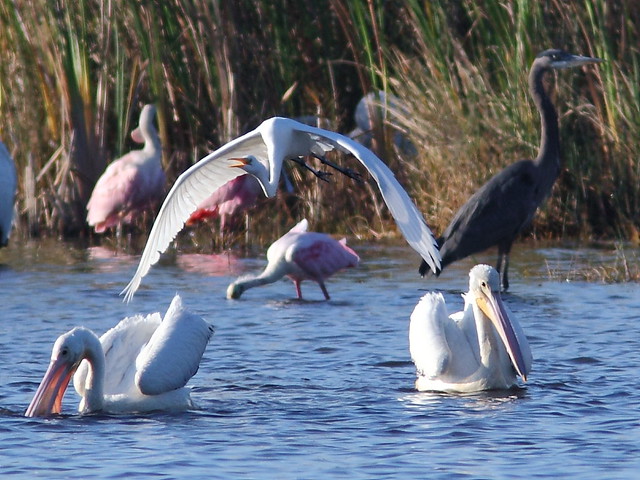
Great Egret with Imm Great Blue and pelicans 20121125

Like storks, spoonbills are tactile feeders-- they sweep their specialized bills and clamp down when they detect their prey, which consist mostly of fishes and other aquatic animals. The water is just the right depth to keep their eyes from being submerged. This immature Little Blue Heron is a sight feeder. It adapts the typical posture of its species while stalking for fishes, the tip of its bill just above the surface of the water.

Little Blue Heron and spoonbill 20121125

The waders included several adult Little Blue Herons...

Little Blue Heron 20121125

...and Snowy Egrets.

Snowy Egret 20121125

In this interesting shot, both a spoonbill and a pelican are demonstrating how they use their bills as strainers.

Pelican and spoonbill feeding 20121125

A Bald Eagle flew over and at least a hundred egrets, herons, ibises and spoonbills took flight. The pelicans seemed not to be disturbed by the predator.

White Ibises 20121125

Roseate Spoonbill in flight 20121125

Three drab Double-crested Cormorants watched a colorful spoonbill fly by. I call this photo "feather envy."

Feather envy 20121125

We logged 45 bird species, among them a Caspian Tern...

Caspian Tern 20121125

...a lone Mottled Duck...

Mottled Duck 20121126

...a belted Kingfisher...

Belted Kingfisher 2-20121126

...and four distant Red-breasted Mergansers.

Distant Red-breasted Merganser 2-20121127

On our second walk, clouds gathered over the impoundment. Note the grove of exotic Melaleuca trees to the right. They were treated with herbicide a couple of months ago. Two years ago, a pair of Ospreys nested  there. Soon they will be cleared to make way for the highway extension that will also result in the paving of our beloved gravel road. Progress!

Harbour Lake impoundment HDR 20121127

Our walk was cut short by a rain storm that came up suddenly. This is the view in front of me as we hurried home. The shower lasted only a few minutes.

 Miramar Parkway HDR 20121127

Sunday, December 2, 2012

Birds of the Sarasota Area

Spending the Thanksgiving holiday with family on the west coast of Florida is always a joy. While on vacation, I try to venture out at least once a day to observe various wildlife and sea life. Many beautiful birds can be spotted where we reside on Longboat Key, as well as in the city of Sarasota and its surrounding suburbs. When visiting on Longboat Key, two of my favorite areas to view birds are Quick Point Nature Preserve and Joan M. Durante Park. The beaches along the key and Sarasota Bay are rich with avian life, as well. When traveling off the island, Celery Fields and Myakka River State Park are glorious destinations to see a variety of birds.

This year's vacation highlights include viewing five new birds to add to my life list. A few that I listed were two Northern Harriers, a Limpkin, and thanks to my very observant, handsome husband, a Northern Gannet. While at Celery Fields, we were treated to observe a pond filled to the brim with hundreds of various herons, egrets, ibises and Wood Storks plucking fish continually from the shallows.  Bruce and I stood, mouths agape while the birds casually waded in the dark water. A Bald Eagle, two Ospreys and five White Pelicans soared effortlessly aloft. I was giddy with delight when we took in the beauty of at least forty Roseate Spoonbills seen across the lake from the bird walk at Myakka River State Park. We also enjoyed watching several furtive American Alligators and mud wallowing Wild Hogs. One of our favorite experiences was coming across three feeding Manta Ray pups gliding swiftly back and forth, mouths agape, wings rippling at the surface and only inches from our toes. These seemingly carefree, acrobatic rays were seen while taking a leisurely stroll on the beach. We even saw one of the pups break the surface and soar through the air!

Back to the birds! This post features several lovely birds seen while vacationing in Florida.


A magnificent Osprey looks out over Sarasota Bay


Pretty in pink ~ A young Roseate Spoonbill sweeps it bill back and forth through the water searching for prey


Northern Mockingbirds are quite a common sight


A lone Short-billed Dowitcher soaks in the late afternoon sun


A sun-kissed Black-bellied Plover escapes the gentle waves of the Gulf of Mexico


Foraging for food in the shallow waters of Sarasota Bay ~ Snowy Egret


In search of sustenance, a Wood Stork wades amid water hyacinth 


A lovely Tricolored Heron blends in well at Celery Fields


A handsome Sandhill Crane pair seen at Myakka River State Park


One of at least twenty stunning Little Blue Herons observed at Celery Fields


A striking Yellow-crowned Night Heron spends the morning fishing in cool bay waters


An elegant Great Blue Heron plucks a fish out of the water


A tiny Sanderling chases the ebbing waves in search of mollusks, sand crabs and other crustaceans


Posted by Julie A. Gidwitz

Saturday, December 1, 2012

Christmas Bird Counts for Kids!


Fellow Idaho birder Danette Henderson emailed me a flyer designed by her daughter Iris for the first Boise area Christmas Bird Count for Kids. I had never heard of a CBC for kids and I love the idea. A subsequent internet search revealed that several groups have organized CBC's for kids over the last few years. I encourage interested birders everywhere to organize and carry out a CBC for Kids. It's all about sharing the passion for birds and birding with the next generation.

Here are some tips:

  • Be flexible with the time frame. A CBC for Kids doesn't have to be from dawn to dusk. Kids, especially young children may not be prepared for long exposure to cold conditions nor have the physical/mental/emotional ability to spend more than a hour or two in the field looking for birds. Older kids, especially teens probably can outlast the most seasoned birders in the field. Adjust to the needs and abilities of the group. You may want to decide which age groups you want to focus on, or have two different report back to headquarters times.
  • Spread the Word - share your event on the local birding listserv. Add the event to local community event calendars. See if you can get it into the newspaper or even getting a local TV station to announce and cover it.
  • Equip the kids - round up equipment and/or volunteers so that kids can have quality viewing experiences with decent optics. I appreciate that donations have been given of binoculars by birding groups, but too often they are cheap binoculars that are so poor that they hurt the experience. To engage kids in birding, they need to see the vivid colors and details. Provide a mentor, a map and a checklist. Just as for regular CBC's, a well planned coverage area and even suggestions for the route will help the adult drivers. An experienced and enthusiastic birding mentor will make the CBC experience all the more impactful. Also see that safety instructions are given to all participants.
  • Hold a Group Debrief Session - once all the groups are back together, go through the checklist and tallies together. This is exciting stuff! They will see the miracle of team work and synergy as the species totals grow and grow.
  • Treats are always good! - Some hot cocoa and a doughnut or even healthy snacks that aren't too boring are always something kids look forward to and enjoy.

Review: National Geographic Birds App

I am delighted to review the newest birding field guide app available, National Geographic Birds: Field Guide to North America. Many of us really like the 6th edition of National Geographic's paper copy field guide. Now we get those same great illustrations and descriptions we have come to know and love plus additional cool features only available in digital formats.

NatGeo Birds is the first birding app I've seen that incorporates video. This is a very exciting development that I have been hoping for for some time. Granted, there are clips of only 18 species, but the video is of very high quality. These brief videos give birders a "real life" glimpse of the appearance, sounds, and behavior of birds. I expect that NatGeo plans to add more videos to this app over time with the goal being to have video for every species. Unfortunately, the videos are currently buried under the "Tool Kit" in the main menu and are not connected to the individuals profiles of the species. That is something I would hope will be corrected in future updates.

Birds Sounds (calls, song, etc)
List of Similar Species
Quick search by typing in name
Submit sightings to eBird
Compare two species on same screen
Photographs
Taxonomic List
I.D. help by entering characteristics
Maintain Sightings Lists in App
Range Maps
The "News" feature is also pretty cool concept and I hope that it will be used regularly and not just become a "dead" button within the app. The "Quizzes" are fun and test users by both sight and sounds, along with other trivia type facts.

NatGeo Birds includes seven of the top ten birding app features that birders find most important as per the survey results. (see table on right)

This app does contain a filtered search tool intended to help people identify birds based on characteristics. I have found that searching for a bird species with "filters" is so tough that it is almost useless, more especially for beginners. Here's why: If a user suggests one field mark different than what the app developer has determined, the correct bird may not show up on the filtered list. Search filters need to be probability based, not filter based. Cornell Lab of Ornithology is doing just that with the Merlin program. I've been suggesting for a couple of years now that bird identification search tools should be built similar to the Q20 electronic game (Twenty Questions), and Cornell suggested precisely the same thing in a recent presentation.

In my opinion there is an over emphasis on personal record keeping in this app and many others. As an eBirder, I just want to record my sightings one time and have it go to eBird where my personal records are superbly maintained and organized and my sightings contribute to science. Now, if I were not an eBirder, and was one of the old-school birders who simply kept track of my life birds by writing in the margins of my field guide, than the personal recording keeping functionality of the app would be of very high importance to me. I hope that all birding apps will team up with eBird and find ways for their uses to submit sightings directly to eBird...it is wonderful and important that they all go that direction!

Though I have my personal preferences about birding apps and have made some suggestions for improvement above, I find National Geographic Birds to be an excellent birding field guide app and strongly recommend it to North American birders. The beauty of apps is that you can have several of them with you in the field to compare and study from rather than lugging a ton of heavy books.