Tuesday, February 5, 2013

Canon SX 50 HS for Bird Photography


Warning! Reading this blog post could cost you money. I just got the new Canon SX 50 HS point and shoot super-zoom camera and I love it. It's in my right hand, my Canon 1D Mark IV with the 300mm lens and 1.4 teleconverter is in my left hand. The SX 50 HS has a 12.1 megapixel back-illuminated CMOS sensor, DIGIC 5 image processor, image stabilization, ISO 80-6400. The focal length when optical and digital zoom are combined is as follows (35 mm equivalent) 24-4800 mm (24-1200mm with optical zoom alone.) It can shoot RAW. Here are some of the reasons why I love the SX 50 HS.

It shoots birds in flight fairly easily in Sports Mode, as I found out when I tried it out on Brown Pelicans and got this photo.

I tired it today on fast moving warblers, always a challenge, and got this Palm Warbler photo.

Recently I took the Canon SX 50 for a test spin to Harn's Marsh in FL. See the ducks in the pond near the far shore?

Here are the ducks zoomed in a little closer, they look like black spots.

Now here are the Ring-necked Ducks photographed with the lens zoomed all the way in, past the optical zoom range, into digital zoom of 200x. Camera was set on Smart Auto photo is untouched.

There were a number of other birds that were just too far away for my other DSLR cameras, such as this Limpkin in the far cattails.

The Limpkin was preening then stretched. 

This Black-crowned Night-Heron was way out of the reach of my usual cameras. There is something immensely fun and powerful in being able to zoom in on very distant birds and get a photo.

The camera has great abililty just set on Smart Auto and people should have little problem photographing close, or relative close, birds in decent light. The harder part is hand holding the camera still when you are zoomed all the way, or a good part of the way, in on a bird. Many people may not want to or be able to do this, but that is where the fun is for me.  Here is my tip for steadying the camera while hand holding and shooting with the lens zoomed in closer on the bird. To steady the camera look through the viewfinder with the camera braced against your head. Do not shoot while looking through the back screen. Hold the barrel of the lens with your hand all the way out on the barrel and tuck your elbows against your body, making a tripod of your body. Try to hold as still as possible. Depress the shutter half way to focus on the bird, then take the photo quickly. If you then lose the bird in the viewfinder,  zoom back out to give you just a wide enough field of view to find the bird again, zoom in, then get the bird in focus and take another photo. You can also use the uppermost button on the left had side of the camera near the base of the lens for Framing Assist-Seek. Hold this button down and the camera zooms out, allowing you find and reacquire the subject. Take multiple photos, some shots will be sharper than others.

Another place we went recently was the Bailey Tract on Sanibel. See the Wilson's Snipe on the far shore?

Here it is with the camera zoomed in to 200x.

The Mottled Duck was closer than the snipe, see the dot in front of the island? I am standing on the bank taking the photo with the camera on 24mm.

Here is the Mottled Duck taken with camera on Smart Auto and the photo only slightly sharpened in photoshop.

There were Gulf Fritillary butterflies at my feet and it was so cool to be be able to take their photo as well as the distant birds.

The view from my back deck in my FL home. See the eagle?

Oh, here it is with the camera zoomed in... 

Here it is zoomed even closer. 

Note, with many of these photos I have pushed the camera to its limit at 200x. I have steady hands so for me, it's fun to do this. For other people who are not as steady, one could use the camera on a tripod, or only photograph birds keeping within the optical range of 24-1200 mm. There is also Digital Zoom which lets you apply up to 1.5 or 2x worth of digital zoom beyond the optical zoom with a minimum drop in image quality, sort of like applying a 1.5 or 2x teleconverter. Access this feature on the regular camera menu. Scroll down to where it says Digital Zoom and your choices are to set it at Off, 1.5x, 2.0x or Standard. Standard lets you zoom all the way in 200x.
At these extreme zoom ranges, such as 200x, the photo quality is not usable for many things such as fine prints. However, for use on blogs, a facebook page, etc., and the internet, which only require photos of 72 dpi, these photos may be usable. Most of these photos I took had minimal processing just a little sharpening in photoshop. Images shot closer, at lower ISO and within the optical range would be much better. I mainly wanted to show some of the extreme things this camera is capable of.

Don't get me wrong. I am not about to give up my professional equipment. I adore my Canon 1D Mark IV (shown here) and I have gotten incredible photos with it, many used on our national field guide, The Stokes Field Guide to the Birds of North America and our soon to be published, The New Stokes Field Guide to Birds: Eastern and Western Region. I use the Mark IVwith a Canon 300mm IS lens and 1.4 teleconverter, or my Canon 500mm IS lens with 1.4 teleconverter, Gitzo 1325 Carbon Fiber Tripod and Whimberley head. The Canon SX 50 is not in the same league with the big, professional, or near professional DSLR equipment. Then again, it costs around $430 vs. the Mark IV originally cost around $5,000 (now it is discontinued, can be bought used for less. Many are buying the new Canon EOS-1Dx at a cost of about $6,799.)

At Harn's Marsh I had my Mark IV with the 300mm lens with 1.4x and in seconds got this Northern Harrier shot. I could not have gotten this with the SX 50.


There is nothing like the thrill and adreneline rush of capturing something like this eagle landing with my 500mm lens and the high speed shooting ability of the Mark IV. You photographers with similar equipment who are reading this know what I mean.  

However, the Canon SX 50 HS is an astounding camera in many ways. It can make decent bird photographs within the reach of even a novice bird photographer just by shooting on Smart Auto, then Sports Mode for birds in flight. In the hands of more experienced photographers it can provide great fun and the ability to capture good bird photos, even when birds are impossibly far away. It will make getting record shots of birds more possible because the reach of the camera is so great. It may convert many to bird photographers/birders and give them a love for and appreciation of birds. That would be a good thing.

It is interesting to me that just about every birder, experienced bird photographer, or novice birder/photographer I have showed this camera to in the last week has said they want one. The light weight of the camera and ability to zoom in so close on a bird just blows people away.

There is so much more to say about this camera which does so many things, including video. I still have a lot to learn about it. Make sure and read the complete reviews here at,

and

Here are a few more thoughts and tips.

- Compared to the Canon SX 40 HS, which I also own, the Canon SX 50 is way better. It has a larger, sharper LCD, faster AF and continuous shooting speeds, and more available scenes in Smart Auto mode. Canon claims it has reduced focus times by 50% and shutter lag by 44%. It shoots 13.0 frames per second in High Speed Burst mode (which has limitations.) The weight is 1.31 lb.

- For more control over photos, many people will want to shoot in Aperture Priority.You choose the aperture and the camera picks the shutter speed. The range is F3.4-F8. I often use this mode and set ISO and exposure compensation as needed.

- Other people may want to shoot in Program Mode, where there is automatic shooting, but with access to all menu options. A Program Shift feature can be activated by halfway-pressing the shutter button and then pressing "up" on the back dial (four-way controller). After that you can use the dial. to scroll through various shutter speed/aperture combinations.

- You must read the manual, which you download to your computer as a PDF. Read it multiple times and learn all the dials and how to set the camera functions.

Practice and most of all, have fun!!! If you have this camera and want to share some tips, let me know.

More photos taken with this camera can be seen on my blog,
Stokes Birding Blog

Also, Don and I will be at The Biggest Week in American Birding, the 10 day birding festival featuring the best warbler watching experience ever, on May 10th giving a keynote address on "Birding and Photography: The Best of Both Worlds." That morning we will be leading a bird walk along with Kenn and Kimberly Kaufman and the staff from Birds and Blooms Magazine that will help raise funds for local conservation work. Other BIF contributers Drew Lanham, Linda Rockwell, and Rob Ripma will also be speaking or leading field trips. Hope to see many of you there!! It will be lots of fun.

Happy Birding!
Lillian Stokes

Monday, February 4, 2013

Rainforest Awakenings

Kiskadee Love!
Greetings all!  I'm very excited to join the Birding Is Fun! team.  Today's post takes place in the beautiful country of Panama. Over the course of this year, I'll be taking you to some very special places around Panama, Guatemala, Mexico and Belize and introduce you to some wonderful places to bird. We begin our journey today in the very tropical and humid Panama City.  
City views from Parque Natural Metropolitano
For many years, I've done a lot of travel around the world studying Spanish, Portuguese, and culture. This trip to Panama would be a game changer for me as it would unlock a passion for birding.  At first, it wasn't obvious because I loved photography so much.  I thought it was fun to snap pics of colorful birds and catch them in flight.  But to get great shots, one has to be quiet and observe.....and predict movement.
As I began to do this, I became more and more curious.  What were their names?  Why did they fly a certain way?  What did the sounds mean? During many incredible hikes, I encountered people known as "birders".  They were intelligent, quiet, kind, and positive people who were out to see the birds. I spoke with a lady who was very enthusiastic about the park. In fact, the whole reason I began speaking with her was because I had a bird question, "What's that weird blue bird over there with the mask?" A Blue-crowned Motmot.  And saying the word Motmot was.....alien. "Motmot", I repeated slowly as if I were in 1st grade again learning new vocabulary.
Enjoy the birds at Punta Culebra
It was a hot, humid and sticky walk through the Metropolitano park.  I recommend everyone bring a hydration backpack(or camelbak) for this trip because a person dehydrates quickly in a tropical climate.  My body was not used to the humidity at all and I remember sweating nonstop.  So make sure you have water on these treks!  This is especially true for Panama's summer months.(June, July, August).
Brown Pelicans with some Cormorants mixed into the bunch on the Amador Causeway
Panama is home to a great many birds all year round.  With a varied landscape in a relatively small area, a birder can do well with their life lists in this country. I just wasn't all into the birding at the time.  I thought birds were beautiful but I still didn't "get it".  And I certainly didn't want to be labelled a "birder". Weren't "birders" strange people?  Yet, in Panama, everyone seemed to be okay with birding.  A lot of people knew so much about it.  In fact, many people go to Panama just to bird.  While Spanish is helpful, I found that most people spoke English perfectly.  Another benefit(for US citizens) is that you don't have to exchange money because they use the American dollar.
Keep a look out for the many hummingbirds in the area!
Like all places, one must be careful where they bird.  I always went during the early part of the day and kept an eye open for potential issues.  Luckily, I had a great time birding. Like I mentioned before, birding wasn't overnight, but it got me thinking about exploring my own state of Arizona.  And it wasn't until I met another birder who liked to EBIRD and journal that I became hooked.  The secret forest paths.  The secret birds.  The secret competitions between birders and photographers.  I discovered birding is fun!
Of course, I like all the critters that come my way but birds are the primary target.  We'll be visiting Coiba island, Gamboa and Bastimentos National  Park in the Bocas Del Toro region down the road.  If you are in Panama City for a day or two, there is a lot to do.  And while it might be a little too urban for some, it does offer wonderful parks covered in rain forest. Check out Parque Natural Metropolitano for some great views of the city from a lush rain forest full of monkeys, birds, and other critters. Tired of the heat and humidity?  Take a walk on the breezy Amador Causeway and head towards the last remaining areas of dry rain forest at the Smithsonian Tropical Research Institute at Punta Culebra.  While on the road, you can have a tradional Panamanian meal(try their Sancocho soup!) and watch ocean birds fly all around you. And like any place, you can always bird right outside your hotel room:)
For now I'll leave you with a taste of what's to come.  Here's a video full of birds from our different trips around Panama.  Our next stop will be Gamboa and the infamous Pipeline Road. For more fun, check out Las Aventuras.  Birding Is Fun!

Sunday, February 3, 2013

Unfortunate Whooping Crane takes trip to Disney World

The Whooping Crane Eastern Partnership (WCEP), of which the International Crane Foundation (ICF) is a founding member, presently operates two projects to restore a migratory Whooping Crane population in the eastern USA.  

The Ultralight-led Migration Project that began in 2001 utilizes eggs from captive breeding centers that are hatched at the Patuxent Wildlife Research Center in Maryland. The young cranes are later transferred to Wisconsin and trained to follow ultralight craft. After making their first migration to St. Marks National Wildlife Refuge on Florida's west coast, they find their way back to Wisconsin alone and continue to migrate back and forth unassisted. 

A second method, called the Direct Autumn Release (DAR), was started in 2005. These cranes are raised by the ICF using attendants dressed in crane costumes. Kept from human contact, they are housed with adult Whooping Cranes to assure that they imprint properly. Before fledging, they are transferred to Wisconsin and finally to the release point at Horicon National Wildlife Refuge. They learn to fly south by following the older cranes. Radio and satellite telemetry allow them to be tracked by ICF and US Fish & Wildlife Service 

As time for fall migration approached, eleven juvenile cranes in the 2012 cohort of captive-raised Whooping Cranes were released to the wild. Five followed an ultralight craft. The other six were part of the DAR program and were permitted to find their way south without assistance. Among them was a female Crane Number 13  who was given the name of Tussock.

The five juveniles led by the ultralight arrived at the St. Marks National Wildlife Refuge in Wakulla County, Florida, on 23 November.


The six free-flying DAR cranes, numbered 12 through 17, are identified by the arrangement of colored bands and transmitters on their left and right legs respectively. Five of the six, including Tussock, migrated south in record time. According to WCEP, they departed from the Horicon National Wildlife Refuge in Wisconsin on 31 October. Satellite information indicated roost locations in Lawrence County, Indiana, on 31 October, then in Chester County, South Carolina, on 2 and 3 November where all five were also visually confirmed. Next they were located at Cape Romain National Wildlife Refuge, Charleston County, South Carolina, on 4 November, and in Glynn County, Georgia on 5 November.


Remarkably, they had flown about 1200 miles unassisted, from Wisconsin to Clay County, Florida in only six days, arriving by 6 November. They moved to Manatee County, Florida, on 7 November and into Everglades National Park, Monroe County, Florida, on 8 November and back northward into Hendry County, Florida, on 9 November.

Crane #13 had been fitted with both a satellite transmitter and a second short-range transmitter. She and a juvenile male #15 named Cypress seemed more adventurous and satellites then tracked their flight another 70 miles southeast  to the birding patch adjacent to our home in Broward County in South Florida, where they arrived around 22 December, 2012. 


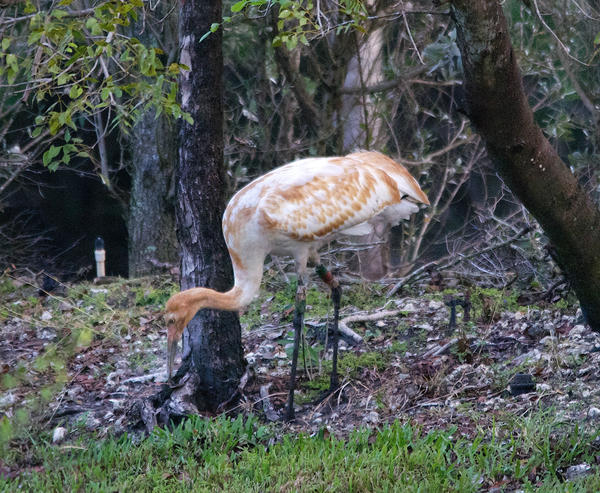
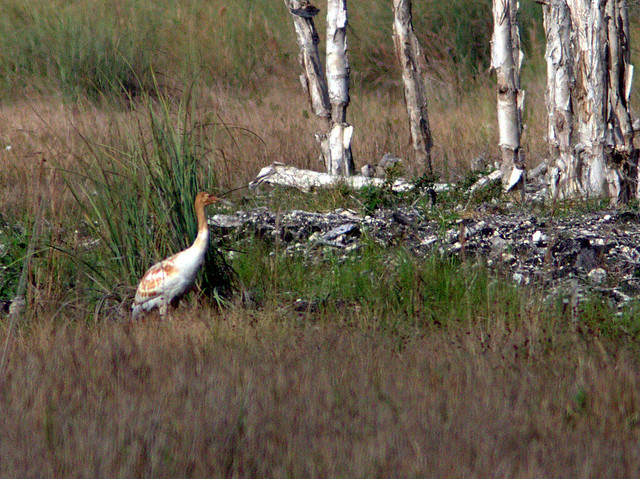
We learned all the above details only after our fateful encounter, which began on Saturday, January 5, 2013. My friend and neighbor Scott, who regularly walks in our local South Florida birding patch, Tweeted me with a photo of a white crane taken by his daughter, at the northern end of the patch. I was surprised to see that it was a juvenile Whooping Crane. The eBird data base contains no historical records of Whooping Crane sightings in either Broward County or Miami-Dade. (Photo © 2013 Scott McPherran, used with permission).


The bird was adjacent to a wetland where groups of off-road vehicle drivers assemble on weekend nights and conduct races. They often drive into the posted wetlands and routinely remove the "No Trespassing" signs. The bird seemed very tame and permitted close approach. This concerned me and since I had obligations that kept me from going out into the patch, I posted the sighting on the Tropical Audubon Society Bird Board with a request that someone come out to monitor and help protect the crane. 

Several birders responded, and when they arrived at the site some of the off-road vehicle riders told them that they had been seeing two of the cranes in the area just north of our patch since December 22. They also said that the birds were very tame and permitted them to drive close by them.

The cranes initially occupied the northern City of Pembroke Pines section of the West Broward Water Conservation Area. Here the wetlands are well maintained and patrolled. During the summer of 2005 this exact spot had attracted a flock of over a dozen  Greater Flamingos that presumably moved up from Snake Bight in the southern tip of Florida during the sustained southerly winds accompanying Hurricane Dennis. 

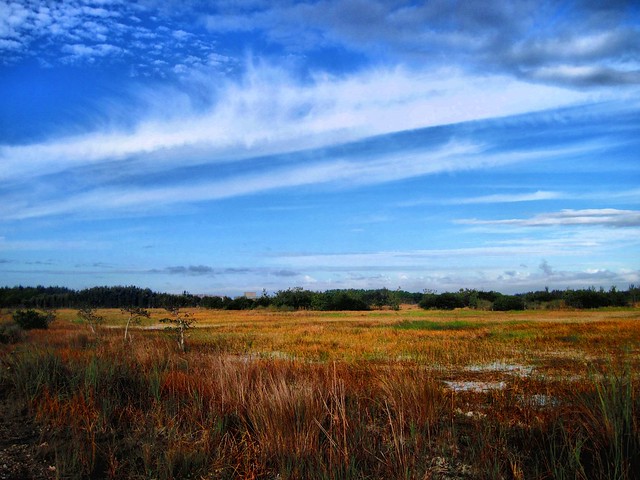
The habitat is largely a wet prairie of mostly low-growing spikerush with areas of taller Sawgrass. It is bordered by dense stands of trees and shrubs-- including exotic Brazilian Pepper, Melaleuca and Australian Pine. This is the habitat initially favored by the cranes:  


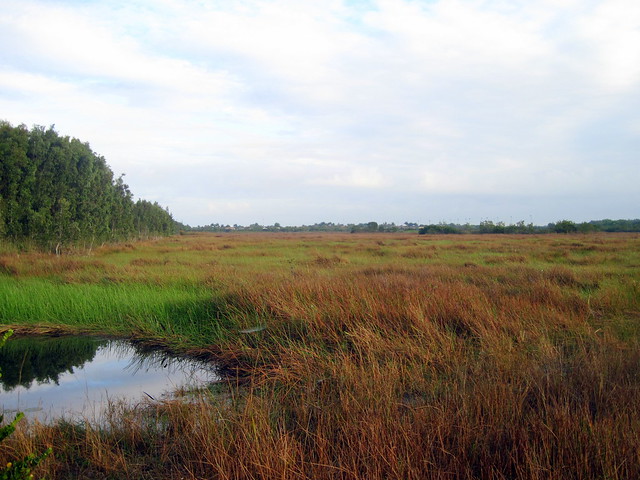
Below is one of the "alligator holes" in the undisturbed portion of the wetlands. The trees to the left are mostly closely-spaced Melaleuca.


Scott's photo was taken near this area of the same water conservation area in the City of Miramar that is not as well maintained. The dead trees are a Meleleuca stand that was treated with herbicide this past spring as part of preparation for a highway extension. Here is how it looked only six weeks ago when the water level was still rather high and kept the off-road vehicles from riding in the slough:


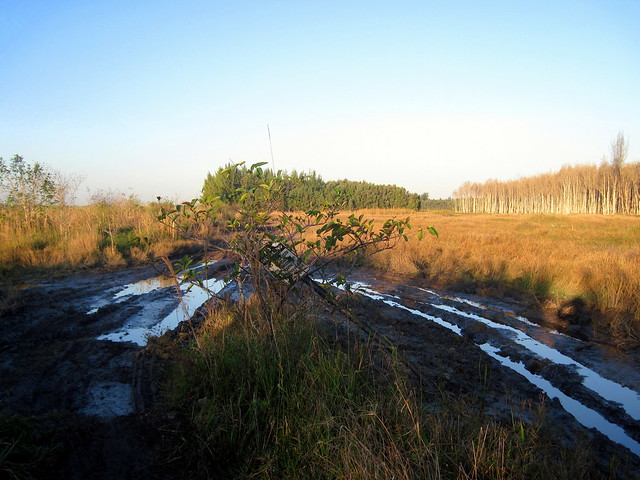
When the water levels decreased it was ravaged by the all-terrain vehicles. Note that the "No Trespassing" sign has been knocked over. The fresh tracks follow along a slough in which the cranes foraged:


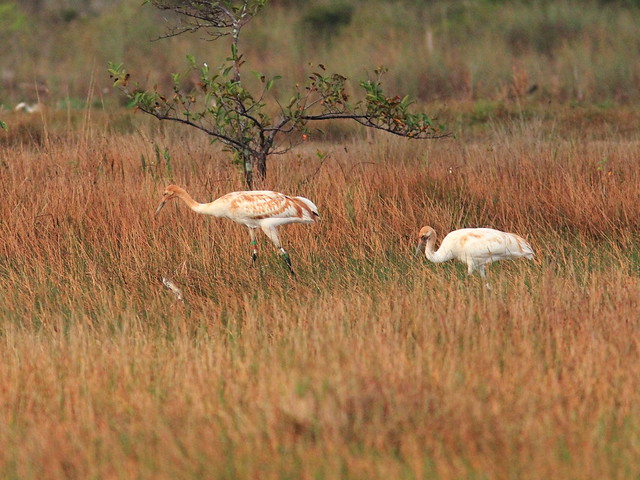
The next morning we got out before sunrise and walked about a mile and a half, all the way north out of Miramar into Pembroke Pines. After taking a few steps across the city limits I sighted two white dots in a wet prairie about a half mile away. We had to detour along a city street to avoid entering private land, but sure enough, we found the two Whooping Cranes.

Whooping Cranes 2012 15 Cypress male and 13 Tussock female 20130106

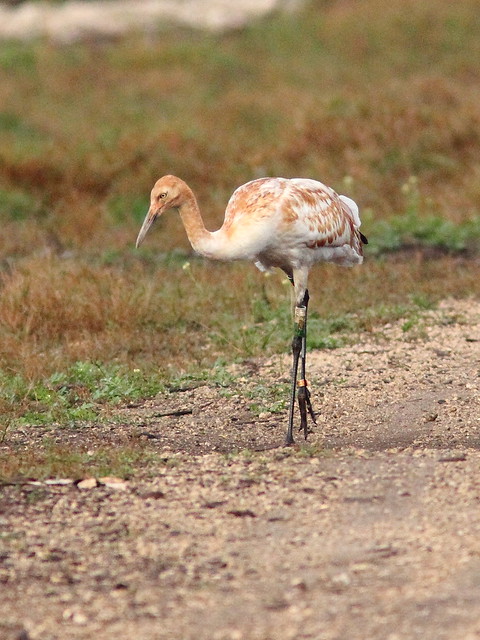
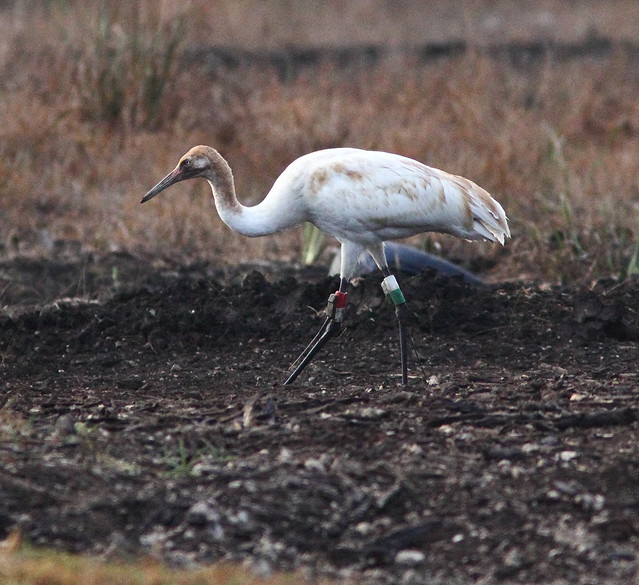
We learned from WCEP that Crane # 15, the one first photographed by my neighbor Scott is a male named Cypress. His band color pattern from top to bottom: left leg has a White/Green transmitter with antenna, and right leg has Green/Red/White bands. The transmitter sends out a short range signal that can be used locally to help find the bird:

Whooping Crane 15-12 Cypress male 20130106

Whooping Crane 15-12 Cypress 20130106

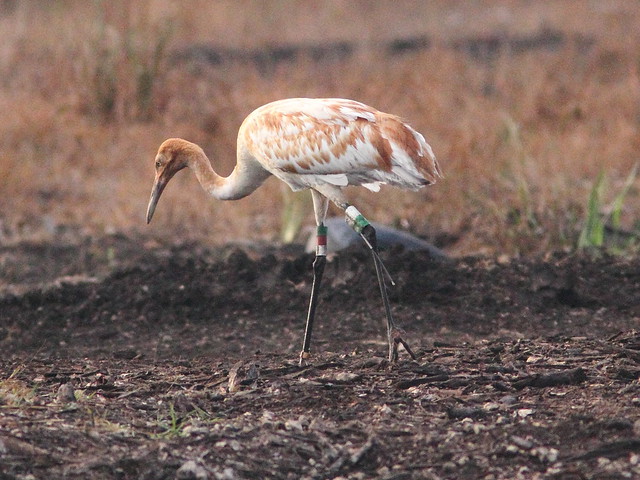
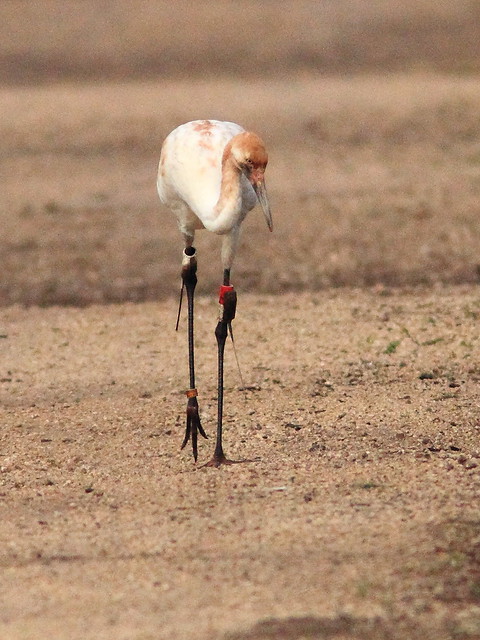
The other is Crane # 13, a female named Tussock. Her band color pattern from top to bottom: left leg has a Red/White transmitter with antenna, and right leg has a White/Green transmitter with antenna. The second transmitter permits satellite tracking.

Whooping Crane 13-12 Tussock female with 2 transmitters 20130106

Whooping Crane 13-12 Tussock female 20130106

I hoped to personally document their presence in the Miramar section of our patch, so on Monday, January 7th I got out before sunrise and walked northward the entire length of the patch. No cranes! I hiked an additional three miles along several paths that border the wetlands and lake.

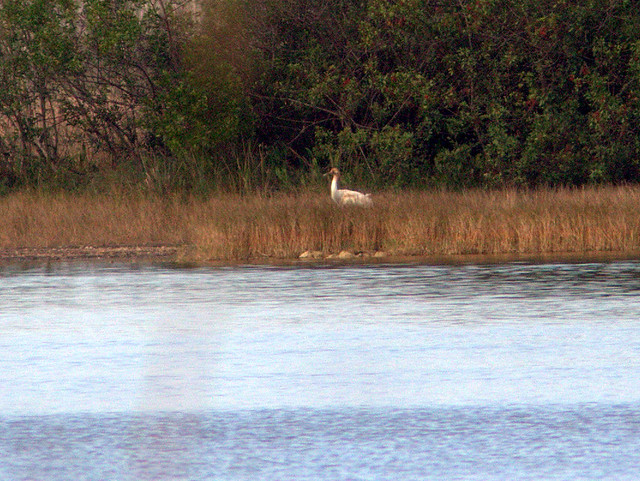
Not finding the cranes, I headed for home. Just after entering our patch I ran into another birder who was also searching for the cranes. I casually scanned the open areas with binoculars, and suddenly spotted one of the cranes. It was nearly a quarter of a mile away (actually 0.21 mile according to Google Earth), so my photo that documents the sighting is quite fuzzy. This is the male, #15:

Whooping Crane 2012-15 male Cypress 20130107

As we continued south along the lake, the other birder saw a white speck on the opposite shore, about 0.43 mile away. He gets credit for providing me the opportunity to photograph the female in my own city of Miramar:

Whooping Crane 2012-13 female Tussock 20130107

The cranes remained in our neighborhood for the next three weeks. Satellite tracking indicated that the female was spending some time inside the residential subdivisions adjacent to the wetland conservation area. I recorded this brief video clip:


Best viewed full-screen size.


On January 7th the female showed signs of injury to her right leg. She limped or hopped to avoid putting weight on it. Photo of injured crane taken January 7 by Barry Heimlich © 2013, used with permission.


On January 25th  the female was found in a residential neighborhood acting listless and mostly sitting down. The next day she had to be captured and was transported to Disney World Animal Kingdom in Orlando, where she is being treated and rehabilitated for injury to her right foot, which was extremely swollen and most of the middle toe was dead. The injuries may have been caused by entanglement of some kind. She was reported to be doing well and  if healing progresses she may soon be released back to the wild.

As of this writing, I have seen the male crane in our neighborhood almost every day. He divides his time between foraging in more remote areas of the wetland and forays into residential subdivisions. I took this photo on January 31 as he flew overhead towards an adjacent housing development.


By the way, Whooping Cranes in this population are not "countable" for listing purposes as officially established in the American Birding Association (ABA) area. Of course, I like to watch pre-season exhibition football, basketball  and baseball, and I enjoy the games even though they don't "count."

For more information, visit   http://www.savingcranes.org/into-the-wild.html

Be sure to listen to the audio stream of this excellent RadioLab podcast "Raising Cranes" about the Patuxent research: 
http://www.radiolab.org/blogs/radiolab-blog/2012/dec/03/operation-migration/

Saturday, February 2, 2013

Did You Know ... ?


A few fun facts about several bird species.


Hooded Merganser

  • Hooded Mergansers are especially skilled at diving and foraging underwater. These striking beauties are able to remain submerged for up to two minutes. Once prey is captured, they resurface and toss and turn it until positioned to be swallowed head first. This behavior allows the merganser to avoid injury from the spiny fins of certain fish species.
  • The especially muscular gizzards of Hooded Mergansers assist them in pulverizing the exoskeletons of shellfish.


Roseate Spoonbill

  • It is widely believed that the pink plumage of Roseate Spoonbills is a result of algae eaten by the crustaceans these bird typically consume.
  • A Roseate Spoonbill is able to breathe with its bill underwater because the nostrils are located at the top of the bill.


Belted Kingfisher

  • Belted Kingfisher parents use their strong bills and feet to excavate a nesting cavity at the end of a long tunnel, usually in river banks near the water. The burrow is either horizontal or slopes slightly upward. Sometimes the pair will line it with grass or leaves.
  • Belted Kingfishers have been known to share their tunnels with swallows. The swallows will hollow out spaces within the tunnel walls for nesting.


Sandhill Crane family

  • Sandhill Cranes often preen with vegetation and mud stained with iron oxide during the breeding season. This practice turns many of their gray feathers a reddish brown color.
  • Sandhill Cranes have a rolling trumpet-like vocalization. The cause of this distinctive rattling is a long, unusual windpipe (trachea) which forms a loop within the breastbone.


Osprey


  • The outer toe of an Osprey is opposable, thus they are able to carry slippery fish with two toes positioned in front and two toes placed behind.
  • Once a fish is caught, Ospreys will situate the prey so that it is parallel to its own body. This creates a more aerodynamic way to fly.


Wood Stork

  • Wood Storks excrete waste on their legs to cool off. The suns rays evaporate the waste, which cools the bird, similar to sweat.
  • A Wood Stork couple needs about 400 pounds of fish to feed their family during breeding season. When the chicks are small, the parents feed them as often as fifteen times a day by regurgitation.


Yellow Warbler

  • The nests of Yellow Warblers are often parasitized by Brown-headed Cowbirds. Yellow Warblers are able to identify the foreign eggs and will often build a new nest directly on top of the parasitized nest, sometimes burying their own eggs. Nests have been found with up to six tiers.


Green Heron

  • Green Herons are known to project their excrement at the eyes of their predators for self defense purposes.
  • Green Herons are also one of a few tool-using birds. They drop insects, twigs and feathers onto the surface of the water to lure prey in.


Eastern Bluebird

  • Eastern Bluebirds are family oriented. A courting male will try to entice a female by singing, waving his wings and performing flying displays. Once she accepts a nesting site, the male will bring food to her while she incubates the eggs.
  • Occasionally, a young bluebird from the first brood will assist in raising its siblings in the second brood.


Ruby-throated Hummingbird

  • Ruby-throated Hummingbirds have very short legs, thus they are unable to walk or hop. They can scoot sideways, though. These diminutive birds scratch their heads by lifting a foot up and over the wing.
  • It is often mistakenly thought that hummingbirds suck nectar through their long bills. They actually use their fringed, fork tongues to lap the nectar up. While feeding, hummingbirds can lick 10 - 15 times per second.


Posted by Julie Gidwitz