Thursday, July 3, 2014

Butcher Bird in early field guides

Shades of gray can be beautiful, but also confusing to a young birder.

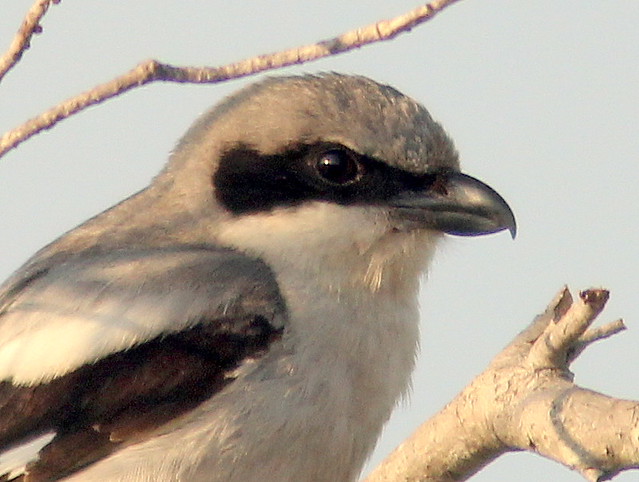
Loggerhead Shrike close 20110605


Back in New Jersey on August 21, 1949 I saw my first Loggerhead Shrike. It was my Life Bird #119. Actually, a few days earlier I had found grasshoppers impaled on the spikes of a barbed wire fence in the Passaic River bottomlands a short walk from my home in Rutherford. 


I had read about how the "Butcher Bird," whose "weak feet" lacked the talons of raptors, must stabilize its victims in this manner to permit them to be torn apart with its hooked beak. Hoping one day to see mice and small birds in a shrike's larder, I did not expect lowly insects. I searched for the shrike to no avail until three days later, when I caught sight of my "lifer."   


I did not know exactly what to call the bird, as nomenclature was confusing. My tattered little pocket Chester A Reed guide (published in 1923) called it a "Loggerhead Shrike." In those days birds were considered to be either "good" or "bad," but in Reed's opinion the shrike seems to straddle the line.
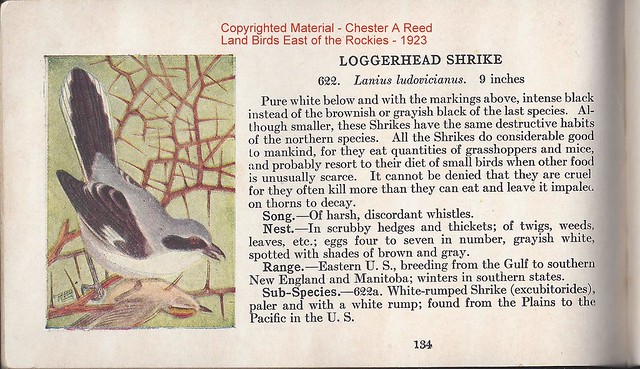

Chester_A_Reed_BirdGuidLandBirdsEastOFRockies1923-Shrike


More up-to-date, my 1937 Peterson Field Guide to the Birds only illustrated the larger (and even less common) Northern Shrike:
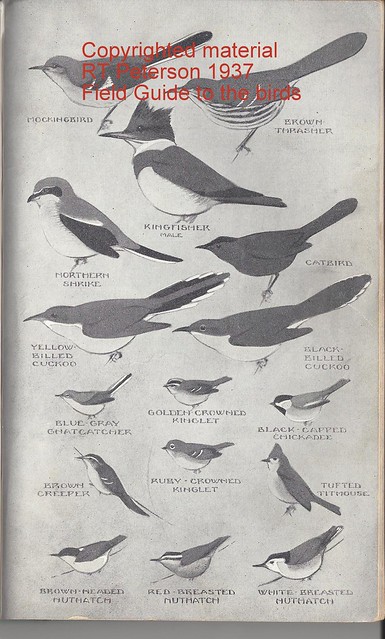

Peterson 1937 Shrike illustration


The text was not very illuminating, as it gave short shrift to the Loggerhead or Migrant Shrike as it was called:
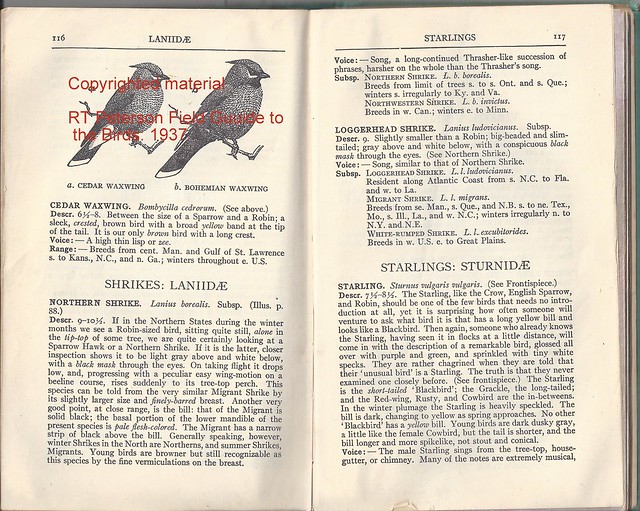

Peterson 1937 Shrike description


My "go to" reference for information about distribution and abundance was Allan Cruickshank's "Birds Around New York City (1942). I was elated that I had seen a relatively rare bird. Cruickshank reverted to calling it a "Migrant Shrike."
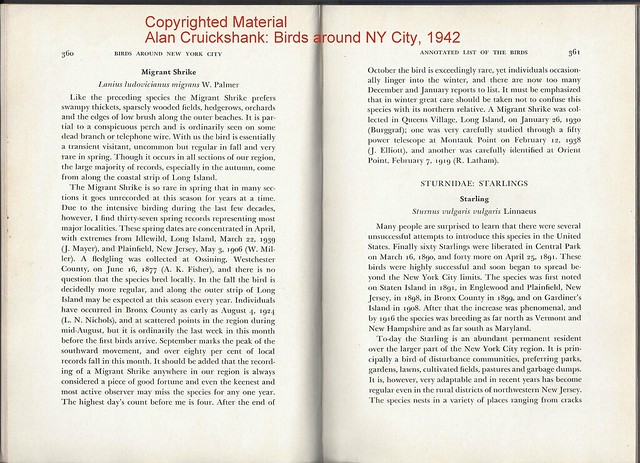

Cruickshank1942BirdsAroundNYC-Shrike


Only later, during the year of my first sighting, did Peterson's 1947 Guide appear, with the Loggerhead Shrike in all its glory.
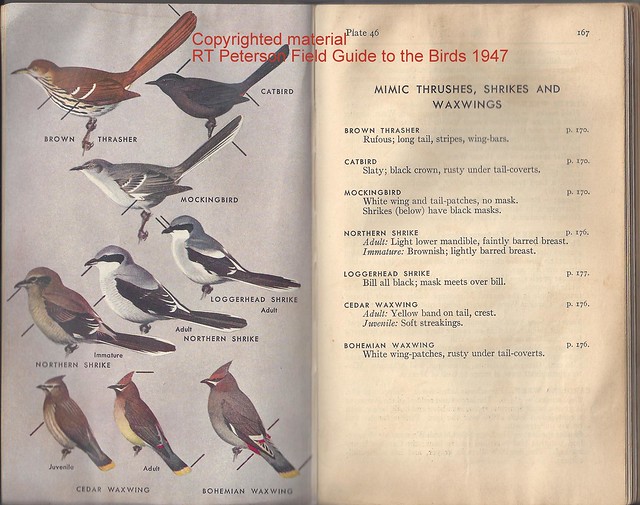
Peterson 1947 Shrike illustration


During the 20 years following my sighting, the Loggerhead Shrike became more common in New Jersey, especially in the southern reaches of the state. However their numbers decreased and they once again became quite rare towards the end of the 20th Century up to the present. Ingestion of pesticides in insect prey is strongly suspected as the cause of their drastic decline. In south Florida, now my home, they are quite common breeders and winter visitors. 


Cold light brings out the blue:
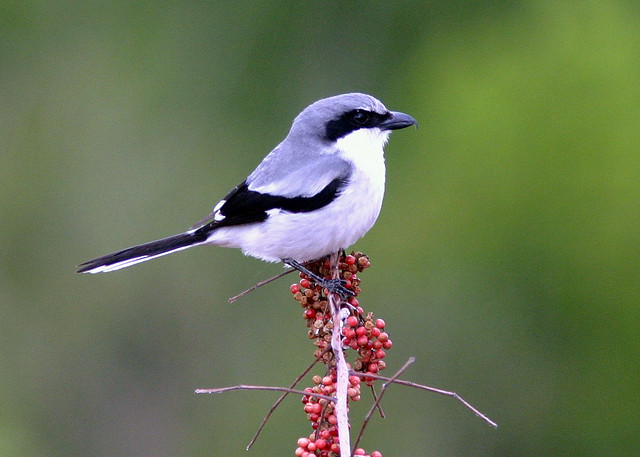
Loggerhead Shrike 20090207


Their prey is varied, but mostly insects. I think this huge grub is a horsefly larva.
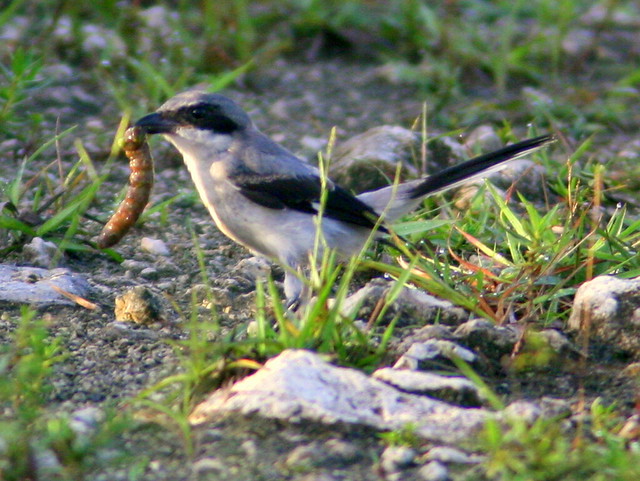
Shrike with big grub (prey ID please) 20100719

Except during the breeding seasons, Loggerhead Shrikes tend to be solitary. They often select the highest perch...
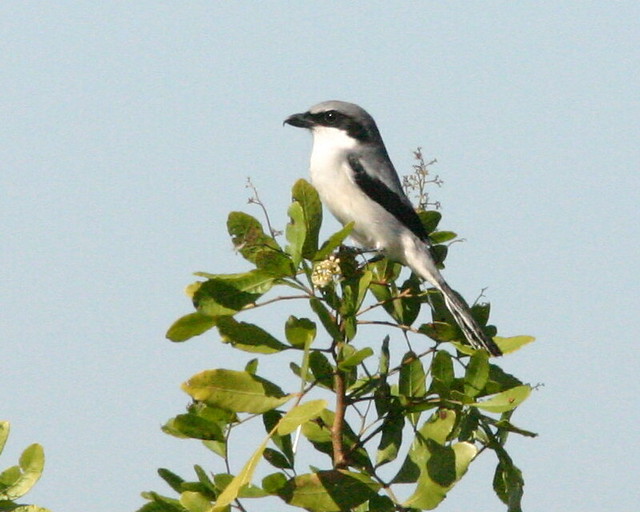

Loggerhead Shrike 20081126


...and may be challenged by grackles...
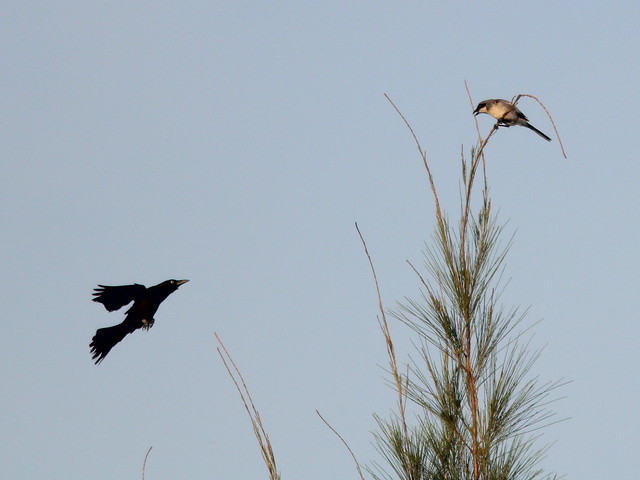
Shrike-Grackle interaction 20110605


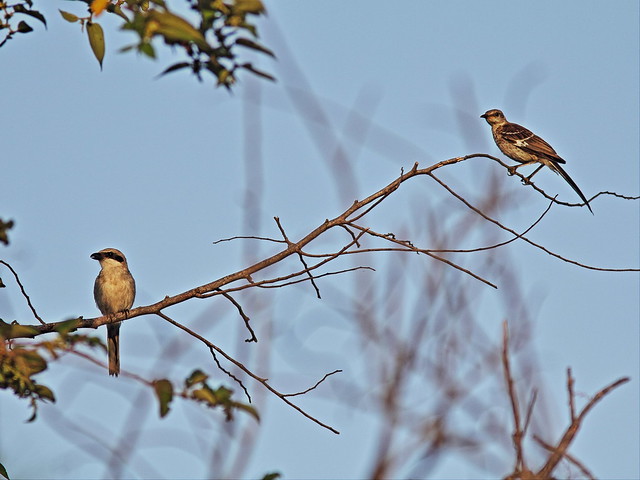
...mockingbirds...


Shrike and mockingbird 20130723


...and Blue Jays. In this case, the shrike retreated, possibly to simply avoid the company of others.
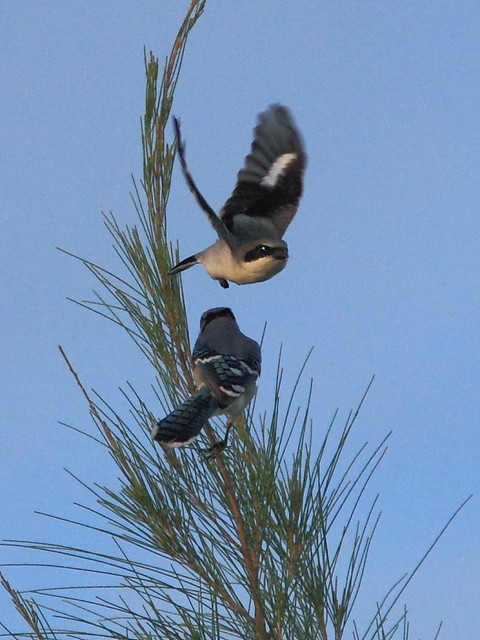
Shrike and jay 2-20121018

Yet, many time I have seen a shrike sit peacefully with a variety of other species, such as this American Kestrel...
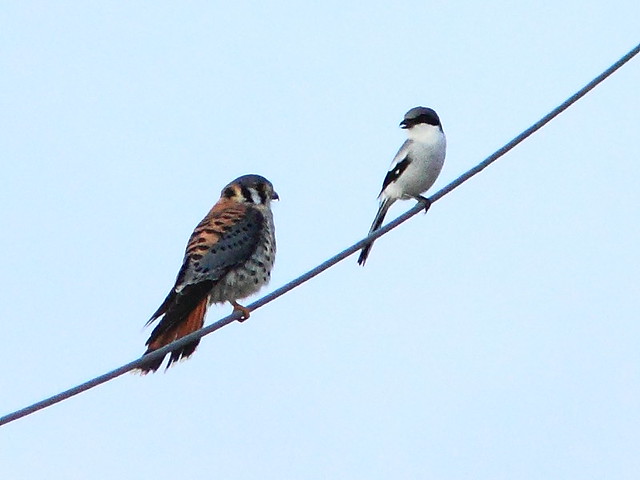
Kestrel and shrike 2-20121213

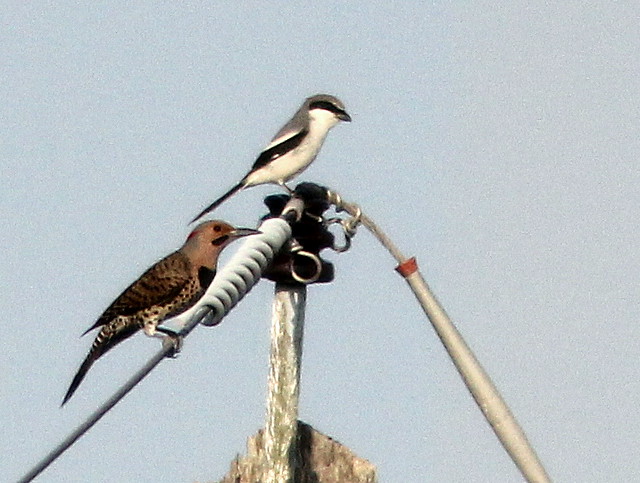
...or a Northern Flicker.

Distant shrike and flicker 20110410


One of my more remarkable shrike images includes two shrikes with a Belted Kingfisher and a kestrel, in late November.

Odd gathering 20111127

In June the shrikes are courting.

Loggerhead Shrike courtship 3-20130607


I usually find it difficult to get any closer than 30-40 feet from a Loggerhead Shrike, but this fledgling was an exception.
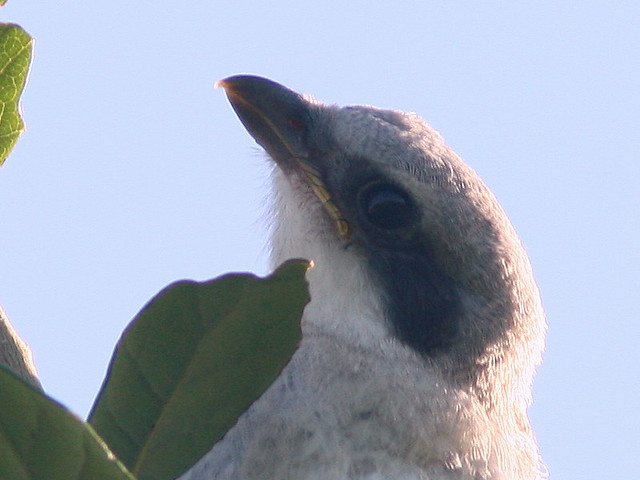

Fledgling Loggerhead Shrike close 20100729

The shrikes like to hunt for lizards on our back patio, so I can get some close views through the glass doors.
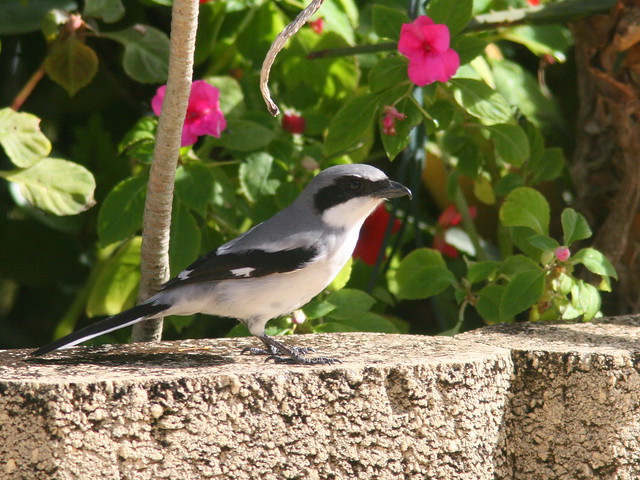
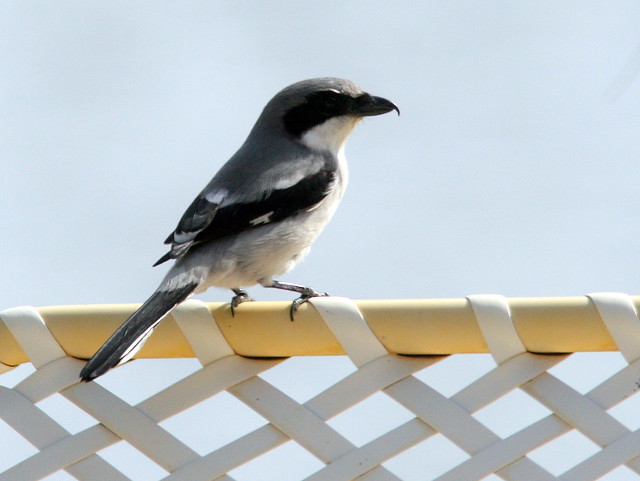
Loggerhead Shrike 2-20101231
Loggerhead Shrike 20101231


Parents watched this youngster as it unsuccessfully pursued a Brown Anole. They did not intervene, perhaps to teach their fledgling the importance of stealth and persistence.
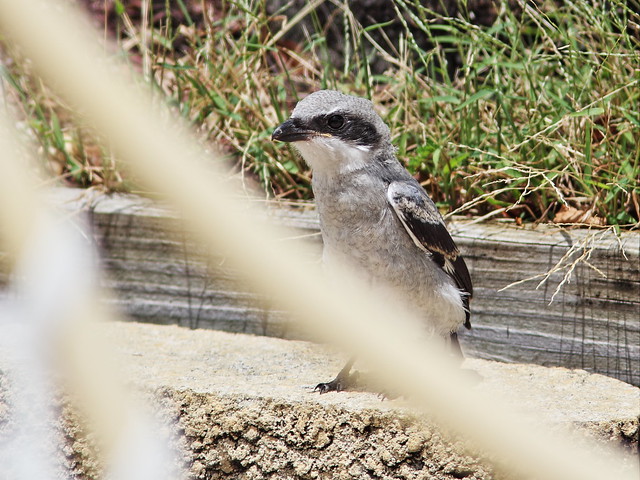
Loggerhead Shrike juvenile thru window 20140601

Friday, June 27, 2014

The Joy of Contributing to Florida's Breeding Bird Atlas

Beginning in about the middle of May Central Florida begins to loose its migrants, and birds the breed in Florida begin to settle into to their breeding locations.  And so June has become one of my favorite months of the year.  Florida is currently conducting what's called a Breeding Bird Atlas. It's a wonderful opportunity for regular birders like me to contribute evidence concerning breeding birds so that scientists can have real data about what birds are breeding in Florida. This is the second atlas that has been conducted in Florida, so the data collected from this one can be compared to the data collected in the mid-80's. It's very gratifying to know that my hobby can be beneficial to science during the summer months.

Marl Bed Flats
Juvenile Black-necked Stilt
Black-necked Stilts have been hanging at Marl Bed Flats just north of Lake Jesup.  A couple weeks ago we began to see juveniles there.

Live Oaks Blvd
Juvenile Killdeer
My office parking lot has one adult and two baby Killdeer. It seems like they breed in my parking lot every year.

Live Oaks Blvd
Juvenile Sandhill Crane
There's also a family of four Sandhill Cranes in my office parking lot. 

Lower Wekiva River Preserve
Common Nighthawk giving Courtship Call
At sunrise and sundown we can sometimes see Common Nighthawks flying overhead.  It's really fun to hear their courtship "boom" calls.

Lake Monroe Marina
Copulating Least Terns
There's a colony of at least 75 or so Least Terns at a marina on Lake Monroe. This year I had the chance to see a couple together.

Electrical Substation
JuvenileAmerican Kestrel (Southeastern Subspecies)
There's also a family of four American Kestrels at an electrical substation near my home.  Most of our kestrels leave us for the summer, but our resident southeastern subspecies stays hear year round.  The subspecies is actually a threatened species.

Lake Monroe Marina
Juvenile Loggerhead Shrike
And Loggerhead Shrikes are also fun to find.  There were at least 5 juveniles at the marina on Lake Monroe, still young enough to be fed by their parents.

Volunteering for the breeding bird atlas is fun, challenging and rewarding. If a survey like this is being done in your area, I highly recommend participating.  It sharpens your observation skills and it makes summer birding all the more exciting.

Monday, June 16, 2014

Magnificent Warblers!


Without a doubt, spring is my favorite season for birding. Exquisite migrating birds adorned in brilliant breeding plumage pass through the Midwest during the spring months. Birders, nature lovers and wildlife photographers delight in the dazzling beauty of feeding warblers throughout the migration season. This post features a variety of the magnificent warblers seen during this glorious period.


A resplendent Blackburnian Warbler explores the oak tree leaves for prey


Seeking nourishment along the creek ~ Prothonotary Warbler


A stunning Chestnut-sided Warbler among the budding pink blossoms


A black-capped bird in pursuit of a meal ~ Wilson's Warbler


A brilliant Yellow Warbler pauses for a moment in the marsh


A secretive Kentucky Warbler searches for food amongst the leaf litter


A gorgeous Magnolia Warbler gleans insects from a budding tree


A handsome Black and white Warbler searches for bugs hidden in the crevices of tree bark


Crooning a tune ~ Hooded Warbler


A lovely Canada Warbler looks for nutrition amidst pretty pink blooms


Seeking a tasty treat of insects or larvae ~ Black-throated Blue Warbler


On the hunt for a buggy snack ~ Pine Warbler


Perched in the lush foliage ~ Blue-winged Warbler


A beautiful Prairie Warbler forages in low tree branches


 A Black-throated Green Warbler sports attractive feather markings


A male American Redstart shows off his striking plumage

Spring is indeed a spectacular time for birding!


Posted by Julie Gidwitz ~ Nature's Splendor Blog -  http://naturessplendor-julie.blogspot.com/

Friday, June 13, 2014

June Shorebirding, Sans-tundra

Michigan is blessed with some incredible shorebird stop-over habitat, thanks in no small part to our monstrous, sea-like lakes. April and May are always fun for the massive push of northbound birds, while July through October is the leisurely time to catch them all trickling back south. There's really only about a five or six week period centered on June that falls between the end of spring migration and the beginning of fall migration for shorebirds. That's when many of these birds are in the high arctic, laying eggs on the tree-less tundra. It's also when they look their best. The alternate (breeding) plumage for some of the shorebirds is simply exquisite. Sometimes late in the spring or early in the fall (which is actually mid-summer according to the shorebird calendar) we'll spot some that are nearly fully molted into alternate plumage or not yet molted out of it, but most of the time they're something like 70% "colored-up" in the spring, or badly worn and tattered in the summer.
Spotted Sandpipers having a discussion at Tawas Point (Sarah Adams photo)
This year, Sarah and I took an excursion to northern Michigan on the first weekend of June and were lucky enough to catch two of our favorite species lingering later than usual and showing off their best summer formal wear. Sarah got some great photos, some of which I'm sharing here.
Piping Plover sporting the latest leg jewelry and piping at Tawas Point (Kirby Adams photo)
Our first stop was at Tawas Point State Park on Lake Huron. Tawas Point is a notable migrant trap, renowned for its May warblers, but shorebirding there can be excellent. We got to see a couple of the critically endangered Great Lakes population of Piping Plover which have regularly nested on the beaches at Tawas Point for the past several years. There were plenty of Spotted Sandpipers, also summer nesters here, cavorting in the lagoons and bobbing their rear-ends at everything that passed.
Sanderlings stopping over at Tawas Point (Kirby Adams photo)
Most of the migrants had moved on, of course, but an expected group of Semipalmated Sandpipers lingered, along with a few Sanderlings who were changing into their striking breeding plumage.

Semipalmated Sandpiper (Sarah Adams photo)
But the highlight at the point was a group of Ruddy Turnstones dressed to kill. (Not literally, unless you're an amphipod living under a beach pebble...then the turnstones most definitely are destined to kill you.) This has been Sarah's favorite shorebird since long before we had ever seen one and they were nothing more than fascinating pictures in the field guides. Our lifer came by random chance one fine mid-May day at Metzger Marsh in Ohio. Since then, we've seen dozens, if not hundreds, mostly in Florida where many of them winter. I remember a particularly hefty flock of them on a mudflat in Ding Darling National Wildlife Refuge one January. But all of those were in their basic (non-breeding) plumage. We just don't encounter them in alternate plumage much, mostly because we spend little time in the far north.
Ruddy Turnstone, probably upset with the lack of stones to turn (Sarah Adams photo)
Ruddy Turnstones - leaving no stone un-turned and no crustacean un-consumed (Sarah Adams photo)
After taking our leave of the stragglers at Tawas Point, we headed to Lake Superior's southeast corner to see what was going on at Whitefish Point. There we braved a cold and blustery pebble-filled beach to spy another couple Piping Plovers, Sanderlings, and Semipalmated Sandpipers. But rather than turnstones, the treat here was one of MY favorite shorebirds, an American Golden Plover. This is quite a rare bird for June in Michigan, and this specimen was looking fine in his breeding colors.
American Golden Plover, Whitefish Point (Sarah Adams photo)
A close examination through the scope revealed a bloody wound on the plover's shoulder, but it didn't appear to impede his flight as he crossed the point in the air right in front of us. Merlins like to hang out and nab small shorebirds at Whitefish Point, so it's possible this individual got in a tussel and fought a falcon to a draw. Regardless, it wasn't seen either before or after the day we were there, and I'd like to think he's above the Arctic Circle enjoying round-the-clock sun right now. I'm just glad he was slow enough with his migratory travels to let me have a look at him without having to drive to Nunavut.
American Golden Plover, Whitefish Point (Kirby Adams photo)

Tuesday, June 10, 2014

To Be Killed by a Mockingbird


There are many, many bird guides out there. Many of them are good, and some are excellent. Some are specialized to a region or a family of birds. Some are even devoted entirely to vagrant birds. All of them neglect to deal with a very pressing issue though. Sure, it's nice to identify birds by plumage and voice, by habitat and range. But sometimes the species identification isn't the most pressing need. Sometimes it is the bird's psyche that needs to be evaluated, and just as importantly, the birds mental condition. Is it stable? Is it an addict? Is it a threat to itself and others?
Luckily, avian artist and psychologist Matt Adrian, a.k.a. The Mincing Mockingbird, is set to release the first attempt at profiling some of these at-risk birds. This thin guide is packed with creative renditions and impersonations of many different species--all of the most psychologically unstable in the ABA area, and reading the anecdotes is just as enjoyable as ogling the illustrations. The Guide to Troubled Birds is set to release on June 12 from Penguin Publishing.


The Guide to Troubled Birds is a thing book, a quick and fun read, though one that's over too quickly. That's part of the trade off in a book that's heavy with inventive artwork. Sometimes brevity is the essence of wit. In fact, that's often the case.


Some of the illustrations and captions are accompanied by anecdotes or excerpts that allude to specific bird behavior, while others seem to be random ramblings and journeys into realms of the insane. They're terribly enjoyable, especially if you have a preference for Far Side comics or books such as Pastoralia by George Saunders.


Most birders have a penchant for reading. After all, we build up our skills, at least early on, by going face-deep in guide books and texts, and there are plenty of other popular supplementary books like Kingbird Highway and The Big Year. I flip pages pretty often, but it's unusual that a book actually makes me laugh out loud, like it's almost as rare as laughing out loud when watching stand-up comedy by oneself. The Guide to Troubled Birds busted me up several times. Even though I found it to be too short (and that's easy for a non-author/illustrator such as myself to say), this little book made a strong impression and I'd recommend it as an enjoyable read, as something to put a little edge on your birding.

Saturday, June 7, 2014

City Birds

New York City 4-21-2014
Early light falls softly on city streets,


Flowers bursting from their winter’s sleep,

White-throated sparrow

Sparrows singing along the lawn,

Northern Cardinal
Cardinals calling a springtime song,

Love is in the air,

In the park, in the lake,

Bufflehead (female)

Ducks looking for love,


Hens looking for drakes,


Flickers searching along the path,


Blue Jays calling, falling fast,


Red-tailed hawk keeps a sharp look-out,

Rock pigeons coo and waddle about,


Rock pigeons live a sheltered life,

In the city, day and night.


Wandering paths where wildflowers bloom,

Life in the city conceals the truth,


Nesting is happening in this busy town,

Central Park in New York City 4-21-2014

Life is sprouting in Central Park town!


~Kathie Adams Brown (June 6, 2014)

Now that I am back on the east coast I am enjoying visiting all my favorite birding haunts, including New York City! I was there a bit early for warbler migration, but I still saw some good birds and had a great time! Come visit me at Kathie's Birds!