Saturday, June 23, 2012

Top 10 Things to Remember When Birding With New Birders


Over the last few weeks, I haven't had a lot of time to go out birding. But when I have, it has been with new birders almost every time, and I have come to realize that they are really one of the most fun groups to bird with. All of us as birders should be interested in introducing new people to our passion for birds because more involvement in birding can only lead to good things! In order to help all of our readers work with new birders, I have put together ten tips for working with new birders. I encourage everyone to look for opportunities to introduce new people to the wonderful world of birds!

·         Teach them how to use binoculars.

Nothing is more frustrating for a first time birder than seeing a bird moving around a tree but not being able to get their binoculars on the bird. It only takes a few minutes to go over binocular basics, but it will greatly enhance the whole birding experience for the participants.

·         Even common birds can be exciting.

Yes, you may have seen a Cardinal, Blue Jay, or Mourning Dove a million times,but it might be the first chance for the new birder to look at that species up close through binoculars.  Some of our most common birds are some of the most beautiful. Don’t squash their enthusiasm by blowing off the common birds.


·         Take it slow. There is a lot to take in when birding for the first time.

It is very important to take your time with new birders. Just getting a quick look at a bird is typically not enough to keep them interested, so take the time to really study the birds you see and answer any questions they have. You might even learn something too!

·         Be sure that they come properly prepared.

Nothing can ruin a day of birding more than being unprepared for the conditions, especially if you have the wrong footwear. Let them know if they need to have a sturdy pair of boots or if tennis shoes are ok.  Think about long pants versus shorts, hats, bug spray, and sunscreen, too.

·         Teach people about the birds they are seeing.

It is easy to build an interest in birds if you can tell people a little about the birds they are seeing. Even the common birds have a story to tell. Migration tends to be a very good topic as most people are unaware of the amazing migrations that our birds undertake each year.

·         Point out the birds and don’t just call them out by sound like you might with an experienced group of birders.

New birders need help finding birds. They have not been birding forever, like some of us, and the more help you can offer them, the more enjoyable their day of birding will be. Take the time to help them get on the birds with binoculars. Remember, it is not about how many species you see but about what the new birder is able to see and enjoy.

·         Carry a field guide.

A field guide will come in very handy with new birders. I have noticed that when I am working with new birders, they like to take a look at the bird in the book after then have seen it in the field. I think that it is a great way to help them remember what it was that they saw and also to help you teach them why it was not another similar species.  If you don’t want to carry a field guide, there are a few really good apps for smartphones.

·         Send a list of birds to expect to new birders before going out.

This will not appeal to all new birders, but I have found that many like to learn some of the common birds that they might find in order to feel prepared to go birding. This gives them the chance to flip through a field guide and familiarize themselves with some of the birds you might see.

·         Be aware of other opportunities in the area for new birders to participate in.

I have been asked many times at the end of hikes with new birders what else they can do to be involved in birding. It is extremely important that we are able to point them in the right direction and help find them other ways to expand their interest in the natural world.

·         New birders might be more interested in other aspects of nature besides birds. That’s ok.

When you are out birding, new birders might take an interest in plants, butterflies, dragonflies, or other animals. No matter what their interest in nature, we should always encourage them to explore it further.


-Rob

Friday, June 22, 2012

Dartford Warbler - A Life on the Edge

I remember, from my childhood days of flicking through bird books, being fascinated by the unusual looks Dartford Warbler which was described as a rare and secretive bird. Move forward in time to the present and it became a species that came high up on my ever expanding list of birds to see and photograph.
The Dartford Warbler is a rare bird in the UK where it is at the extreme northern edge of it geographic range and generally confined to the south of the country. A bird that thrives in the warm climates of the Mediterranean suffers when harsh winter condition prevail here as the population is non-migratory. It was estimated that the after the harsh winter of 1962 there were only 10 pairs left. Numbers have since recovered to around 3000 pairs, no doubt helped by an ever warming climate and careful maintenance of its healthland habitat. Given the tentative hold of this species  in the UK it has rightly been afforded Schedule 1 status. From a photographer point of view this means that a permit is required to photograph birds near the nest.
My first encounter with what is probably the most colourful warbler species in the UK, came back in 2010  when I had to make a journey to the south coast for a couple of days for the unfortunate business of a funeral for someone who had unexpectedly passed on well before their time. I had decided that on the day following the funeral, I would head out at first light with the camera as a bit of therapy to forget the sadness of the day before.  I trawled the internet for information for somewhere to go  in an area I didn't know and it appeared that a nearby area of heathland held a small population of Dartford Warblers. I knew from my reading that the best chance to see one of these skulking birds was in early spring when males would sing from the top of low gorse bushes and healthland scrub to attract a mate. Well the timing was right at least and pre-nesting time would remove the need for the Schedule l licence, the only task that remained was actually finding one!

I arrived at my chosen area just as the early morning sun was peeking above the horizon and filtering through the early morning mist. As the mists started to clear so did my confidence as spread out before me was hundreds of acres of low gorse bushes. Finding the bird could be trickier than I thought. Anyway I set off towards a low ridge line where most of the birds had been sighted in the old reports. After quite a bit of wandering round I heard an unfamiliar scratchy warbler and to my disbelieve a beautiful looking male, bathed in early morning light, appeared on a bush next to me and started singing.
If you want to see one in action I have found this clip on YouTube Dartford Warbler video. The illustrations in my childhood books really had not done this beautiful bird justice but I was quite surprised how much smaller the bird was than the image in my head. In fact it was tiny which no doubt does not help it plight in cold weather. I stayed with the bird for about an hour until a female appeared in response to his constant song.

My second encounter with Dartford Warblers unexpectedly happened much closer to home. The nearest and mostly northerly population is a few bird in the Midlands region. During the very cold winter of 2010 / 2011 it appears one of the male birds was displaced in its search for food to an upland area in North Wales. This bird quickly became popular with photographers, and as I tend to avoid the crowds, I only visited when it had gone quiet again when it was assumed the bird had disappeared. However, this was not the case.  The need for the Schedule 1 Licence was not necessary for a non-breeding solitary male but I still sought permission to photograph the bird from the authorities in the late spring period. I undertook two visits to take some photograph and quickly located the bird from the now characteristic song as it flitted between low bushes and gorse.
Interestingly during my second visit the bird was collecting large numbers of caterpillar and feeding them to an 'adopted' brood of recently fledged Common Whitethroat which are from the same family of Sylvia warblers. I guess the bird, having unsuccessfully found a breeding mate,  found it hard to ignore the incessant chemical call of the hormones driving its paternal instincts.
Who knows when my next encounter with one of these special birds will be? It may not be for many years but if  it does happen I will cherish every moment spent in close proximity to this fascinating little warbler.

Thursday, June 21, 2012

on Dickcissels and Blue Grosbeaks

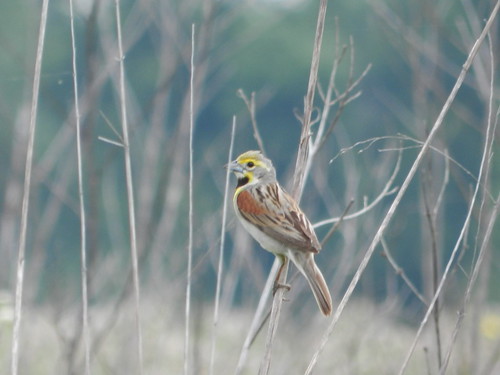
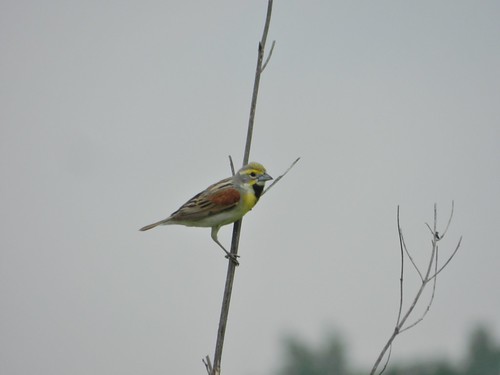
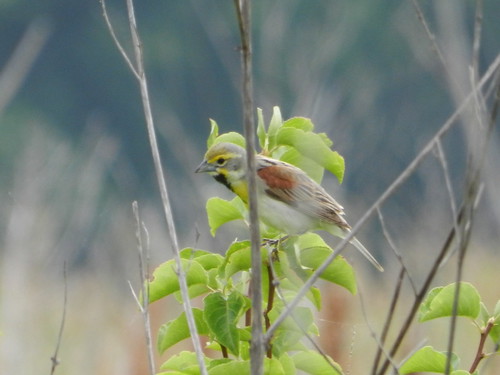
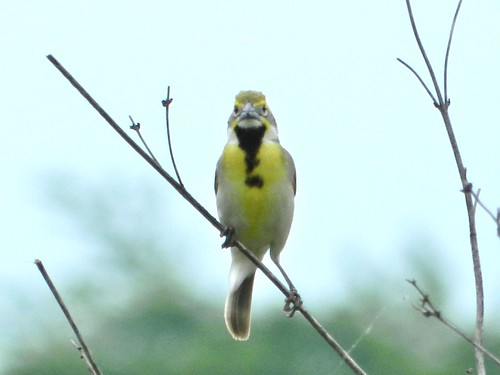
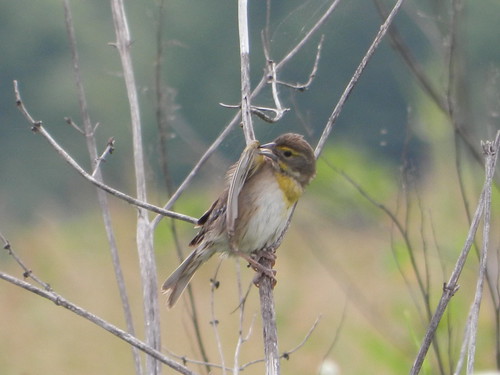
vagrant Dickcissel seen in Farmington, Utah 2011
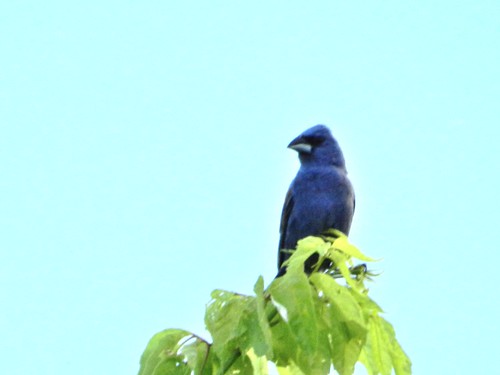
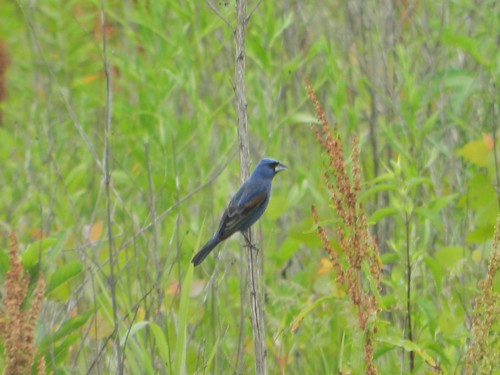
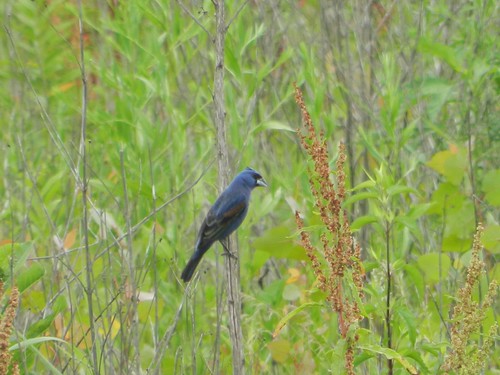
probably my favorite Blue Grosbeak photo
by "Birding is Fun!" contributor Steve Creek.
Donald the Birder's post this morning here talking about Dickcissels and Blue Grosbeaks in the same vicinity in Ohio got me to thinking. In Utah last year, we had a vagrant Dickcissel and it was also very near a nesting pair of Blue Grosbeaks. It got me to wondering if there were some connection between these birds regarding habitat or diet that may have made these birds migration buddies.

AllAboutBirds.org describes Dickcissels as birds of the prairie grasslands and Blue Grosbeaks as birds of the open woodland or forest edge. I suppose there are habitats of grassland and forest edges near each other. Their diets of seeds and insects appear to be pretty close to the same. Let's take a look at some eBird sightings maps and see what we can learn...(see maps below)

These eBird sightings maps reveal that Dickcissels and Blue Grosbeaks do seem to share their winter range in Central America and around the Gulf of Mexico. It appears that Dickcissels in winter tend toward more vagrancy than Blue Grosbeaks. Dickcissels must be found in higher concentrations in their Central America wintering grounds due to the sparse amount of sightings, or they may be harder to find in winter for some reason. AllAboutBirds.org states that winter roosts of Dickcissels may number in the millions of birds.

All kinds of interesting stuff here, but what about my original curiosity about why Donald and I both saw the two species together? Is there some mysterious connection between the two species. Ah, it was probably just coincidence.

Blue Grosbeak Dickcissel
Summer - concentrations in the southern states, in the southwest, and in southern Mexico
Summer - largest concentration in the prairie lands of the midwest and along the Mississippi River corridor
Winter
Winter

A field (bird) day

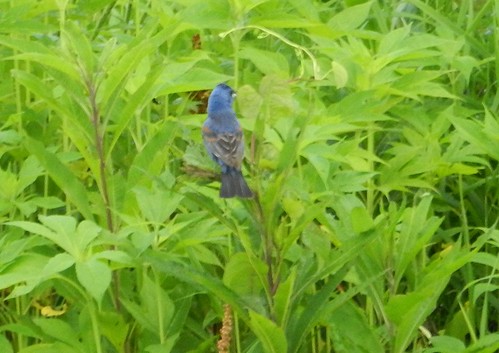
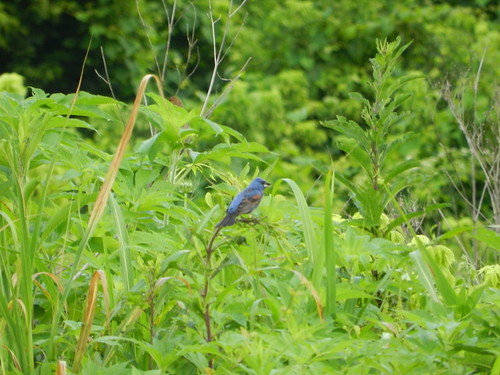
Hearing reports of Dickcissels and Blue Grosbeaks at Armleder Park, I decided to spend my off day trying to photograph them.  I don't get out to this park much, even though I find good birds here just about every time I go.  I think it has to do with my need to "escape".  The park is in the city of Cincinnati proper.  It just feels odd to me to go to the city to see good birds.  One can hear sirens and traffic constantly.  I can see "big" business from many spots in the park. The second bird that I saw when I arrived at the park was a male Blue Grosbeak foraging in one of the parking lots near the front of the park.  I tried to use the car as a blind, but the bird flew to the brush immediately.  I was only able to get two quick shots out the window.
Blue Grosbeak
Blue Grosbeak
The grosbeak flew off.  I was hoping for better pics, but I was just glad to see one.  I decided to go to the fields to try my luck at photographing the many Dickcissels I was hearing. I can't recall ever hearing so many Dickcissels here.  I remember when I got my life Dickcissels at Voice of America Park (VOA) in West Chester, OH.  This is the same park that I got my lifer Bobolinks at.  VOA looks a lot different then it did back then and I fear for the future of Armleder, as I see the same "things" happening here.  The birds are still hanging on at VOA, but they definitely aren't a priority. We as birders must make sure that the birds continue to have a voice. The Dickcissels were more cooperative photo wise than the Blue Grosbeak.  I spent a couple of hours just watching and photographing them.
Such a nice looking bird!
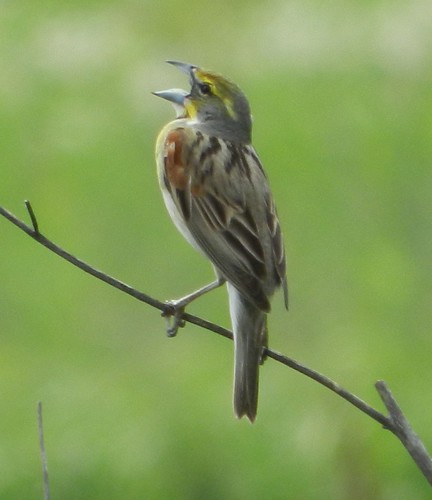
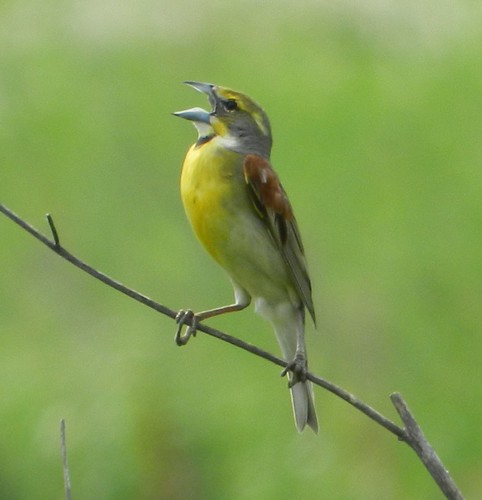
Dickcissel
Dickcissel
Dickcissel
The males were chasing each other and singing for this female.  She didn't seem too interested, as she just continued preening.
Dickcissel
Dick-dick-cissel-cissel!
Dickcissel
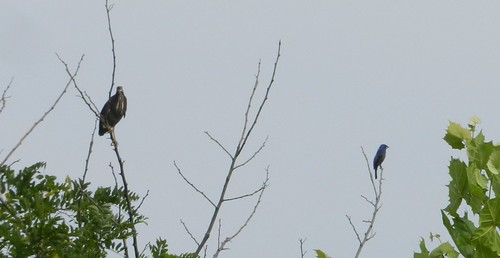
While watching the Dickcissels, I spotted a far off Green Heron perched on a dead tree.
Green Heron and Blue Grosbeak
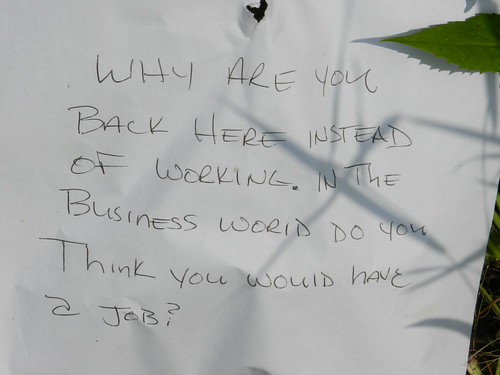
At first, I didn't see the other bird.  I looked at the pic on my camera and noticed a Blue Grosbeak in the same shot!  I went back to see if I could get a better pic of the grosbeak. As I went back to near the spot were I first saw the Blue Grosbeak, I found this odd letter on a mowed path.
DSCN2569
It brought back memories of when I was in college.  I often heard "you should quit watching birds and dreaming and get a real job".   I tend to find the oddest things when I am birding...

As I stood there, I looked up to see many people going about their day.  Most were riding bikes and walking dogs.  As I was looking at the Dickcissels, I was startled by a bike rider that yelled out that I was walking on the "wrong side" of the bike path.  I wasn't on the paved part, as I was in the mowed grass off to the side.   It always strikes me that so many people go by and don't notice the nature around them.  The mindset that is portrayed in the odd letter above is the same kind of thinking that could evict the birds from their home.  I decided to head towards the other end of the park to see what I could find.  I did run across another Blue Grosbeak.  This one was also being very skittish and sneaky, but allowed for a couple brief shots.
Blue Grosbeak

Wednesday, June 20, 2012

Connecting the Conservation Dots

Wondering how to begin my stint as a newbie on the "Birding is Fun!" site, I thought long and hard about how best to get at it. Perhaps I might drop a sampling of verse that would give the readers my feathered flavor. I am a wanna-be poet and write quite a bit on birds. But for now, perhaps I’ll keep the poems personal. Or maybe I would take the easy way out the first time and recycle an older blog. While that’s an option that I’ll keep open, I want to come into the flock fresh! And so I thought about it and that maybe sharing my experiences with some students in my summer conservation ecology class would make an appropriate entry into the "Birding is Fun!" community.

As birders we all appreciate diversity and in fact I like being different. How so, you might ask? You see, I happen to be a B.O.C.. What’s that? Well, it’s a Birder of Color. In case you haven’t noticed, birding is a pretty homogenized past-time. The flock of folks who enjoy what many have characterized as the most popular outdoor hobby in the U.S. might be favorably compared to a gaggle of white-phase snow geese – with a few dark hued blue morphs thrown in here and there to make things interesting. I happen to be one of those uncommon dark hued birds. I’m not blue though, I’m black.

Being one of the few B.O.C.s out there, I am constantly on the lookout for ways to expose non-traditional audiences to the joys of birding and being out in nature. I get the chance here and there but hardly ever the extended time and concentrated attention I’d like to get my point across. My summer gig gives me the perfect opportunity to do just that.

A few years ago, I signed on with South Carolina State University and the US Forest Service at Savannah River o teach wildlife ecology to students in a an environmental sciences field station. Most of the students are juniors and senior undergraduates and come primarily from Historically Black Colleges and Universities (HBCU's). The mission of the field station, run by my good friend Dr. Denise Simmons, is to expose a traditionally underserved audience to environmental issues ranging from remediation to soil science and in my class, wildlife conservation ecology. Although few of the students are in majors I would consider “environmental" sciences, they are at least in S.T.E.M. (Science, Technology , Engineering, Math) disciplines. It is a palette I can paint on. And so for four weeks in June, I finally have the forum to focus a small group of folks in to the necessity of nature and why it is especially important that they think about the environment as people of color.

Yesterday, I was out and about in the heat and humidity of a South Carolina almost-summer day with eight nearly dehydrated yet attentive field station students trying them to “connect the conservation dots.” The task, simple in concept but absurdly difficult in practice, is putting the pieces together to make some greater whole. For us birders and conservation professionals that means connecting bits and pieces of habitat to make things better for warblers, thrushes, tanagers and other birds we love. Since most of the students have never birded or botanized my goal for them is not so much be able to identify every bird they see and hear or snap off the latin names of plants. Rather it is to put themselves in the context of a larger, nature-centered focus. So my questions to them often go like this: “So guys, we’ve seen 1,000 year old cypress trees in the Beidler swamp watching over Prothonotary warblers, people promoting hunting to save wild turkeys and other wildlife at the National Wild Turkey Federation, and longleaf pine forests that need to be burned to conserve bobwhite quail. What ethic connects these things together?"

Of course the simple answer is conservation. They all get “A’s” there. But I press the issue forward, asking them how THEY fit into all of this. For an African-American engineering technology major from suburban Columbia who doesn’t know a warbler from a hole in the ground, the answer is never an easy one. To see the larger picture one of the first assignments I gave was to have each student compose a conservation ethic. Not only that but I ask them to blog about it and talk to their peers about it. Now some of you know that I’m a Leopold-ite and as such push the ideas of the land ethic whenever I can. And so the students are also responsible for reading A Sand County Almanac to help prime their pumps for the “connect the dots” exercise. Although I got back a couple questions back like “What’s a conservation ethic?” (…and sadly, one that I also get from my Clemson wildlife and forestry major students who are supposedly steeped in the stuff at a Land Grant Institution) I was pleasantly surprised at the responses.

Words like “sustainability”, “love” and “legacy” showed up. Phrases reflecting the connections between life, wildlife and our lives or honest statements about a lack of connection to nature but a desire to learn filled my head and heart with hope. They are showing that there is a color to conservation and it needs to be brought out. Their blogging is evolving and I can see the connections being made from the ground up.

As much as I push the teaching of Aldo Leopold, I’m learning a valuable lesson from my summer students. It is not an easy thing for many young African-Americans who’ve grown up connected to nature by a satellite dish and a few wildly exaggerated contrived "nature" shows to relate to some old white guy who wandered around on an abandoned farm in Wisconsin waxing poetically about “good oaks” and such almost eighty years ago. As much as I’d like to think that these kids would connect like I did –growing up rural and full of wonder when it came to birds and the world outside—it’s not the case. Most are growing up in urban or suburban settings and even those that grow up in rural areas are looking to get out as soon as possible. We need to help these folks reconnect in relevant ways. And so I think that I will begin to work on a “translation” of my beloved “Sand County”—a “revised standard version” of the conservation “Bible” if you will. Heck, if folks can translate the words of dieties and religious prophets to make them modern and relevant, why not the words of a conservation prophet? It’s high on my writing to-do list! Stay tuned.

Outside of a couple of lectures to introduce them to the principles of conservation ecology, I didn’t want to waste good, sunny days on boring PowerPoint presentations. That means most days we load into an aging but functional (and air conditioned!) mossy green Dodge van and hit the road. So far my octet of students have been to the National Wild Turkey Federation in Edgefield, SC to learn a little history and how conservation in the United States has been supported by the efforts of people who like to occasionally kill the things they love. Doesn’t that sound odd? That someone would watch birds and try to kill some of them seems “wack” to many folks. Well it’s not. As a turkey and deer hunter, I pay taxes and license fees that go back into supporting the resources I occasionally exploit. Birders seldom bear the same burden. Let’s be honest here. Because I spend so much time watching for other birds in the new green spring woods, the turkeys win almost every time and so some might call my efforts less hunting than just being out. But I proudly carry the hunter banner and the ideals of the North American Model for Wildlife Conservation and want the students to understand the ethic that underlies that. I saw the connection exemplified almost like nowhere else when I was at Magee Marsh a few weeks back at the “Biggest Week in American Birding” and was re-invigorated to make sure I carry the message forward. The students seemed thrilled to be so up close and personal with a bird as grand bird as the wild turkey and I think they got the message. Even though none of them hunt, they all like to eat meat and so they understand the connections to legacy, sustainability, ethical hunting and conservation. They were rewarded with a stop at a local produce stand on the way home to buy some of the sweetest peaches in the world that grow on the sandy South Carolina ridges and in doing so support local foods and sustainability! Experiential learning is a good thing!

Next, I wanted them to see conservation on the grandest and oldest scale with superlatives presented in the ages of trees and expanses of rare habitat. We took a trip to Beidler Audubon Sanctuary in Harleyville, South Carolina.


This is the kindest, wildest place I know as you can wind through true old growth, virgin timber in your tennis shoes and shorts without concern for cottonmouths. And so novices and non-nature-nics can be comfortable in the midst of wildness. It is a place where many of the bald cypress, tupelo and other trees are hundreds of years old with a couple of specimens more than a thousand years in the growing. It is the largest expanse of virgin bald cypress swamp in the world and it’s in our back door here in South Carolina. It’s a place where golden nuggets of feathers called Prothonotary warblers flit through the buttressed colonnades of forest almost close enough to touch.
It is a place where water controls the ebb and flow of life. It’s a place I wanted them to hopefully be engulfed by so many grand things that their minds turned off of the mile-a-minute mental interstate for a moment and wandered the back roads at a slower, more contemplative pace. Sure, I wanted them to have a close encounter with a Prothonotary or hear the baritone bawl of a barred owl; but more than that I wanted them to see the connections to conservation in saving things that maybe serve less of a tangible purpose. Sure, they understand the ecological services bit—tree give us oxygen, pollinators give us food, watersheds filter…blah, blah, blah. Really I wanted them to let a little bit of the idea that these were beings that had seen sunrises over a landscape where Native Americans held property right and shared the bounty of a largely unbroken land with panthers , Carolina parakeets and Ivory-billed woodpeckers . I wanted them to touch something that had seen more than they, their children and legions of generations forward would ever see. I wanted them to think about time outside of the years in the span of a human lifetime. I wanted them to let the trees and the swamp into their souls. Love it and you will save it.

As we stood around the Meeting Tree, a humongous bald cypress that would take a half-dozen of us to hug, I could see the place getting into some of them. The questions flowed along with” ooooo’s” and “ahhhhhh’s”. By the day’s end, we had indeed seen a Prothonotary up close and personal, singing his little golden swamp warbler guts out to proclaim his swampy knothole as the best in Beidler. But I could detect that the students took away a lot more than just the names and field marks I pointed out. Check! More dots were connected.


And so yesterday was another chance to expose them to something new. This time, I wanted them to see how the same organization, South Carolina Audubon could conserve old growth in one place with a preservationist perspective, and not more than a couple of hours away in another sanctuary at Silver Bluff, manage the threatened long leaf pine ecosystem and wetlands for federally endangered wood storks in a much more intensive manner.
Our trip to the center was a hit as Brandon Heitcamp, a Clemson trained forester with an ecologist’s heart, took us on a tour to talk about how he helps the forest work for birds by burning it. What?! Burning things on purpose to make them better? As Brandon showed us stands of longleaf pine in different stages of recovery and regeneration, it was clear that this is a very hand’s on place. He spoke with pride about the strip fires he employs like a paintbrush to get the pine to grow with a carpet of wire grass and broomsedge underneath it. He talked about the risks of natural resources management and the reward in walking through head high wire grass or hearing a bobwhite whistle in the pines.

Only a few years removed from where my summer students are as undergraduates, Brandon showed them what it took to be a young, competent, confident conservationist. The students listened intently to him and were asking questions even though the humid heater of the day was turning up.

l to r: Iris, Simone, GiGi, Javashia, Michael, Briana, Quin, Chris--Me in green
About mid-morning we made our way to the namesake place for the sanctuary and looked over the sluggish Savannah River from a bluff fifty feet above the water. A red-headed woodpecker flashed black, white and red through the woodland and then a pileated laughed maniacally at us –maybe for being out in the heat --before flapping across to the shade on the Georgia side. The place is full of history and Brandon helped the students connect the dots between all the peoples that had stood where we stood-Indians, Spanish Conquistadors, English settlers, African slaves and us.
Silver Bluff overlooking the Savannah River
As we left the river to finish up at the fish ponds looking for wood storks, I felt the swelter we were enduring was worth the sweat. I am constantly asking questions on the van as we travel and the responses are largely thoughtful. At the ponds where the managers draw down the water to make the fish more available to the flocks of waders that will come into the refuge, the students watched a Mississippi kite float on the humid air. They got to see and learn about water turkeys (that’s Anhinga anhinga for you purists) and even saw a wood stork spiraling higher and higher on a thermal like a feathered glider. One of the students found a molted nuptial plume from a great egret and I got a chance to explain how much of the conservation movement got started because of the greed over such a fine and delicate thing and women’s desires to satisfy the fashion thing. It was hot and getting hotter but they trudged on listening and seeming to enjoy the day.

egret nuptial plume - a feather that started a movement!
And so that is how I am spending my summer. Well, at least the June portion of it. It has been a fun and rewarding experience for me and I hope for the students. While their bird list will likely limit out at 25 or 30 birds and an assortment of lizards, frogs, toads, turtles, mammals and plants, I am not unrealistic in trying to create uber-birders or all-knowing naturalists. No, I’ve had to release my ego and understand that not everyone is going to connect the dots just like I do. But in the three weeks so far that I’ve had the pleasure of being in the company of Javashia, Iris, Briana, Quinn, Michael, GiGi, Simone and Chris, there’s been teaching and learning alike. And it’s been a pretty fair exchange. As these young folks connect the dots to where they live and how they see nature, hopefully in the new light of a few pretty cool birds and other wild things, I’m hopeful. I’m connecting dots too. This time they are look a little (no a lot!) different than the ones I’m used to seeing. Eight more dots that might think about birds, nature and their connection to them can only move the mission forward. Until next time folks—keep connecting dots of whatever color you can where you are!

- Drew

P.S. A huge thanks to Robert Mortensen for giving me this platform! I am amongst bird-brained conservation kindred here and some really cool folks. I'm glad to be in the number and offer a little "Down South" flavor of a different hue! Looking forward to the blogs ahead!

Idaho Birders Visit Guatemala with Alvaro Jaramillo

Guest Post from Jay Carlisle of the Idaho Bird Observatory


I've taken a variety of winter-season trips to Latin America - primarily in search of birds but more recently with a second goal of continually improving my Spanish. For some years now, a few SW Idaho birders have encouraged me to put together a trip designed for Idaho birders to see "our" breeding birds on the wintering grounds mixing in with the exotic resident birds. Perfect idea, right? But, as the Research Director of the primarily soft-money-funded Idaho Bird Observatory (at Boise State University - "IBO"), one thing I don't have is a lot of free time for organizing and researching trip details. Thus, I hadn't been able to make it happen.

Last March, reknowned birder and author, Alvaro Jaramillo, came to Boise as the keynote speaker for the Golden Eagle Audubon Society's (GEAS) annual banquet. When GEAS president Bruce Ackerman asked me if I'd be willing to take Alvaro birding during the day before the banquet, I said, "twist my arm". After all, I'm one of a few passionate Larophiles ("gull lovers") in Idaho and, among other things, Alvaro is well known for his expertise on gull identification. Thus, after a great morning of birding up in Idaho City (White-headed Woodpeckers and multiple finch species), it wasn't hard to convince Alvaro (and Heidi Ware - a "Birding is Fun!" blogger) that a trip to the Canyon County landfill was in order ;-)

Soon, I learned that Alvaro had just started his own business, Alvaro's Adventures, so we started discussing the idea of a trip to southern Mexico or northern Central America - somewhere in the heart of the winter range for western migrants that also has a great variety of resident birds. Alvaro had some experience working with the Guatemalan government to increase eco-tourism there and had previously led a few trips there. Thus, before long we'd settled on Guatemala and Alvaro pulled together a great-looking itinerary! After that, it didn't take too long to fill the trip and we were off.
We had originally designed the trip for GEAS members, partially as a fundraiser for Idaho Bird Observatory. Happily, we ended up with a mixed group consisting of 6 folks from SW Idaho and 4 folks from the Moscow/Viola area. We had a great time traveling various areas in the highlands of central and western Guatemala. We covered 9 birding destinations, including several operating coffee fincas where we enjoyed great coffee and an informative tour of the coffee process, including a tasting test.


In 9+ days of birding, we enjoyed a wide variety of resident and migratory birds - including 248 species observed by the group as a whole. For Facebook users, check out a few pics in Alvaro's "Guatemala 2012" album. 

Highlights:
  • Resplendant Quetzal
  • 3 trogon species
  • 4 motmot species (great looks at Tody, Blue-throated, Blue-crowned, and Turquoise-browed)
  • 19 raptor species including ideal looks at several tropical specialties: Black and Ornate Hawk-eagles, Collared Forest-falcon, & Bat Falcon (we watched one chase a hummingbird!)
  • 20 hummingbird species, including: Sparkling-tailed, Wine-throated, and Emerald-chinned hummingbirds
  • 5 owl species: Mountain (aka Guatemalan) and Ferruginous Pygmy-owls, as well as Fulvous, Mottled, and Black-and-white
  • Long-tailed Mannakin
  • 29 warblers including Pink-headed Warbler and my first ever view of a Golden-cheeked (and a stud male at that)!!
  • the elusive Blue Seedeater (a bamboo specialist that was a lifer for everyone)
  • 6 oriole species including Spot-breasted
  • Elegant Euphonia and Blue-crowned Chlorophonia
Also, Alvaro took several folks on a 3-day extension to bird the Mayan ruins of Tikal and the surrounding area. Highlights there included Great Curassow, Orange-breasted Falcon, and many other awesome birds.

And, finally, we enjoyed an abundance of wintering migrants everywhere we went - including a healthy mix of "eastern" and "western" breeding species. In places it seemed as if every other small bird we saw was a Townsend's, Wilson's, or Tennessee Warbler! We also saw good numbers of Hammond's and Least Flycatchers, Northern Rough-winged and Violet-green Swallows, Rose-breasted Grosbeak, Indigo Bunting (a few Painteds too), Western Tanagers, Vaux's Swift, Warbling Vireo, and many more. 

Some of us have already begun talking about potential future trips, possibly including Chile, Panama, Trinidad and Tobago, and more ;-)

Feel free to contact myself and/or Alvaro if interested in learning more.